Facts
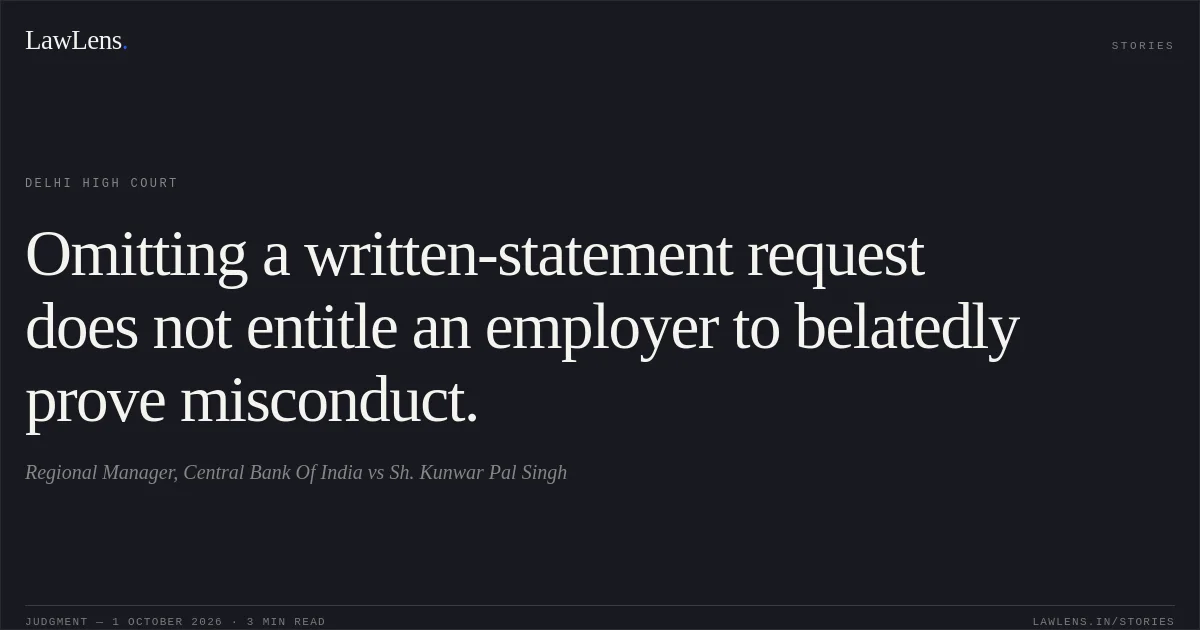
The Respondent, a bank clerk, was dismissed after a domestic enquiry into allegations that he credited a pay order of ₹4,139 to his own overdraft account and used another official’s code and password to authorise the transaction.
Source reference: para. 2–3He challenged the dismissal before the Industrial Tribunal. The Tribunal held the enquiry vitiated for withholding documents relevant to his defence and denying cross-examination after re-examination; it rejected the Bank’s subsequent request to lead evidence on the charges because no such request had been made in its written statement, and ordered reinstatement with consequential benefits.
Source reference: para. 5–8The Single Judge dismissed the Bank’s writ petition, and the Bank appealed.
Source reference: para. 9–10The Respondent’s sworn statement that he had been unable to obtain alternative employment was made in his Section 17B application.
Source reference: para. 39Issues
1. Whether the domestic enquiry was rightly held to be vitiated for breach of natural justice.
Source reference: para. 27(i); paras. 28–322. Whether the Bank, having neither sought nor reserved leave in its written statement to lead evidence on the charges, was entitled to do so after the preliminary ruling or to obtain a remand.
Source reference: para. 27(ii); paras. 33–363. Whether the Respondent was entitled to consequential benefits, including arrears of wages and retiral benefits.
Source reference: para. 27(iii); paras. 38–42Law Applied
The principles of natural justice require a fair opportunity to defend; withholding material relevant to the defence and denying cross-examination on matters raised in re-examination may vitiate a domestic enquiry where prejudice is established.
Source reference: paras. 28–32Under Shankar Chakravarti v. Britannia Biscuit Co. Ltd. and Karnataka State Road Transport Corporation v. Lakshmidevamma, an employer should specifically seek leave to lead additional evidence in its written statement; a Labour Court or Tribunal is not obliged to invite such evidence if no request is made, although it retains discretion to permit evidence in an appropriate case.
Source reference: paras. 33–35On back wages, National Gandhi Museum v. Sudhir Sharma and Ramesh Chand v. Management of Delhi Transport Corporation establish that an employee may discharge the initial burden of showing non-employment through a statement on oath, after which the employer may rebut it with evidence.
Source reference: para. 39Section 17B of the Industrial Disputes Act, 1947 was relevant to the Respondent’s interim-benefit application.
Source reference: paras. 9, 39Reasoning
The withheld attendance sheet and documents concerning the co-delinquent who was the Bank’s sole witness bore directly on the allegation that the Respondent used another official’s credentials and on the witness’s credibility; the Respondent was then faulted for lacking supporting evidence. The denial of further cross-examination was also material because re-examination raised matters beyond clarification and the Appellate Authority relied on those answers. The enquiry was therefore vitiated on independently sufficient grounds.
Source reference: paras. 30–32The Bank had not sought leave in its written statement despite the Respondent’s express challenge to the enquiry, and waited until the preliminary ruling to apply, without explaining the delay. The Tribunal’s refusal and the Single Judge’s decision were consistent with the governing principles; a remand was unwarranted given the delay and the Respondent’s superannuation.
Source reference: paras. 35–36As to benefits, the Respondent’s sworn statement of non-employment was unrebutted by evidence from the Bank, and the earlier period spent pursuing a writ petition could not be held against him in light of the liberty granted to approach the Tribunal.
Source reference: paras. 38–39Holding
The Court dismissed the appeal and upheld the finding that the enquiry was vitiated and that the Bank could not obtain a belated opportunity to prove the charges.
Because the Respondent had superannuated, reinstatement was replaced by deemed continuity in service until superannuation.
Source reference: para. 40The Registry was directed to release the deposited ₹32,83,591, with accrued interest, to the Respondent within four weeks; the Bank was directed to compute and pay consequential benefits, including arrears of wages and retiral benefits, within eight weeks, after adjustment of that deposit. No interest was awarded on the arrears.
Source reference: paras. 41–42Acts & Sections Cited
2 provisions across 2 statutes referred to in this judgment. Linked provisions open on LawLens.
Industrial Disputes Act, 19471
Indian Evidence Act, 18721
Original Court PDF
Regional Manager, Central Bank Of IndiavsSh. Kunwar Pal Singh
Click to open original judgment
Original judgment, available to read, download and summarize on LawLens.in