Facts
The Petitioner/State sought leave to appeal against the judgment of acquittal dated October 6, 2025, passed by the First Additional Sessions Judge, FTC, Bemetara
Source reference: para. 2The State filed an interlocutory application (I.A. No. 01) seeking condonation of a 58-day delay in preferring the criminal miscellaneous petition
Source reference: para. 1The State explained the delay by citing the time required for administrative processes, including the Law and Legislative Affairs Department sending a proposal to the Advocate General’s office, receiving certified copies of documents, and the general "multi-functioning" nature of government machinery
Source reference: para. 2-3Issues
Whether the State established "sufficient cause" under Section 5 of the Limitation Act to condone a 58-day delay in filing an application for leave to appeal against an order of acquittal
Source reference: para. 4Law Applied
The Court applied Section 5 of the Limitation Act regarding the condonation of delay
Source reference: para. 4The Court primarily relied on the principles established in Postmaster General v. Living Media India Limited (2012), which held that the law of limitation binds the Government and that "procedural red-tape" is not an acceptable explanation for delay in the modern era
Source reference: para. 5It further applied State of Madhya Pradesh v. Ramkumar Choudhary (2024), which clarified that "sufficient cause" must be established by events occurring within the limitation period and that delay should not be excused as a matter of generosity
Source reference: para. 6Reasoning
The Court observed that while a liberal approach is generally preferred to advance substantial justice, it cannot be exercised when there is "gross negligence" or a lack of bona fides
Source reference: para. 5, 28The Court noted that the State’s explanation was a generic recitation of departmental formalities lacking specificity or justifiable cause
Source reference: para. 8-9Referring to the Ramkumar Choudhary precedent, the Court emphasized that a party seeking condonation must explain what prevented them from filing within the prescribed period (the first 90 days), rather than merely accounting for the period after the limitation expired
Source reference: para. 6, 7The Court determined that the State failed to demonstrate diligence and that the "bureaucratic methodology" of making notes does not exempt the Government from the rigors of the Limitation Act
Source reference: para. 5, 28-29; para. 10Holding
The Court held that the State miserably failed to provide a cogent or satisfactory explanation for the inordinate delay of 58 days
The application for condonation of delay (I.A. No. 01) was dismissed, and the Criminal Miscellaneous Petition seeking leave to appeal was rejected on the grounds of delay and laches
Source reference: para. 11Original Court PDF
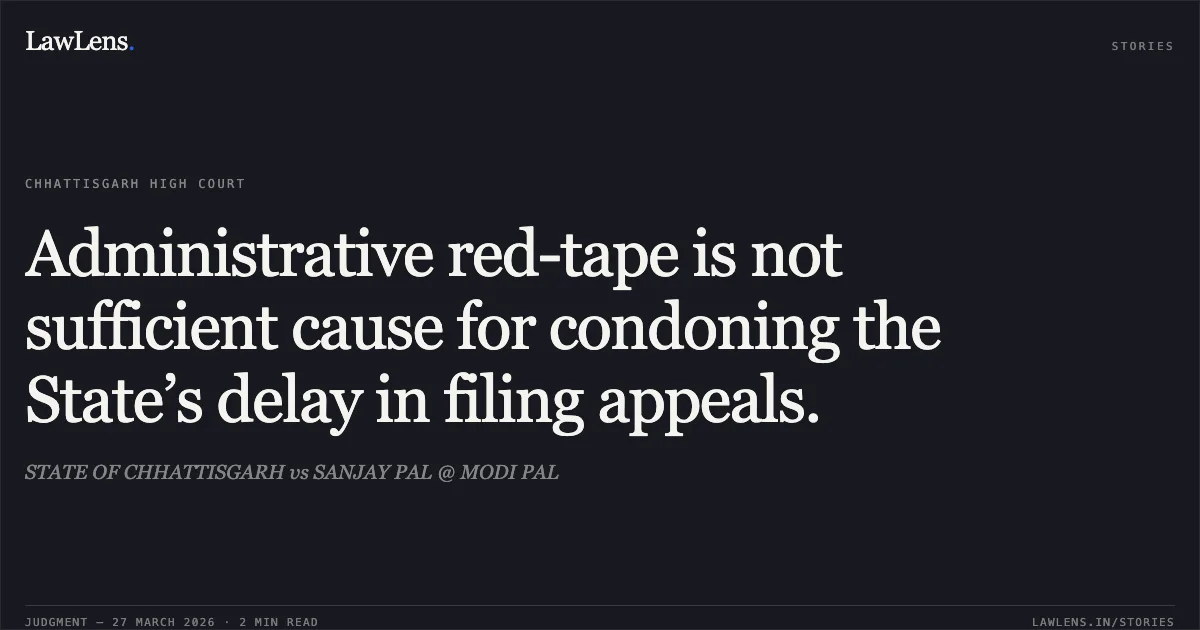
STATE OF CHHATTISGARHvsSANJAY PAL @ MODI PAL
Click to open original judgment
Original judgment, available to read, download and summarize on LawLens.in


