Facts
The Petitioner, a Pharmacist at the Community Health Centre (CHC), Bhairamgarh, was transferred to CHC Bhopalpatnam by an order dated 30.06.2025
Source reference: p. 2He challenged this transfer before a committee constituted under the Transfer Policy, which rejected his representation on 01.09.2025
Source reference: p. 2-3The Petitioner approached the High Court seeking to quash the transfer and the rejection order, contending that he suffers from heart disease and that Respondent No. 5 (his replacement) had been permitted to continue at the original place of posting by the Chief Medical Health Officer (CMHO), leaving no vacant post for the Petitioner to join
Source reference: p. 3Issues
1. Whether the transfer order dated 30.06.2025 and the rejection of the Petitioner's representation were arbitrary or unlawful, warranting judicial interference under Article 226?
Source reference: p. 3 / para. 22. Whether the Petitioner is entitled to a court direction for the payment of unpaid salary and interest?
Source reference: p. 2 / para. 10.3Law Applied
The court applied the principle that transfer is an exigency of service and a government servant holding a transferable post has no vested right to remain at a specific station
Source reference: p. 4, para. 6It relied on Shilpi Bose (Mrs.) and Ors. v. State of Bihar and Ors. (1991), which held that courts should not interfere with administrative transfers unless they violate mandatory statutory rules or are grounded in mala fides
Source reference: p. 4, para. 6It further cited Union of India and Ors. v. S.L. Abbas (1993), which established that administrative guidelines do not confer legally enforceable rights
Source reference: p. 4, para. 7Finally, it applied Punjab and Sind Bank and Ors. v. Durgesh Kuwar (2020), affirming that judicial review of transfer orders is highly restricted unless the order is issued by an incompetent authority or is proven to be malicious
Source reference: p. 5, para. 8Reasoning
The court found that the Petitioner had completed his minimum tenure and that his transfer was explicitly made on administrative grounds
Source reference: p. 3, para. 5By applying the Shilpi Bose and S.L. Abbas precedents, the court reasoned that it cannot interfere with day-to-day administrative decisions under Article 226 unless a legal right is violated
Source reference: p. 6, para. 9Addressing the Petitioner’s argument regarding Respondent No. 5, the court observed that the CMHO had only "temporarily permitted" Respondent No. 5 to work at his earlier station due to a health condition; this did not constitute a cancellation of the transfer order or an administrative irregularity that would invalidate the Petitioner's move
Source reference: p. 6, para. 10The court concluded that the Petitioner failed to establish any statutory violation or mala fides
Source reference: p. 6, para. 11Holding
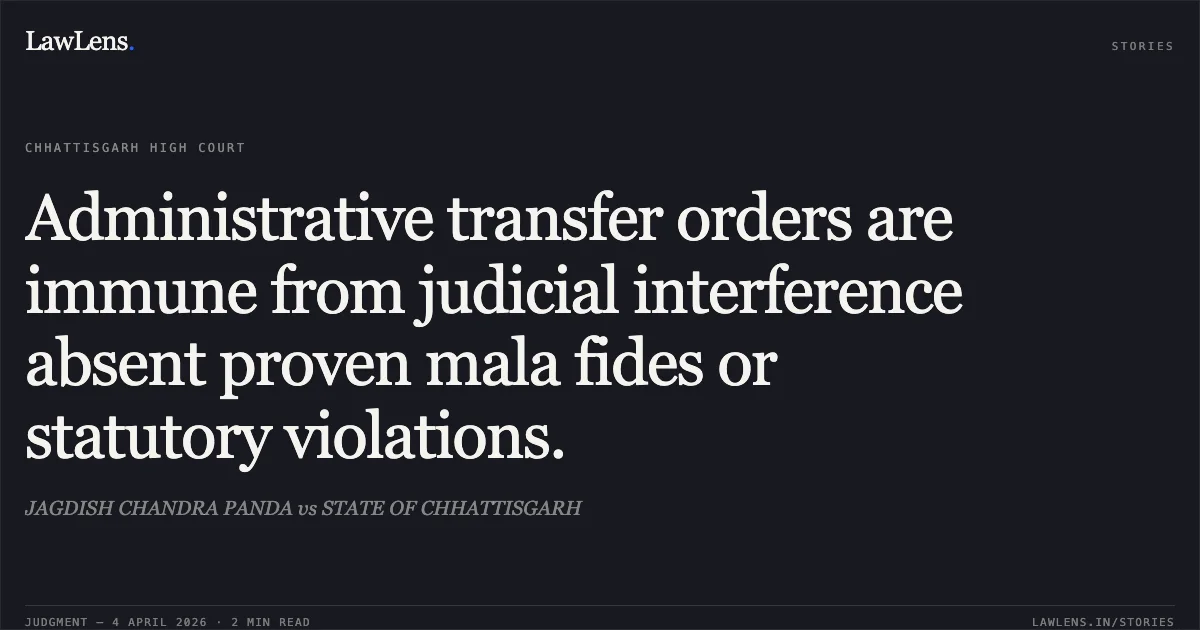
The court dismissed the writ petition, holding that there were no grounds to interfere with the transfer order dated 30.06.2025
Regarding the claim for unpaid salary and interest, the court declined to grant direct relief, holding that it is the province of the competent authority to consider and decide upon such administrative claims
Source reference: p. 6, para. 12Original Court PDF
JAGDISH CHANDRA PANDAvsSTATE OF CHHATTISGARH
Click to open original judgment
Original judgment, available to read, download and summarize on LawLens.in


