Facts
The petitioner, a Forest Guard, challenged his transfer order dated 15 June 2026, citing his wife’s serious illness, her treatment near Sheopur, and the care of their two-month-old child.
Source reference: paras. 2–4In an earlier petition, the High Court had directed him to submit a fresh, documented representation and the competent authority to decide it by a reasoned order; the transfer was stayed pending that decision.
Source reference: paras. 2–4The petitioner alleged that the authority’s subsequent rejection of his representation was arbitrary and non-speaking.
Source reference: paras. 2–4The State maintained that the transfer was made on administrative grounds and that the petitioner had completed the normal tenure at his posting.
Source reference: paras. 2–4The authority’s reasons, as reproduced by the Court, included the petitioner’s tenure at the beat, the availability of a health centre near the new posting, forest-protection concerns, and a staff shortage.
Source reference: para. 13Issues
1. Whether the transfer order warranted interference under Article 226 on the grounds raised by the petitioner
Source reference: paras. 2, 5, 11–142. Whether the authority’s rejection of the petitioner’s representation disclosed a ground for setting aside the transfer
Source reference: paras. 2, 11–14Law Applied
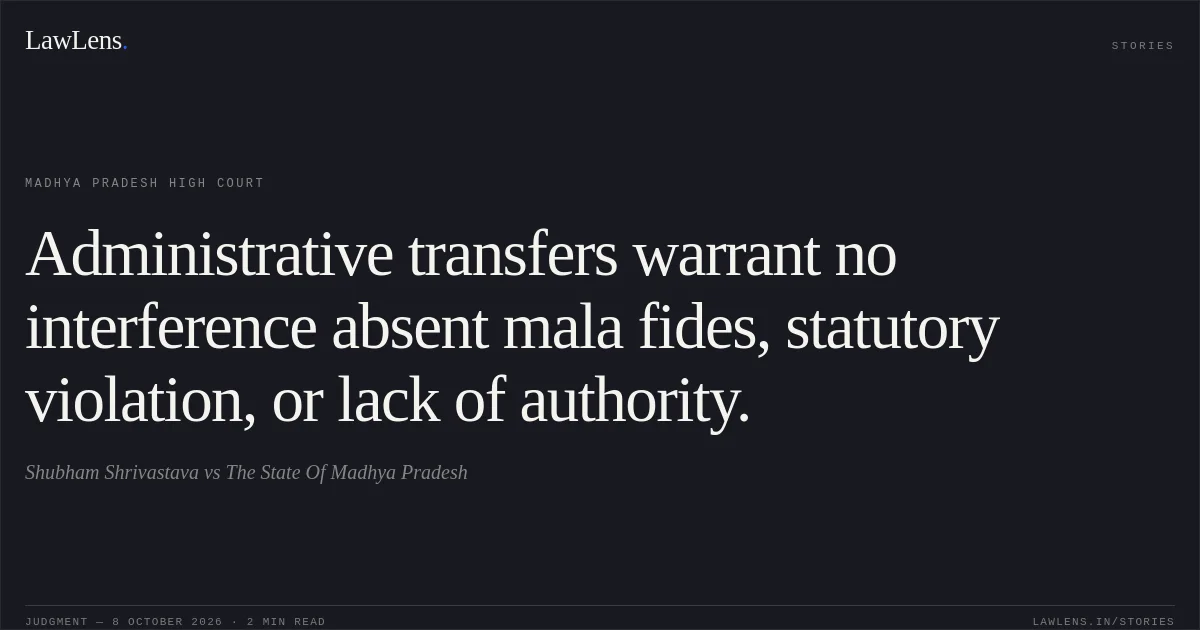
Under Article 226, transfer is ordinarily an incident of service, and an employee has no vested right to remain posted at a particular place.
Source reference: paras. 5–10A court will generally interfere only where the transfer is mala fide, violates a statutory provision, or is made by an incompetent authority; administrative transfer guidelines do not ordinarily create legally enforceable rights.
Source reference: paras. 5–10The Court relied on *Rajendra Roy v. Union of India* (1993) 1 SCC 148, *National Hydroelectric Power Corpn. Ltd. v. Shri Bhagwan* (2001) 8 SCC 574, *State Bank of India v. Anjan Sanyal* (2001) 5 SCC 508, *Gujarat Electricity Board v. Atmaram Sungomal Poshani* (1989) 2 SCC 602, *Rajendra Singh v. State of U.P.* (2009) 15 SCC 178, *Airports Authority of India v. Rajeev Ratan Pandey* (2009) 8 SCC 337, *State of U.P. v. Gobardhan Lal* (2004) 11 SCC 402, and *Union of India v. S.L. Abbas*, AIR 1993 SC 2444
Source reference: paras. 5–10Reasoning
The Court found that the transfer had been made by the competent authority on administrative grounds and that the petitioner had not established mala fides, violation of a statutory rule, or another recognised basis for judicial interference.
Source reference: paras. 11–12, 14It noted that the authority had considered the representation and recorded reasons, including the proximity of a health centre to the new posting and operational needs relating to forest protection and staffing.
Source reference: para. 13The Court also relied on the petitioner’s failure to disclose his posting tenure.
Source reference: para. 14Notably, the authority’s reasons reproduced immediately beforehand recorded that the petitioner had served at the beat from 22 October 2021 until 15 June 2026.
Source reference: para. 13Holding
The Court held that no ground for interference with the transfer or the decision on the petitioner’s representation had been made out.
It dismissed the writ petition as lacking substance.
Source reference: paras. 14–15Original Court PDF
Shubham ShrivastavavsThe State Of Madhya Pradesh
Click to open original judgment
Original judgment, available to read, download and summarize on LawLens.in