Facts
The petitioner held a five-year licence to operate a fruit-juice stall, General Minor Unit No. FJS-4, at Itarsi Railway Station. After the licence term expired, it applied for renewal on 9 January 2025, but the Railways did not grant renewal; the petitioner also alleged that it had been directed to close the stall on 17 October 2024.
Source reference: p.1–3It sought relief from the High Court, arguing that renewal was warranted under the Supreme Court’s decision in Senior Divisional Commercial Manager, South Central Railways v. S.C.R. Caterers, Dry Fruits, Fruit Juice Stalls Welfare Association, (2016) 3 SCC 582. The Railways opposed the claim, relying on the Catering Policy, 2017 and the agreement’s express bar on renewal.
Source reference: p.2–4Issues
1. Whether the petitioner had a vested right to renewal of its stall licence under the Supreme Court’s decision concerning the Catering Policy, 2010.
Source reference: p.2–3, 52. Whether the Railways’ decision not to renew the licence, and instead to require fresh allotment, warranted judicial interference.
Source reference: p.4–7Law Applied
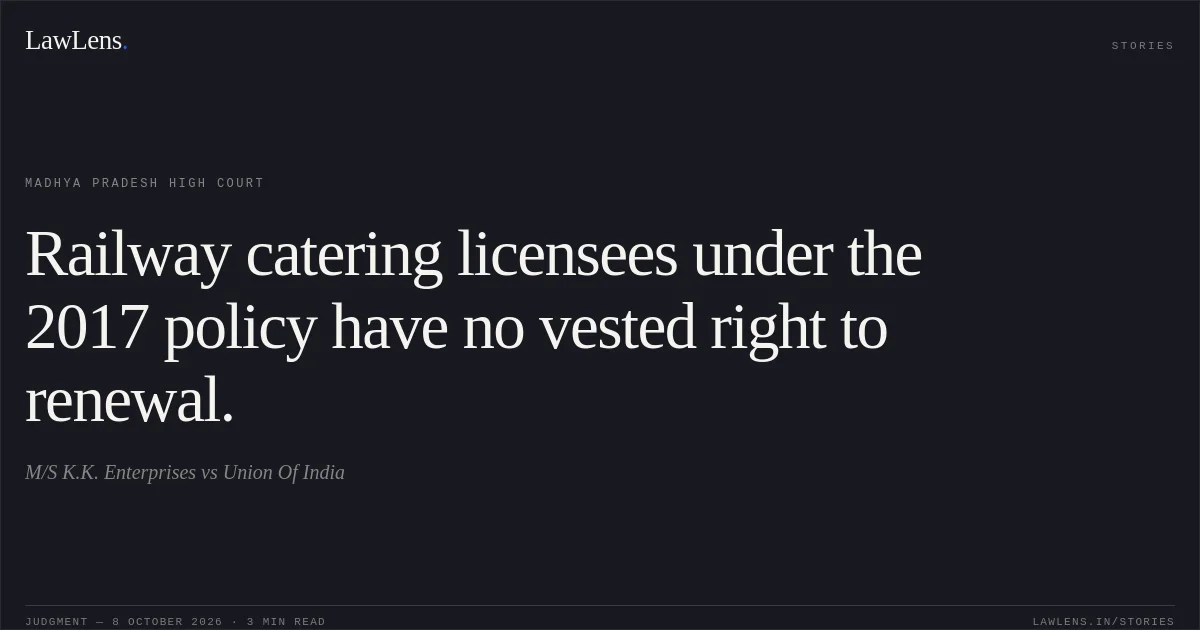
The Catering Policy, 2010 provided for renewal under Clause 16, and the Supreme Court’s decision in South Central Railways concerned vendors covered by that policy. By contrast, Clause 11.2 of the Catering Policy, 2017 limits the tenure of ordinary major and minor catering units to five years and provides for no further extension or renewal, except for units specified in paragraph 3.8.1. The petitioner’s agreement likewise stated that there would be no extension or renewal.
Source reference: p.4–5In reviewing commercial policy decisions, constitutional courts ordinarily examine whether the decision-making process is affected by illegality, arbitrariness, bias, mala fides or unconstitutionality, but do not substitute their view on the commercial wisdom of the decision. The Court relied on Jagdish Mandal v. State of Orissa, (2007) 14 SCC 51; Peerless General Finance & Investment Co. Ltd. v. Reserve Bank of India, (1992) 2 SCC 34; Narmada Bachao Andolan v. Union of India, (2000) 10 SCC 664; Silppi Constructions Contractors v. Union of India, (2020) 16 SCC 489; and N.G. Projects Ltd. v. Vinod Kumar Jain, (2022) 6 SCC 127.
Source reference: p.6–7Reasoning
The Court distinguished South Central Railways because that case concerned licensees covered by the 2010 Policy, which contained a renewal provision; the petitioner’s licence was governed by the 2017 Policy and its agreement expressly barred renewal. The petitioner’s unit was not one of the units excepted under paragraph 3.8.1, and the Court found no vested right to renewal.
Source reference: p.4–6It also considered the unit’s substantial licence fee and the Railways’ evidence that competitive retendering had increased licence revenue, concluding that the no-renewal policy was supported by commercial considerations and disclosed no basis for judicial interference. The Court further held that the petitioner could not obtain renewal under the Railway Board circular of 15 March 2017 in light of the non-renewal condition governing its licence.
Source reference: p.5–7Holding
The Court held that the petitioner had no vested right to renewal and declined both to direct renewal and to require the Railways to consider the renewal application.
The petition was dismissed, but the petitioner was permitted to participate in any future allotment process for the unit, subject to meeting the applicable requirements, including payment of earnest money and provision of security and guarantees.
Source reference: p.7–8Original Court PDF
M/S K.K. EnterprisesvsUnion Of India
Click to open original judgment
Original judgment, available to read, download and summarize on LawLens.in