Facts
The applicant, an Assistant Teacher at an MCD Primary School, filed an Original Application (OA) seeking multiple reliefs, including the quashing of disciplinary orders and a declaration that Aadhaar-based biometric attendance is unconstitutional
Source reference: p. 1-2, para 1Upon objection by the respondents regarding the maintainability of multiple reliefs under the CAT (Procedure) Rules, the applicant restricted his claim to Prayer ‘D’: the release of withheld salary for March 2018 to June 2018 and other arrears
Source reference: p. 3, para 2-4The salary was withheld because the applicant failed to mark his biometric attendance, citing his lack of an Aadhaar card
Source reference: p. 3, para 5Previously, the applicant had filed OA No. 2866/2018 on the same grounds, which was dismissed on 01.08.2018 with the observation that he could not refuse to mark biometric attendance
Source reference: p. 3-4, para 6Issues
1. Whether the applicant is entitled to the release of arrears of salary for the period March 2018 to June 2018 despite failing to register for and mark biometric attendance
Source reference: p. 3, para 52. Whether the Central Administrative Tribunal has the jurisdiction to adjudicate upon the validity of Aadhaar-related mandates under the Administrative Tribunals Act, 1985
Source reference: p. 4, para 6; p. 5, para 10Law Applied
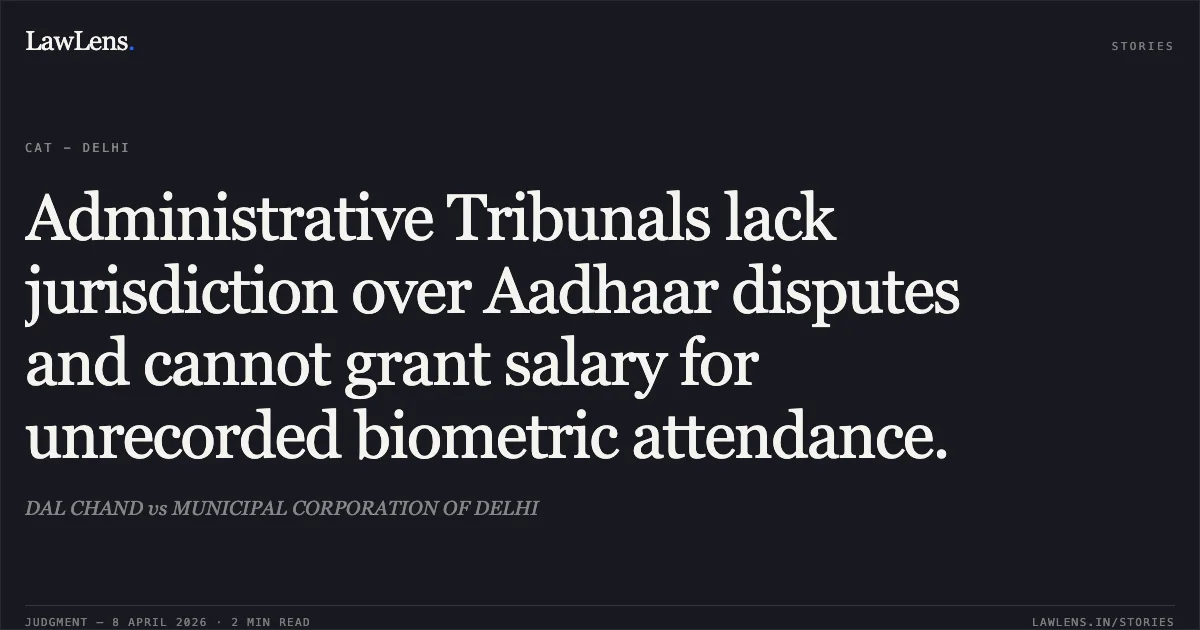
The Tribunal applied the jurisdictional limitations set forth in the Administrative Tribunals Act, 1985, noting that issues regarding the mandate or constitutional validity of Aadhaar fall outside its purview
Source reference: p. 4, para 6It further applied the principle of finality of litigation, noting that a similar prayer by the same applicant was previously dismissed in OA No. 2866/2018
Source reference: p. 4, para 6The Tribunal also adhered to the CAT (Procedure) Rules regarding the impermissibility of seeking multiple distinct reliefs in a single OA
Source reference: p. 3, para 2Reasoning
The Tribunal found that the applicant’s refusal to mark biometric attendance was the direct cause for the non-release of salary
Source reference: p. 4, para 8While the applicant argued he could not mark attendance without an Aadhaar card, the Tribunal noted that the biometric system was available at the school and the applicant had simply failed to register
Source reference: p. 4, para 8-9The court highlighted that the applicant was essentially re-agitating an issue already decided in OA No. 2866/2018, where it was held that a refusal to obtain Aadhaar does not entitle an employee to refuse biometric attendance
Source reference: p. 5, para 10Furthermore, the Tribunal emphasized that the applicant had failed to challenge the specific office order dated 10.07.2018, which served as the legal basis for denying the salary
Source reference: p. 5, para 11Consequently, the Tribunal reasoned that without a challenge to the underlying order or a change in circumstances, the prayer for salary release could not be entertained
Source reference: p. 5, para 12Holding
The Tribunal dismissed the Original Application, holding that the prayer for release of salary for the period of March 2018 to June 2018 could not be granted due to the applicant's failure to mark attendance and the lack of a challenge to the relevant administrative order
The Tribunal reaffirmed that Aadhaar-related policy disputes remain outside its statutory jurisdiction
Source reference: p. 5, para 10All pending Miscellaneous Applications were also dismissed
Source reference: p. 5, para 13Original Court PDF
DAL CHANDvsMUNICIPAL CORPORATION OF DELHI
Click to open original judgment
Original judgment, available to read, download and summarize on LawLens.in