Facts
The Appellant was the Director of two Corporate Debtors (CDs) that defaulted on loans sanctioned by DHFL in 2014.
Source reference: para. 3DHFL classified the accounts as Non-Performing Assets (NPA) on 06.12.2016.
Source reference: para. 3Following the resolution of DHFL’s own insolvency, the debts were assigned to Respondent No. 1.
Source reference: para. 4A first Corporate Insolvency Resolution Process (CIRP) against the CDs commenced on 23.12.2021 but was terminated on 29.07.2024 due to "fraudulent initiation".
Source reference: para. 12Respondent No. 1 then filed a fresh Section 7 application under the Insolvency and Bankruptcy Code (IBC) on 23.09.2024.
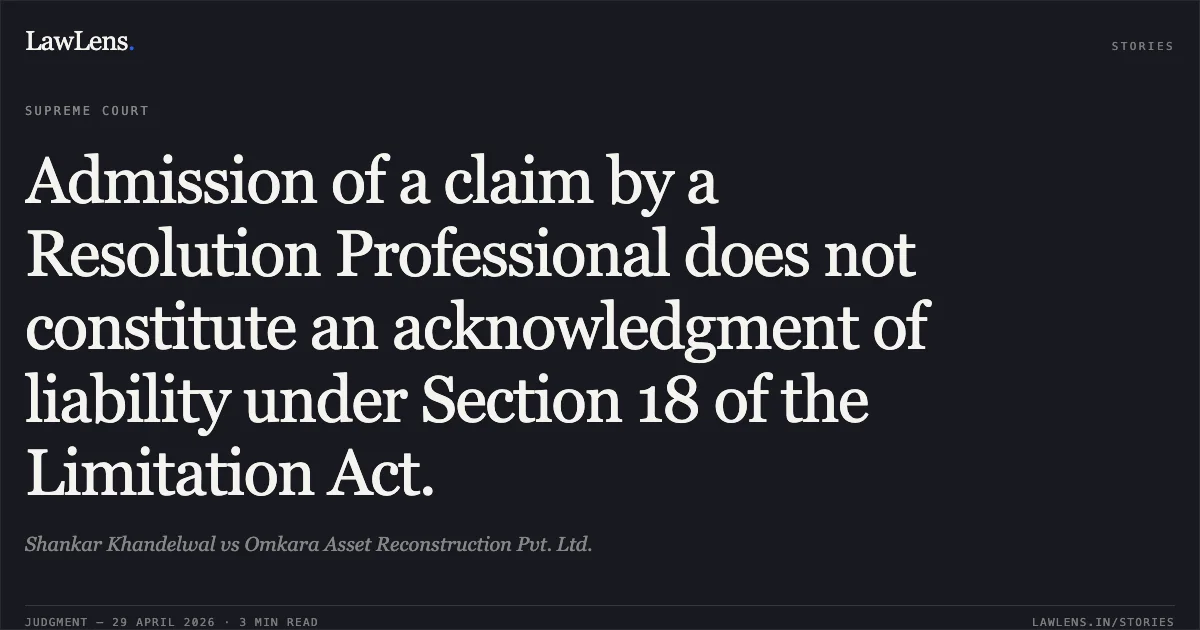
Source reference: para. 4Both the NCLT and NCLAT held the application was within limitation, treating the Resolution Professional’s (RP) admission of claims during the first CIRP as an "acknowledgment" under Section 18 of the Limitation Act.
Source reference: para. 5Issues
1. Whether the period of limitation for filing a petition under Section 7 of the Code is to be reckoned from the date of NPA or the expiry of the SARFAESI notice period.
Source reference: para. 112. Whether the petition filed on 23.09.2024 was within the prescribed period of limitation.
Source reference: para. 113. Whether an admission of debt by an Interim Resolution Professional (IRP) constitutes an acknowledgment of liability under Section 18 of the Limitation Act, 1963.
Source reference: para. 11Law Applied
The Court applied Article 137 of the Limitation Act, 1963, establishing a three-year limitation period from the date the "right to apply accrues"—defined as the date of default/NPA.
Source reference: para. 10, 13Section 60(6) of the IBC provides for the exclusion of the moratorium period when computing limitation.
Source reference: para. 10Regarding Section 18 of the Limitation Act, the Court relied on Prabhakaran v. M. Azhagiri Pillai and Tilak Ram v. Nathu, holding that an acknowledgment must be a "conscious and unequivocal intention" to admit a subsisting jural relationship.
Source reference: para. 16It further applied Swiss Ribbons (P) Ltd. v. Union of India and Committee of Creditors of Essar Steel, which establish that an RP/IRP performs purely administrative functions and lacks adjudicatory power.
Source reference: para. 16Reasoning
The Court rejected the Respondents' argument that limitation begins after the SARFAESI notice period, affirming that the "date of default" is the date of classification as NPA (06.12.2016).
Source reference: para. 13Calculating the timeline, the Court noted the three-year period would have expired on 06.12.2019. While certain periods were excluded—DHFL's CIRP, the Suo Motu COVID-19 extension, and the first CIRP moratorium—only three days of the limitation period remained after the first CIRP was terminated on 29.07.2024. Consequently, the limitation expired on 01.08.2024, making the filing on 23.09.2024 belated.
Source reference: para. 14-15Crucially, the Court held that the IRP’s admission of a claim is a clerical/administrative task of "collating" debt and does not constitute a "voluntary acknowledgment" by the debtor. Since the IRP is not an authorized agent of the CD for the purpose of admitting liability, and the admission occurred after the original limitation had expired, it could not renew the limitation period.
Source reference: para. 16-17Holding
The Supreme Court answered the issues by holding that (i) limitation is reckoned from the date of NPA (06.12.2016); (ii) the Section 7 petition was filed beyond the limitation period; and (iii) an admission of debt by an IRP/RP is not an acknowledgment under Section 18 of the Limitation Act.
The Court allowed the appeals, quashing the orders of the NCLAT and NCLT, and set aside the admission of the Corporate Insolvency Resolution Process.
Source reference: para. 18-19Acts & Sections Cited
7 provisions across 3 statutes referred to in this judgment. Each provision opens on LawLens.
Insolvency and Bankruptcy Code, 2016.4
Limitation Act, 19632
Securitisation and Reconstruction of Financial Assets and Enforcement of Security Interest Act, 20021
Original Court PDF
Shankar KhandelwalvsOmkara Asset Reconstruction Pvt. Ltd.
Click to open original judgment
Original judgment, available to read, download and summarize on LawLens.in