Facts
The complainant alleged that the petitioner owed ₹1,26,600 for retreading and purchase of tyres and issued a cheque for that amount, which was dishonoured for “insufficient funds.” A statutory demand notice dated 24.06.2014 was served, but payment was not made, leading to a complaint under Section 138 of the Negotiable Instruments Act, 1881 (NI Act).
Source reference: para. 2The petitioner admitted issuing the cheque and his signatures but claimed that he had issued a blank cheque in connection with a tyre transaction worth ₹22,000, had already paid ₹8,000, and was liable only for ₹14,000.
Source reference: paras. 5, 18The Trial Court convicted him and sentenced him to three months’ simple imprisonment, a fine of ₹1,75,000, and, in default, two months’ simple imprisonment.
Source reference: para. 6The Appellate Court affirmed the conviction and sentence.
Source reference: para. 7In revision, the petitioner challenged the appreciation of evidence, the absence of bills, the complainant’s connection with “Super Treads,” and the alleged prematurity of the complaint.
Source reference: para. 8Issues
Whether the admission of the petitioner’s signatures and issuance of the cheque attracted the presumptions under Sections 118(a) and 139 of the NI Act, and whether the petitioner rebutted them by establishing a probable defence?
Source reference: paras. 18–30Whether the complaint was not maintainable because the cheque was issued in favour of “Super Treads” and the complainant’s proprietorship or connection with that business was not independently proved?
Source reference: para. 28Whether the statutory notice was duly served and whether the complaint was filed prematurely before expiry of the statutory period for payment?
Source reference: paras. 10, 32–33Whether the concurrent findings of conviction and the sentence imposed warranted interference in revisional jurisdiction?
Source reference: paras. 14–15, 34–38Law Applied
Section 138 of the NI Act criminalises dishonour of a cheque issued towards a legally enforceable debt or liability, subject to presentation within validity, timely statutory notice, failure to pay within fifteen days of receipt of notice, and filing of the complaint within the prescribed period.
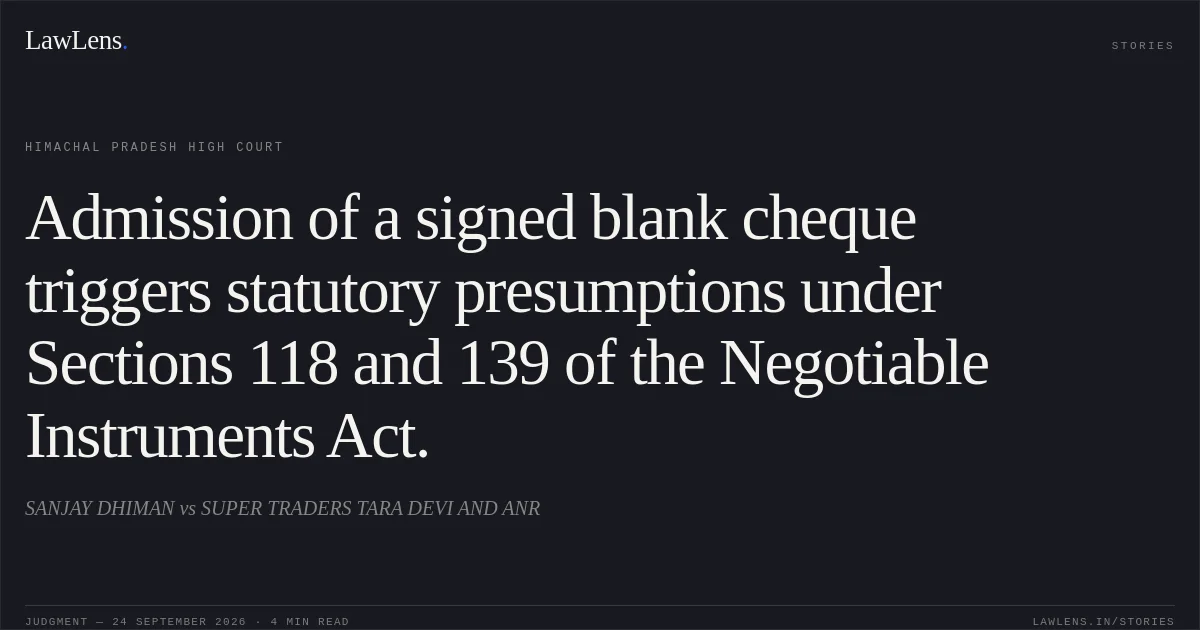
Source reference: para. 16Sections 118(a) and 139 create rebuttable presumptions that a cheque was issued for consideration and in discharge of a debt or liability once its execution or signature is admitted or proved; a voluntarily issued blank signed cheque also attracts these presumptions, as held in Rajesh Jain v. Ajay Singh and Sanjabij Tari v. Kishore S. Borcar.
Source reference: paras. 19–21The accused must rebut the presumptions by presenting a probable defence; a bare denial is insufficient.
Source reference: para. 21Under revisional jurisdiction, the High Court does not reappreciate evidence as an appellate court and interferes only for perversity, gross illegality, material non-consideration, arbitrariness, or miscarriage of justice, as explained in Kuntegowda v. Thurubaiah and the authorities cited therein.
Source reference: paras. 14–15The complainant is not initially required to prove the antecedent transaction or financial capacity once the statutory presumption operates, though the accused may rebut it through evidence or cross-examination, as recognised in Uttam Ram v. Devinder Singh Hudan and Ashok Singh v. State of U.P.
Source reference: paras. 24–26Section 138 is both deterrent and compensatory; compensation and fine may appropriately reflect the loss caused by delayed payment, as stated in Bir Singh v. Mukesh Kumar and Kalamani Tex v. P. Balasubramanian.
Source reference: paras. 34–36Reasoning
The petitioner admitted issuing the cheque and admitted his signatures, including that the cheque was issued in connection with the purchase of tyres. These admissions triggered the presumptions under Sections 118(a) and 139 of the NI Act, shifting the evidential burden to him.
Source reference: paras. 18–22His version was considered improbable because his own statements regarding the price of the tyres produced inconsistent figures, and he supplied no receipt or other proof of the alleged ₹8,000 payment.
Source reference: paras. 23, 29–30The absence of bills or account records did not, by itself, displace the statutory presumption.
Source reference: paras. 24–27The petitioner had also admitted that the complainant owned or operated “Super Treads,” defeating the objection regarding the complainant’s connection with the payee named on the cheque.
Source reference: para. 28The cheque’s dishonour for insufficient funds was proved through the bank witness and account statement, which remained unchallenged.
Source reference: para. 31Service of notice was established by the acknowledgment bearing the petitioner’s signatures; consequently, the argument based on presumptive service and premature filing was rejected.
Source reference: para. 32Since the petitioner failed to rebut the statutory presumptions and identified no perversity or illegality in the concurrent findings, the revisional court found no basis to interfere.
Source reference: paras. 34–38The three-month imprisonment and fine of ₹1,75,000 were also held proportionate, particularly considering the ten-year delay since issuance of the cheque and the compensatory object of Section 138.
Source reference: paras. 34–38Holding
The High Court answered the issues against the petitioner. It held that the admitted signature and issuance of the cheque attracted the statutory presumptions, that the petitioner failed to establish a probable defence, that the complainant was sufficiently connected with “Super Treads,” and that the demand notice was duly served.
Finding no perversity, illegality, or miscarriage of justice, the Court dismissed the revision petition and affirmed the conviction under Section 138 of the NI Act and the sentence of three months’ simple imprisonment, a fine of ₹1,75,000, and two months’ simple imprisonment in default of payment of fine.
Source reference: paras. 35, 38, 40Pending applications, if any, were also disposed of.
Source reference: para. 40Acts & Sections Cited
7 provisions across 3 statutes referred to in this judgment. Each provision opens on LawLens.
Negotiable Instruments Act, 18813
Code of Criminal Procedure, 19732
Bharatiya Nagarik Suraksha Sanhita, 20232
Original Court PDF
SANJAY DHIMANvsSUPER TRADERS TARA DEVI AND ANR
Click to open original judgment
Original judgment, available to read, download and summarize on LawLens.in