Facts
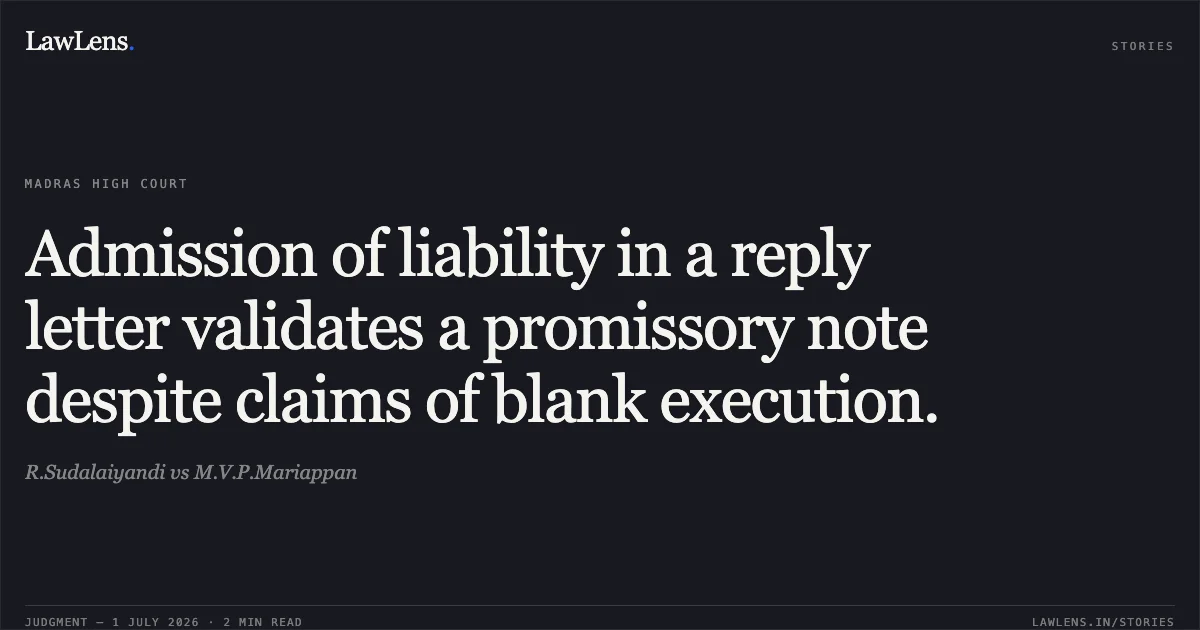
The 1st Respondent (Plaintiff), a money lender, filed a suit for recovery of ₹10,72,050/- based on a promissory note (Ex.A.1) and voucher (Ex.A.2) dated 05.01.2016, allegedly executed by the Appellant (1st Defendant) and the deceased 2nd Defendant.
Source reference: para. 3, 5(a)The Plaintiff claimed the Defendants borrowed ₹10 lakhs for real estate business and the Appellant subsequently issued a cheque (Ex.A.3) which was returned for "insufficient funds".
Source reference: para. 5(a)The Appellant contested the suit, admitting to a smaller loan of ₹1,60,000/- in 2014 and claiming he signed blank documents, alleging Ex.A.1 was forged.
Source reference: para. 5(b)The Trial Court decreed the suit in favor of the Plaintiff.
Source reference: para. 8The Appellant challenged the decree on grounds of forgery, the Plaintiff’s lack of financial means, and the non-production of original ledger accounts.
Source reference: para. 11Issues
1. Whether the suit promissory note (Ex.A.1) is a forged and fabricated document
Source reference: para. 102. Whether the Plaintiff lacked the financial capacity/means to advance the loan amount to the Defendants
Source reference: para. 10Law Applied
Section 118 of the Negotiable Instruments Act, which mandates a legal presumption that every negotiable instrument was made for consideration until the contrary is proved.
Source reference: para. 20, 21The principle regarding the burden of proof in rebuttal of presumptions as established in Bharat Barrel & Drum Manufacturing Company v. Amin Chand Payrelal (1999).
Source reference: para. 16(2), 26Section 114 of the Evidence Act and the principle from Vidhyadhar v. Manikrao, holding that an adverse inference is drawn against a party who fails to enter the witness box to support their pleadings.
Source reference: para. 16(4), 23Violations of Section 269-SS of the Income Tax Act do not render a debt legally unenforceable under the NI Act as per Prakash Madhukarrao Desai v. Dattatrya Sheshrao Desai.
Source reference: para. 25, 26Reasoning
The court found that while the Appellant alleged forgery, he admitted his signatures on Ex.A.1 (Promissory Note) and Ex.A.2 (Voucher), claiming they were signed in blank.
Source reference: para. 17, 19Under Section 118(a) of the NI Act, once execution (signature) is admitted, the burden shifts to the defendant to provide rebuttal evidence, which the Appellant failed to do.
Source reference: para. 21, 22The court placed heavy reliance on Ex.A.8, a handwritten reply letter from the Appellant, where he explicitly admitted the contents of the legal notice and promised to repay the loan from his voluntary retirement (VRS) benefits.
Source reference: para. 15, 18P.W.2 corroborated the passing of consideration by testifying to the delivery of twenty bundles of ₹500 notes.
Source reference: para. 15, 22The court rejected the defense regarding the Plaintiff’s failure to produce Income Tax Returns, noting that such a plea was not specifically raised in the written statement and that tax law violations are a matter between the assessee and the authorities, not a bar to debt recovery.
Source reference: para. 24, 26Holding
The Court answered both issues in the negative, holding that Ex.A.1 is a genuine document and that the Plaintiff successfully demonstrated the capacity to lend.
The Court affirmed that once signatures are admitted, the statutory presumption regarding consideration stands unless displaced by cogent evidence.
Source reference: para. 19, 22The Appeal Suit was dismissed with costs, and the judgment/decree of the Trial Court in O.S.No.35 of 2016 was confirmed.
Source reference: para. 28, 29Acts & Sections Cited
7 provisions across 4 statutes referred to in this judgment. Each provision opens on LawLens.
Code of Civil Procedure, 19082
Negotiable Instruments Act, 18813
Companies Act, 20131
Banking Regulation Act, 19491
Original Court PDF
R.SudalaiyandivsM.V.P.Mariappan
Click to open original judgment
Original judgment, available to read, download and summarize on LawLens.in