Facts
The respondent-complainant, representing Shah Investors Home Ltd., filed a complaint under Section 138 of the Negotiable Instruments (NI) Act against the applicant and his father regarding an outstanding debt of Rs. 5,25,000 arising from share broking transactions.
Source reference: para. 4The applicant issued three cheques to discharge his father’s liability, which were dishonored due to "insufficiency of funds" on July 30, 2007.
Source reference: para. 4The trial court convicted the applicant on March 30, 2009, sentencing him to one year of simple imprisonment and a fine of Rs. 5,000.
Source reference: para. 4The Sessions Court upheld this conviction on June 23, 2009.
Source reference: para. 2The applicant moved the High Court in revision, contending that the cheques were issued as security for a franchise and not for a legally enforceable debt.
Source reference: para. 5Issues
1. Whether the applicant successfully rebutted the statutory presumptions under Sections 118 and 139 of the NI Act regarding the existence of a legally enforceable debt.
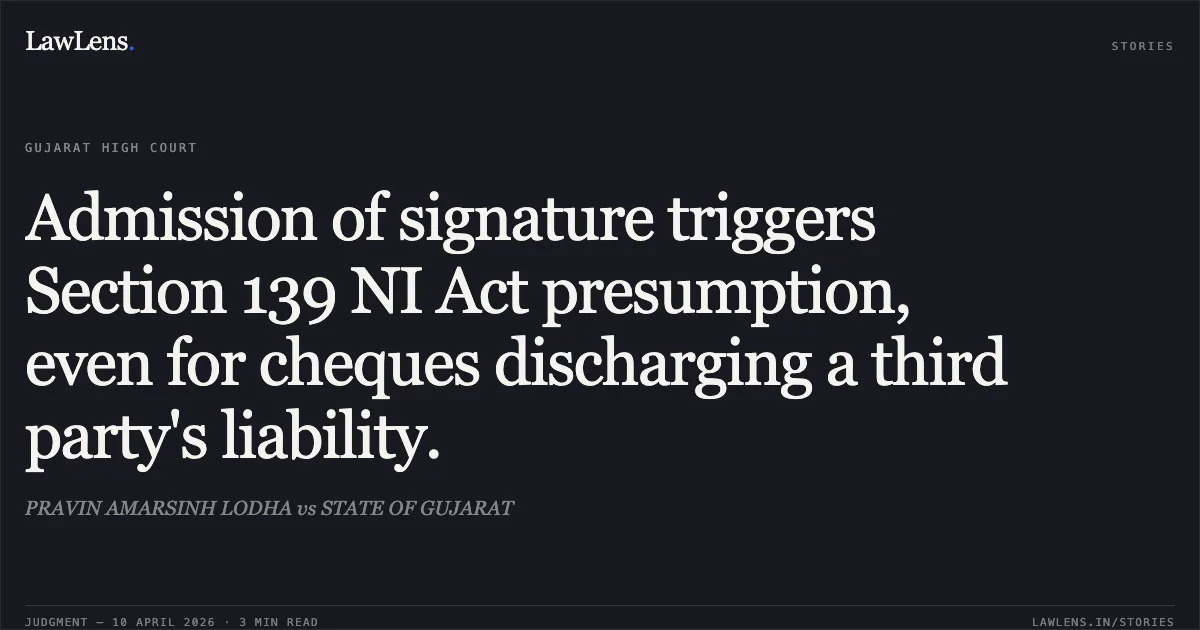
Source reference: para. 82. Whether a cheque issued as security for future payment or to discharge a third party's liability (the father's) falls within the ambit of Section 138 of the NI Act.
Source reference: paras. 9, 133. Whether the High Court, in its revisional jurisdiction under Sections 397/401 of the CrPC, can reappreciate concurrent findings of fact in the absence of perversity.
Source reference: paras. 15, 16Law Applied
The court primarily applied Sections 138 and 139 of the NI Act, which establish the criminal liability for cheque dishonor and the presumption that a holder receives a cheque for the discharge of a debt.
Source reference: para. 6, 8It relied on Section 118 of the NI Act, which presumes consideration for negotiable instruments.
Source reference: para. 9The court invoked Sections 20 and 87 of the NI Act, which empower a holder to complete an inchoate (blank) instrument.
Source reference: para. 12The court relied on Kalamani Tex v. P. Balasubramanian, stating that admission of signature triggers the statutory presumption of liability.
Source reference: para. 11The court applied the principles from Amit Kapoor v. Ramesh Chander, which limits revisional jurisdiction to correcting patent defects or jurisdictional errors rather than reappreciating evidence.
Source reference: para. 15Reasoning
The court reasoned that since the applicant did not dispute the issuance of the cheques or the signatures thereon, the statutory presumptions under Sections 118 and 139 were immediately attracted.
Source reference: para. 7, 11The applicant’s defense—that the cheques were merely "security"—was insufficient because the complainant produced account statements proving a debt of Rs. 7,77,000 owed by the applicant's father, which the applicant sought to partially discharge.
Source reference: para. 9The court clarified that even if a cheque is issued as security, it remains a valuable instrument; once signed and delivered, the holder is authorized to fill the details to recover the debt.
Source reference: para. 12, 13Regarding the revisional scope, the court found no perversity or arbitrary exercise of discretion by the lower courts. It held that concurrent findings of fact cannot be substituted unless they are legally untenable.
Source reference: para. 15, 16Holding
The High Court dismissed the revision application and affirmed the conviction.
The court held that the applicant failed to provide a "probable defense" to rebut the statutory presumptions and that a son issuing a cheque to discharge a father’s liability constitutes a legally enforceable debt.
Source reference: para. 9, 11The interim relief was vacated, and the applicant was ordered to surrender to the trial court to serve the remaining sentence.
Source reference: para. 18Acts & Sections Cited
7 provisions across 2 statutes referred to in this judgment. Each provision opens on LawLens.
Code of Criminal Procedure, 19732
Negotiable Instruments Act, 18815
Original Court PDF
PRAVIN AMARSINH LODHAvsSTATE OF GUJARAT
Click to open original judgment
Original judgment, available to read, download and summarize on LawLens.in