Facts
The Central Council of Indian Medicine (CCIM) amended regulations on 07.12.2018, mandating a uniform entrance examination (NEET) for AYUSH undergraduate courses.
Source reference: p. 3-4Several private medical colleges in Uttarakhand admitted students for the 2019-20 academic year bypasssing the NEET counseling process, primarily on the strength of interim orders passed by the High Court.
Source reference: p. 2, 6These interim orders specified that admissions were provisional and subject to the final outcome of the writ petitions.
Source reference: p. 7Following the Supreme Court’s 2020 judgment in Union of India v. Federation of Self-Financed Ayurvedic Colleges Punjab, which upheld the NEET requirement but allowed a "one-time" relaxation for certain students, the petitioners sought regularization of their admissions, declaration of results, and permission to complete their B.A.M.S. courses.
Source reference: p. 4-5, 7Issues
1. Whether admissions granted to AYUSH students in 2019-20 by private colleges bypassing NEET counseling can be regularized based on subsequent judicial precedents.
Source reference: p. 2-32. Whether provisional registrations granted under interim orders entitle students to appear in final examinations and have their results declared after several years of study.
Source reference: p. 3Law Applied
The Court applied Section 22 of the Indian Medicine Central Council Act, 1970, which empowers the Council to prescribe minimum standards of education, including the conduct of NEET.
Source reference: p. 5The primary precedent was Union of India v. Federation of Self-Financed Ayurvedic Colleges Punjab and others (2020) 12 SCC 115, wherein the Supreme Court upheld the validity of the 2018 NEET-based regulations but exercised its extraordinary powers to grant a one-time relaxation to students admitted before 15.10.2019.
Source reference: p. 5-6The Court also applied the principle of equity regarding students who had pursued courses for several years under the shield of interim judicial orders.
Source reference: p. 8Reasoning
The Court reasoned that while the legislative competence of the Central Government to mandate NEET for AYUSH courses is now settled law, the specific facts of the 2019-20 batch required an application of the Supreme Court’s one-time relaxation.
Source reference: para. 7-8The University conceded that the students in question possessed minimum qualifications and were admitted before the cutoff date of 15.10.2019.
Source reference: para. 8-9Regarding WPMS No. 207 of 2021, where the University argued the interim order was passed late (February 2021), the Court found that since the actual admission occurred before the 2019 cutoff and the students had already appeared in professional exams, they should not be excluded from the benefit of the Supreme Court's mandate.
Source reference: para. 11The court connected the "peculiar circumstances" identified by the Supreme Court to the current batch to prevent career disruption for students who had nearly completed their degrees.
Source reference: para. 11-12Holding
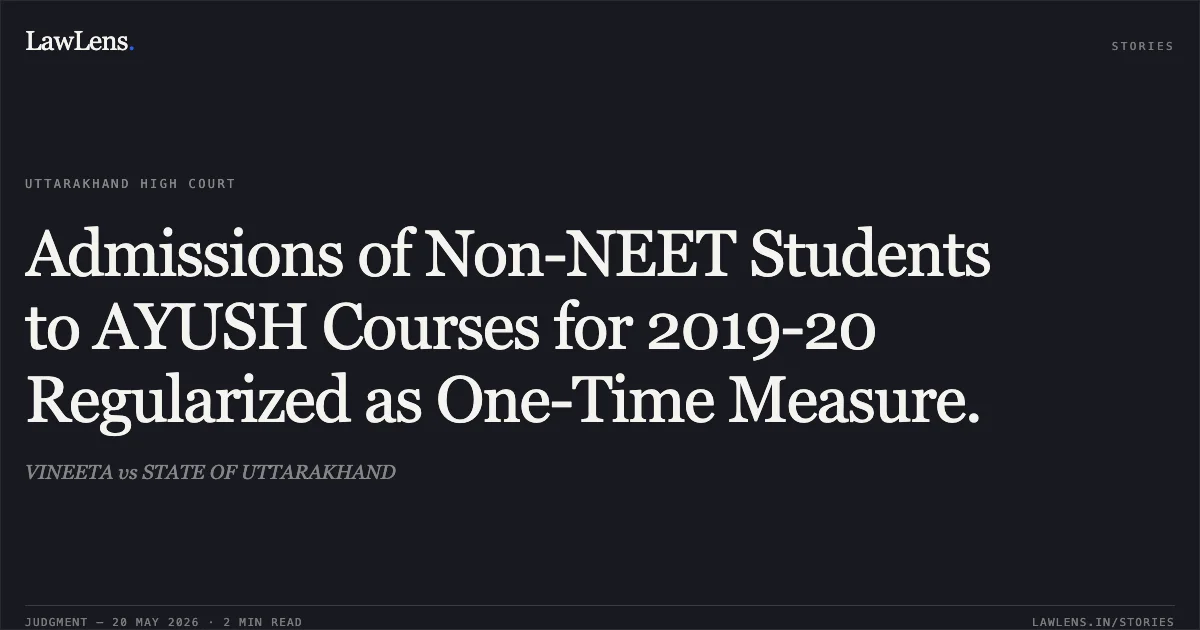
The High Court dismissed the challenge against the 2018 Regulations and the NEET notification but held that all students admitted on or before 15.10.2019 are entitled to have their admissions regularized.
The Court ordered the University to declare the results of the students, issue marksheets, and permit them to appear in any scheduled back-paper examinations. The writ petitions were disposed of with the direction that these admissions be treated as regular in light of the Supreme Court’s one-time relaxation.
Source reference: para. 12-13Acts & Sections Cited
1 provisions across 1 statute referred to in this judgment. Linked provisions open on LawLens.
Indian Medicine Central Council Act, 19701
Original Court PDF
VINEETAvsSTATE OF UTTARAKHAND
Click to open original judgment
Original judgment, available to read, download and summarize on LawLens.in