Facts
The Plaintiffs (Gurbir and partner) and Defendant No. 1 (Robinder) are brothers
Source reference: p.3Plaintiffs filed a suit for declaration and possession regarding the First Floor of property C-460, Defence Colony, New Delhi, asserting that Defendant No. 1 relinquished his share via a 1984 partition and a 1991 Memorandum of Family Settlement (MoFS) after receiving sale proceeds from the terrace floor
Source reference: p.4-5Defendant No. 1 contested this, arguing he is a 25% co-owner via a registered 1995 Conveyance Deed
Source reference: p.9, 11Plaintiffs filed I.A. 11149/2020 under Order XII Rule 6 CPC for judgment on admissions, citing Defendant No. 1’s admission of his signatures on the MoFS and Relinquishment Deed
Source reference: p.2, 13Conversely, Defendant No. 1 filed I.A. 16018/2022 under Order VII Rule 11 CPC seeking rejection of the plaint, arguing the suit relies on inadmissible unregistered documents
Source reference: p.13, 27-28Issues
1. Whether a judgment on admissions under Order XII Rule 6 CPC is warranted when a party admits signatures on documents but disputes their contents and circumstances of execution.
Source reference: p.13 / para. 132. Whether a plaint is liable for rejection under Order VII Rule 11 CPC on the grounds that it relies on unregistered family settlement documents.
Source reference: p.26/ para. 38Law Applied
The court applied Order XII Rule 6 CPC, which grants discretionary power to pass a judgment where admissions of fact are "clear, categorical, unconditional, [and] unequivocal"
Source reference: p.17, 24It relied on Uttam Singh Duggal & Co. Ltd. v. United Bank of India, clarifying that the rule's object is speedy judgment on admitted claims
Source reference: p.18-19It applied Himani Alloys Limited v. Tata Steel Limited, holding that a judgment on admission is discretionary and should not deny a defendant's right to trial unless the admission is deliberate
Source reference: p.19-20Regarding Order VII Rule 11, the court strictly followed Popat and Kotecha Property v. State Bank of India Staff Assn., stating only plaint averments must be considered
Source reference: p.30Kale & Ors. v. Deputy Director of Consolidation, which establishes that a memorandum recording a pre-existing oral family settlement does not require compulsory registration under the Registration Act, 1908
Source reference: p.32-36Reasoning
Regarding I.A. 11149/2020, the court reasoned that while Defendant No. 1 admitted his signatures, he specifically alleged they were obtained on blank papers and disputed the document contents
Source reference: p.13, 25Such a dispute creates a triable issue regarding the "nature of the documents" and "intention of the parties," precluding the "unambiguous" admission required for Order XII Rule 6
Source reference: p.25-26Regarding I.A. 16018/2022, the court observed that the Plaintiffs’ claim is built on an alleged family arrangement. Following the principle in Kale, whether the MoFS merely recorded a prior oral agreement (not requiring registration) or created new rights (requiring registration) is a mixed question of fact and law that cannot be decided at the threshold
Source reference: p.38-39Consequently, the court found the plaint disclosed a valid cause of action based on the bundle of facts asserted by the Plaintiffs
Source reference: p.38-40Holding
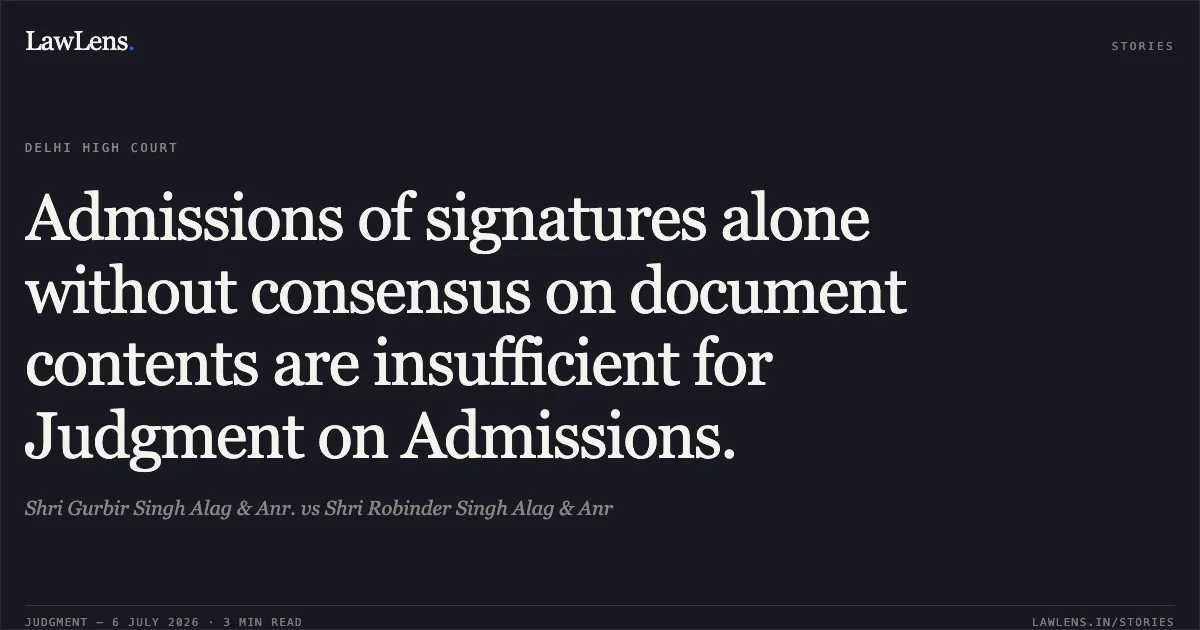
The court held that a judgment on admissions cannot be passed when the veracity and legal effect of the admitted signatures are contested, as this requires a full-fledged trial
It further held that the plaint cannot be rejected under Order VII Rule 11 because the necessity of registration for family settlements is a matter for trial, and the defense's pleas are irrelevant at the rejection stage
Source reference: p.39-40The court dismissed both applications
Source reference: p.26, 40The matter was listed for further proceedings on 08.09.2026
Source reference: p.40Acts & Sections Cited
8 provisions across 3 statutes referred to in this judgment. Each provision opens on LawLens.
Code of Civil Procedure, 19085
Negotiable Instruments Act, 18811
Registration Act, 19082
Original Court PDF
Shri Gurbir Singh Alag & Anr.vsShri Robinder Singh Alag & Anr
Click to open original judgment
Original judgment, available to read, download and summarize on LawLens.in


