01Facts
The complainant alleged that, in February 2009, he advanced a friendly loan of ₹4,50,000 to the petitioner, who issued account-payee Cheque No. 625994 dated 02.06.2009 towards repayment.
¶ 3–6The cheque was dishonoured for “insufficient funds” on 05.06.2009. After statutory notices dated 18.06.2009 and 03.07.2009, the petitioner failed to make payment, leading to Complaint Case No. C-1/1885 of 2009 under Section 138 of the Negotiable Instruments Act, 1881 (“NI Act”).
¶ 3–6The Trial Court convicted the petitioner under Section 138 of the NI Act and sentenced him to six months’ rigorous imprisonment with compensation of ₹4,50,000, with one year’s further rigorous imprisonment in default. The appellate court affirmed the conviction and sentence, giving rise to the present revision.
¶ 9–1002Issues
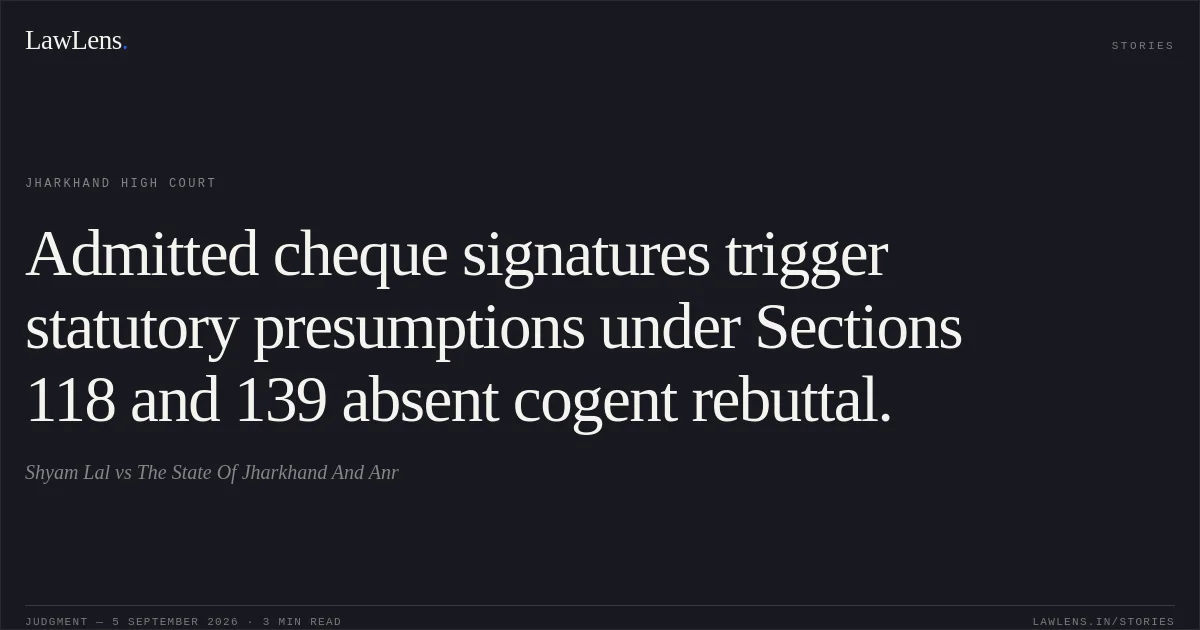
i.Whether the petitioner rebutted the statutory presumptions under Sections 118 and 139 of the NI Act after admitting his signature on the cheque and money receipt.
¶ 10, 13–14ii.Whether the complainant’s alleged failure to establish financial capacity and the alleged contravention of Section 269SS of the Income Tax Act invalidated the prosecution under Section 138 of the NI Act.
¶ 10, 14iii.Whether the conviction was vitiated because the succeeding Magistrate allegedly relied upon evidence recorded by a predecessor in violation of Section 326(3) of the Code of Criminal Procedure, 1973.
¶ 10, 15iv.Whether the concurrent findings of conviction and sentence warranted interference in revisional jurisdiction.
¶ 16–1703Law Applied
Section 138 of the NI Act creates penal liability where a cheque issued towards a legally enforceable debt or liability is dishonoured and the drawer fails to pay within the statutory period after receipt of notice.
Sections 118 and 139 of the NI Act raise presumptions regarding consideration, the existence of a legally enforceable debt or liability, and the cheque having been issued towards its discharge; these presumptions may be rebutted by cogent and reliable evidence.
¶ 13Section 326(3) Cr.P.C. restricts a succeeding Magistrate from acting on evidence recorded by a predecessor in a summary trial; however, the restriction was held inapplicable because the case had been conducted as a summons trial and not a summary trial.
¶ 15Revisional interference is warranted only where the subordinate courts’ findings suffer from perversity, illegality, material impropriety or jurisdictional error.
¶ 16Provisions in the judgment · 6 · Linked ones open on LawLens
Negotiable Instruments Act, 1881 Section 138Section 118Section 139
Indian Penal Code, 1860 Section 420
Code of Criminal Procedure, 1973 Section 313Section 326
04Reasoning
The petitioner did not dispute his signature on either the cheque or the money receipt. Consequently, the presumptions under Sections 118 and 139 of the NI Act operated in favour of the complainant.
¶ 13Although the petitioner challenged the complainant’s financial capacity and relied upon Section 269SS of the Income Tax Act, he failed to produce cogent and reliable evidence sufficient to rebut the statutory presumptions.
¶ 14The challenge based on Section 326(3) Cr.P.C. also failed because the appellate court found, upon examining the record, that the proceedings were conducted as a summons trial rather than a summary trial.
¶ 15The High Court therefore found that both subordinate courts had properly appreciated the evidence and that their concurrent findings were neither perverse nor legally infirm.
¶ 16–1705Holding
The High Court dismissed the criminal revision and affirmed the petitioner’s conviction under Section 138 of the NI Act and the sentence of six months’ rigorous imprisonment with compensation of ₹4,50,000, together with one year’s further rigorous imprisonment in default.
¶ 17The petitioner’s bail bond was cancelled, and he was directed to surrender before the Trial Court within two months to serve the remaining sentence; failing surrender, the Trial Court was directed to take coercive steps for his arrest and detention.
¶ 18Pending interlocutory applications, if any, were disposed of, and the Trial Court record was directed to be returned.
¶ 19–20Original Court PDF
Shyam LalvsThe State Of Jharkhand And Anr
Click to open original judgment
Original judgment, available to read, download and summarize on LawLens.in