01Facts
The petitioner, Punita Kumhar, had served as Sarpanch and was proceeded against by the Sub-Divisional Officer (Revenue), Pamgarh, under Sections 89/92 of the Chhattisgarh Panchayat Raj Adhiniyam.
¶ 1–2The proceedings arose from a complaint by Jagatram Gond, an erstwhile Sarpanch, concerning alleged non-payment of ₹1,42,724 in relation to certain work executed during the relevant tenure.
¶ 1–2By order dated 9 July 2026, the SDO fastened liability upon the petitioner.
¶ 5–6The petitioner challenged the order and the underlying proceedings under Article 226 of the Constitution, alleging procedural irregularity, denial of an effective opportunity of hearing, and non-consideration of material facts.
¶ 1–2, 5–602Issues
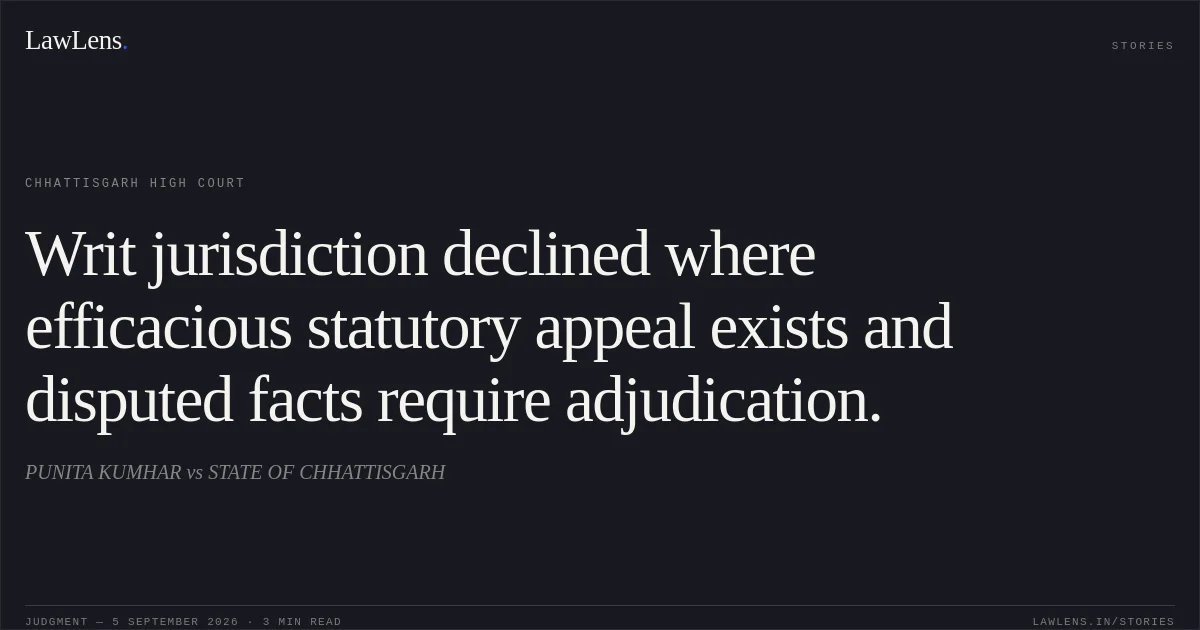
i.Whether the writ petition was maintainable when the petitioner had an efficacious statutory appeal before the concerned Collector against the order dated 9 July 2026.
¶ 3, 6ii.Whether the disputed factual issues arising from the proceedings under Sections 89/92 of the Panchayat Raj Adhiniyam ought to be examined in the first instance by the competent appellate authority.
¶ 3, 6iii.Whether the petitioner was entitled to interim protection against coercive steps while pursuing the statutory appellate remedy.
¶ 7–903Law Applied
The Court applied Sections 89/92 of the Chhattisgarh Panchayat Raj Adhiniyam, under which proceedings may be initiated to determine liability arising out of alleged irregularities or financial responsibility of Panchayat office-bearers.
¶ 6It further applied the settled rule that the High Court ordinarily declines to exercise writ jurisdiction where an efficacious alternative statutory remedy, such as an appeal, is available, particularly where the dispute involves disputed questions of fact requiring examination of records and evidence.
¶ 3, 6The Court also applied the principle that the availability of an alternative remedy does not prevent appropriate interim protection while the aggrieved party pursues the statutory remedy.
¶ 7–9Provisions in the judgment · 1 · Linked ones open on LawLens
Limitation Act, 1963 Section 5
04Reasoning
The Court noted that the impugned order arose from proceedings under Sections 89/92 of the Panchayat Raj Adhiniyam and involved the fastening of financial liability upon the petitioner on the basis of a complaint by another former Sarpanch.
¶ 5–6The petitioner’s allegations regarding procedural non-compliance, inadequate opportunity, and improper appreciation of material required factual examination.
¶ 6, 8Since the statutory framework provided an appeal to the concerned Collector and the controversy involved disputed questions of fact, the Court held that the appellate authority was the appropriate forum to assess the record and the petitioner’s grounds.
¶ 6, 8Without expressing any opinion on the merits, the Court therefore declined to adjudicate the writ petition substantively and relegated the petitioner to the appellate remedy.
¶ 6, 8, 1005Holding
The writ petition was disposed of without adjudication on merits.
¶ 7The petitioner was permitted to file an appeal before the concerned Collector within 10 days of receiving a copy of the order.
¶ 7The appellate authority was directed to consider the appeal in accordance with law, including any question of limitation and any application under Section 5 of the Limitation Act.
¶ 7The petitioner could seek interim relief or stay, which the appellate authority was directed to consider on priority, preferably within 30 days of filing.
¶ 8Until expiry of 30 days, no coercive steps were to be taken against the petitioner.
¶ 9All questions of fact and law were left open for consideration by the appellate authority.
¶ 8–11Original Court PDF
PUNITA KUMHARvsSTATE OF CHHATTISGARH
Click to open original judgment
Original judgment, available to read, download and summarize on LawLens.in