01Facts
The respondent, a Tax Assistant in the Office of the Commissioner of Income Tax, was convicted and sentenced by the Special Judge, CBI, on 23 January 2012.
p. 2 · ¶ 5He had superannuated on 31 December 2011, before the conviction was recorded.
p. 2 · ¶ 5He challenged the conviction and sentence in Criminal Appeal No. 344/2012, which remained pending before the High Court; the sentence was suspended by order dated 24 July 2012, but the conviction was not set aside.
p. 2 · ¶ 6The respondent alleged that the Union of India had illegally withheld his gratuity and leave encashment.
p. 2 · ¶ 7Leave encashment was subsequently released, leaving only the gratuity claim for determination.
p. 2 · ¶ 7–9The Central Administrative Tribunal allowed the respondent’s original application, holding that no departmental proceedings had been initiated and that, after four years from retirement, such proceedings were barred under Rule 9(2)(b) of the Central Civil Services (Pension) Rules, 1972.
pp. 3–4 · ¶ 11–12The Union of India challenged that decision before the High Court.
02Issues
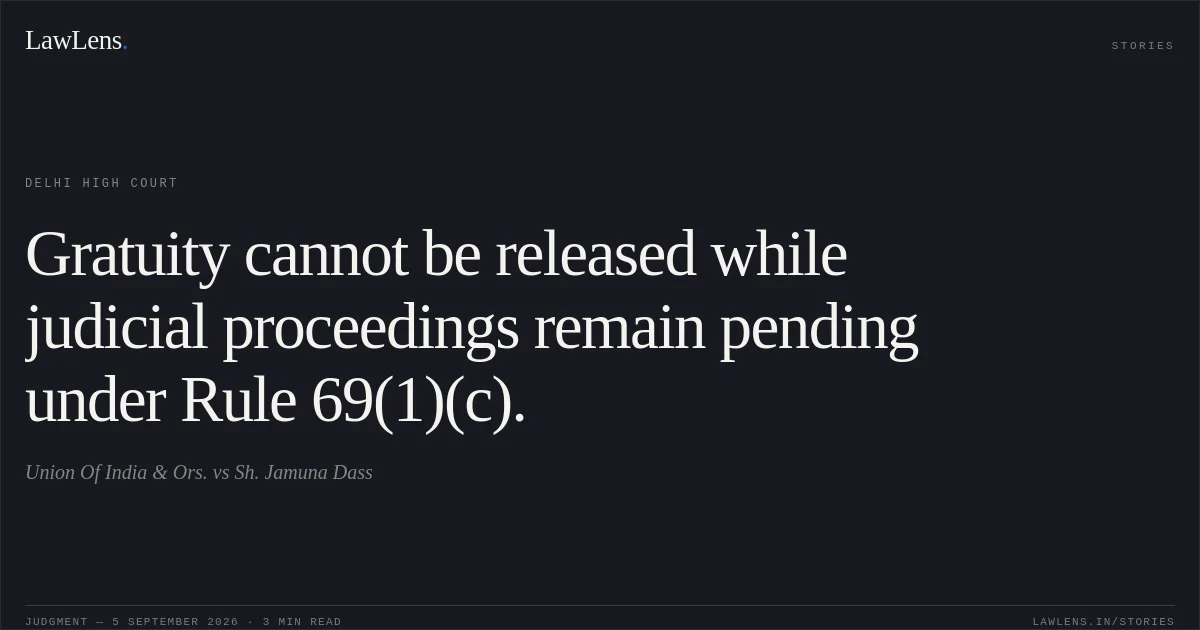
i.Whether gratuity could be withheld under Rule 69(1)(c) of the Central Civil Services (Pension) Rules, 1972, while the respondent’s criminal appeal remained pending before the High Court?
p. 4 · ¶ 13 · p. 5 · ¶ 16ii.Whether the bar under Rule 9(2)(b), relating to initiation of departmental proceedings after four years from the relevant event, required release of the respondent’s gratuity?
pp. 3–4 · ¶ 11–13iii.Whether the expression “judicial proceedings” in Rule 69(1)(c) included the pending criminal appeal against the respondent’s conviction?
p. 6 · ¶ 17–1803Law Applied
The Court applied Rule 69(1)(c) of the Central Civil Services (Pension) Rules, 1972, which provides that gratuity shall not be paid until the conclusion of departmental or judicial proceedings and the issuance of final orders thereon.
p. 4 · ¶ 10Rule 9(2)(b) was also considered; it restricts the institution of departmental proceedings against a retired Government servant in respect of an event occurring more than four years before such institution.
p. 3 · ¶ 11 and footnote 3The Court relied on Bikram Chand Rana v. Himachal Pradesh Road Transport Corporation, 2026 SCC OnLine SC 535, which held that Rule 69(1)(c) operates as a statutory embargo, and that the disjunctive expression “or” means that the bar continues while either departmental or judicial proceedings remain pending.
pp. 5–6 · ¶ 15The Supreme Court further held that the provision has a broad, protective purpose of safeguarding the State’s financial interests and cannot be defeated merely because one category of proceedings has concluded.
p. 6 · ¶ 1504Reasoning
The Tribunal’s reasoning focused exclusively on the absence of departmental proceedings and the alleged expiry of the four-year period under Rule 9(2)(b).
pp. 3–4 · ¶ 11–12The High Court held that this approach overlooked the independent and alternative bar created by Rule 69(1)(c).
Although the trial proceedings had concluded, the respondent’s criminal appeal against his conviction remained pending before the High Court.
p. 6 · ¶ 16–18Such an appeal constituted continuing “judicial proceedings” for the purposes of Rule 69(1)(c).
p. 6 · ¶ 16–18The suspension of the sentence did not terminate or dispose of the criminal appeal, nor did it eliminate the statutory embargo on payment of gratuity.
Accordingly, the pendency of the criminal appeal was sufficient to justify withholding gratuity, irrespective of whether departmental proceedings could still be initiated under Rule 9(2)(b).
pp. 6–7 · ¶ 18–2005Holding
The High Court held that the Union of India was entitled to withhold the respondent’s gratuity so long as Criminal Appeal No. 344/2012 remained pending, since the appeal constituted pending judicial proceedings under Rule 69(1)(c).
p. 6 · ¶ 19The respondent’s claim to gratuity would revive upon disposal of the criminal appeal, regardless of the outcome.
p. 6 · ¶ 20The Tribunal’s judgment was quashed and set aside, and the writ petition was allowed without any order as to costs.
p. 7 · ¶ 21Original Court PDF
Union Of India & Ors.vsSh. Jamuna Dass
Click to open original judgment
Original judgment, available to read, download and summarize on LawLens.in