01Facts
The petitioner-landlord challenged, under Section 25-B(8) of the Delhi Rent Control Act, 1958 (“DRC Act”), the order dated 19.05.2025 of the Additional Rent Controller, Shahdara District, granting the respondent leave to defend in an eviction petition under Section 14(1)(e) of the DRC Act.
p. 1The petitioner asserted ownership of the premises through documents executed by the erstwhile owner, while the respondent disputed both the landlord–tenant relationship and the petitioner’s claim to the property, relying on alleged title documents in his favour.
pp. 2–3The ARC found that the petitioner had produced neither a rent agreement nor rent receipts, and had not specified the mode of payment of rent, despite the respondent’s categorical denial of tenancy.
p. 3The respondent also contended that he was not “Nasir Khan” but “Nafees Ahmed, son of Zamir Ahmed”; the ARC considered this discrepancy relevant to the disputed identity and alleged tenancy.
pp. 4–5Before the High Court, the petitioner relied principally on another eviction proceeding concerning the same property, in which leave to defend had been refused and eviction ordered; however, the petitioner conceded that a rent agreement existed in that proceeding, unlike in the present case.
pp. 1–2, 502Issues
i.1. Whether the ARC was justified in granting leave to defend where the respondent disputed the very existence of the landlord–tenant relationship and the petitioner produced no rent agreement, rent receipt, or other material establishing the tenancy.
pp. 2–5 · ¶ 4–9ii.2. Whether the order in another eviction petition concerning the same property, in which a rent agreement existed and leave to defend was refused, warranted interference with the impugned order in the present proceedings.
pp. 1–2, 5–6 · ¶ 2–3, 8–10iii.3. Whether the High Court, in limited revisional jurisdiction under Section 25-B(8) of the DRC Act, should interfere with the ARC’s finding that the respondent had raised a triable issue.
p. 6 · ¶ 9–1003Law Applied
Section 25-B(8) of the DRC Act confers limited revisional jurisdiction on the High Court in summary eviction proceedings; interference is warranted only where the ARC’s order suffers from a material illegality or jurisdictional error.
p. 6 · ¶ 10For an eviction petition under the DRC Act, establishing a jural relationship of landlord and tenant is a fundamental and indispensable requirement; a landlord’s assertion of ownership or better title cannot, by itself, substitute proof of the tenancy where the relationship is specifically denied.
pp. 2–4 · ¶ 4–7Where the existence of the tenancy is seriously disputed and the tenant raises a substantial or triable issue, leave to defend must be granted.
pp. 4–5 · ¶ 5The existence of a rent agreement or rent receipts may constitute material evidence of the landlord–tenant relationship, and the absence of such evidence assumes significance when tenancy is categorically denied.
pp. 3, 5–6 · ¶ 5–8Provisions in the judgment · 1
Delhi Rent Control Act, 1958 Section 25B
04Reasoning
The High Court held that the petitioner’s title claim did not resolve the threshold question of whether a landlord–tenant relationship existed.
p. 3 · ¶ 5The respondent did not merely allege that he had subsequently acquired ownership; he denied having entered the premises as a tenant from the outset.
p. 3 · ¶ 5Since the petitioner produced no rent agreement, rent receipt, or particulars regarding the payment of rent, the ARC was justified in finding that the tenancy itself remained doubtful.
p. 3 · ¶ 5The competing and unregistered title documents raised an additional factual controversy, but could not replace proof of the jural relationship required under the DRC Act.
pp. 3–4 · ¶ 5–7The earlier eviction proceeding was distinguishable because it involved an admitted or documented rent agreement, whereas no such document existed in the present case; that factual distinction went to the root of the dispute.
pp. 5–6 · ¶ 8Consequently, the ARC’s conclusion that the respondent had raised a triable issue was neither erroneous nor perverse, and did not warrant revisional interference.
p. 6 · ¶ 9–1005Holding
The High Court answered the issues against the petitioner.
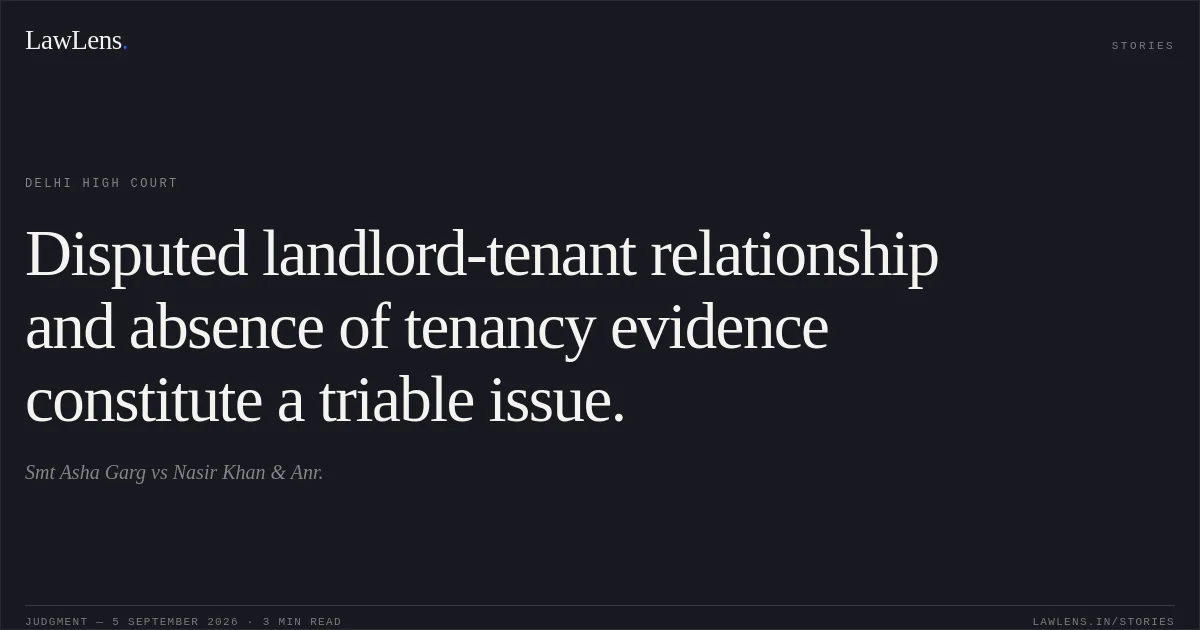
p. 6 · ¶ 8–9It held that the disputed existence of the landlord–tenant relationship, coupled with the absence of any rent agreement, rent receipt, or comparable material, constituted a triable issue justifying leave to defend.
p. 6 · ¶ 8–9The prior order in a separate eviction proceeding did not control the present case because the evidentiary circumstances were materially different.
p. 6 · ¶ 8Exercising limited jurisdiction under Section 25-B(8) of the DRC Act, the Court found no infirmity in the ARC’s order and dismissed the revision petition as devoid of merit; pending applications, if any, were also disposed of.
p. 6 · ¶ 10–12Original Court PDF
Smt Asha GargvsNasir Khan & Anr.
Click to open original judgment
Original judgment, available to read, download and summarize on LawLens.in