Facts
The petitioner, a State Bank of India officer with over thirty years of service, was transferred from the Digha Branch, Patna, to the Muzaffarpur Zone and was subsequently placed at the disposal of the Regional Business Office, Bettiah.
Source reference: paras. 5(i)–5(iv)He applied for sick leave on account of jaundice and related medical conditions.
Source reference: para. 5(v)The leave for 1 July 2019 to 31 July 2019 was approved through the Bank’s HRMS portal, and the petitioner was paid salary for that period.
Source reference: paras. 7–8, 34–36The Bank later treated the petitioner’s absence from 29 June 2019 as unauthorised, stating that the leave had been approved by an incompetent authority and that the medical documents were unsatisfactory.
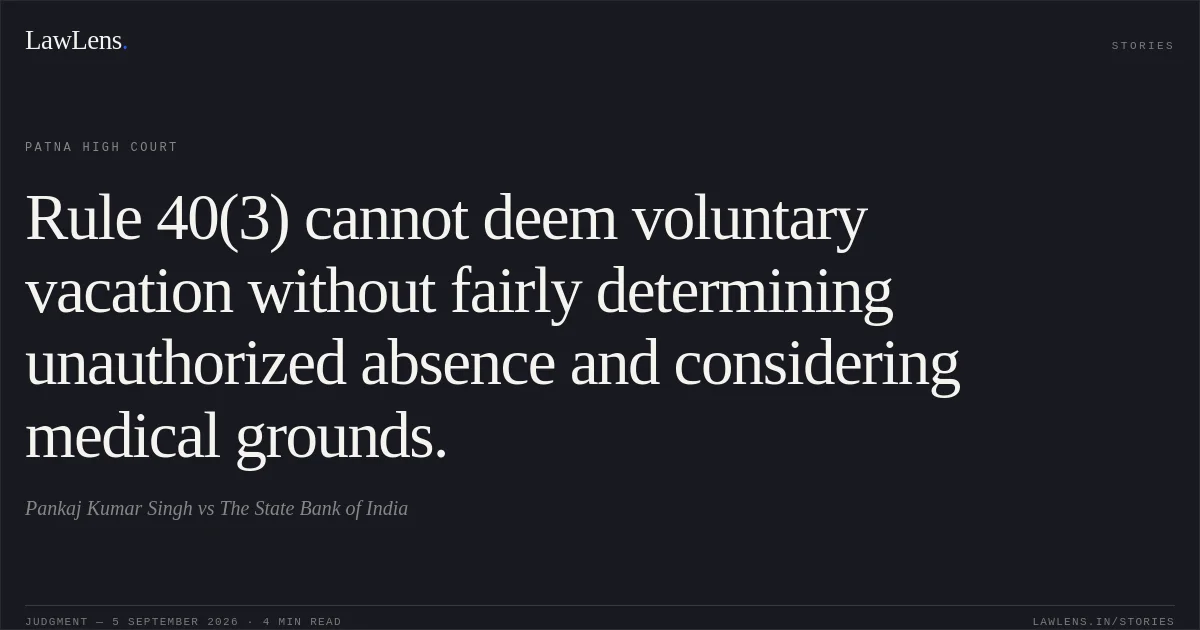
Source reference: paras. 5(ix), 20A notice dated 6 November 2019 was issued under Rule 40(3) of the State Bank of India Officers’ Service Rules, 1992, requiring the petitioner to report for duty and explain his absence within thirty days, failing which he would be deemed to have voluntarily vacated his employment.
Source reference: paras. 2, 5(x)By notice dated 13 December 2019, the Bank declared that the petitioner had voluntarily vacated service with effect from 7 December 2019.
Source reference: para. 3The petitioner, who claimed to have been medically unfit until 13 December 2019, reported for duty on 16 December 2019 and challenged the notices.
Source reference: paras. 5(vii)–5(xiii)His appeal was rejected on 24 June 2020.
Source reference: para. 5(xiii)Issues
Whether the Bank was justified in treating the petitioner’s medical absence as unauthorised and invoking Rule 40(3) to deem him to have voluntarily vacated his employment, despite the prior approval of leave through HRMS and the medical materials produced by him?
Source reference: paras. 30–41, 45–53Whether the statutory conditions and procedural requirements under Rule 40(3), including service of notice at the petitioner’s last known address and a meaningful opportunity to explain his absence, were satisfied?
Source reference: paras. 32, 42–50Whether the impugned notices and appellate order were arbitrary and violative of Article 14 and the principles of natural justice?
Source reference: paras. 48, 54–55Law Applied
The Court applied Rules 40(2) and 40(3) of the State Bank of India Officers’ Service Rules, 1992.
Source reference: paras. 30–33Rule 40(2) permits consequences for overstaying leave, while Rule 40(3) permits the Bank, after an officer remains absent for ninety or more consecutive days, to issue notice at the officer’s last known address requiring him to report within thirty days; failure to do so may result in an order deeming the officer to have voluntarily vacated employment.
Source reference: paras. 30–33The Court held that Rule 40(3) can be invoked only after the authority properly determines that the absence is unauthorised or constitutes overstaying of leave.
Source reference: paras. 45–46It relied on Vijay S. Sathaye v. Indian Airlines Ltd., holding that statutory rules may provide for cessation of service upon prolonged absence.
Source reference: para. 29Krushnakant B. Parmar v. Union of India, holding that absence caused by compelling circumstances such as illness is not necessarily wilful absence.
Source reference: paras. 17, 51Chhel Singh v. M.G.B. Gramin Bank, concerning the need to properly assess medical certificates where their genuineness is not disproved.
Source reference: para. 16Dipak Babaria v. State of Gujarat, for the principle that a statutory procedure must be followed in the prescribed manner.
Source reference: para. 15The Court also applied Article 14, requiring statutory discretion to be exercised fairly, reasonably, and non-arbitrarily, together with the principles of natural justice.
Source reference: paras. 50, 54–55Reasoning
The Court found that the petitioner’s sick leave had been approved through the HRMS portal and that he had received full salary for the relevant period.
Source reference: paras. 34–36Even if the initial approval had been granted by an incompetent authority, that circumstance did not justify outright rejection of the leave without forwarding the application to the competent authority or examining the medical claim on its merits.
Source reference: paras. 35–38The medical prescriptions, reports, and fitness certificate were not found to be forged, fabricated, or otherwise unreliable; nor did the Bank verify them or refer the petitioner for examination by a Medical Board.
Source reference: paras. 38, 40–41, 47The Court held that the Bank’s bare statement that it was “not satisfied” with the documents was unsupported by reasons and amounted to arbitrary decision-making.
Source reference: para. 47Since the foundation for treating the absence as unauthorised was defective, the precondition for invoking Rule 40(3) was not established.
Source reference: paras. 45–46, 52–53The Court also noted the unresolved dispute regarding service of the first notice at the petitioner’s last known address and held that subsequent receipt of communications on 16 December 2019 did not necessarily cure the earlier procedural defect.
Source reference: paras. 42–44The petitioner had therefore not been afforded a fair and meaningful opportunity to explain his absence before the drastic consequence of deemed voluntary vacation was imposed.
Source reference: paras. 48, 54–55Holding
The Court held that the notice dated 6 November 2019, the consequential notice dated 13 December 2019, and the appellate order dated 24 June 2020 were unsustainable in law and quashed them.
The Bank was directed to reinstate the petitioner with continuity of service.
Source reference: para. 57However, he was denied salary and allowances for the period during which he did not actually perform duties; that period was to count for continuity of service and other admissible consequential benefits under the applicable service rules.
Source reference: para. 58The writ petition was accordingly allowed, with the parties directed to bear their own costs.
Source reference: paras. 59–60Original Court PDF
Pankaj Kumar SinghvsThe State Bank of India
Click to open original judgment
Original judgment, available to read, download and summarize on LawLens.in