01Facts
The respondent, an aged mother and the claimed owner of the residential property bearing Khasra Nos. 267/430 and 267/433 at Naveen Nagar, B.M.Y. Charoda, District Durg, initiated proceedings under the Maintenance and Welfare of Parents and Senior Citizens Act, 2007, alleging harassment and ill-treatment by her son, petitioner No. 1, and daughter-in-law, petitioner No. 2.
¶ 2–5 · pp. 2–4The Maintenance Tribunal directed eviction of the petitioners from the property by order dated 28 February 2022. The Collector/Appellate Tribunal affirmed that order on 12 October 2023. The petitioners challenged the appellate order under Article 226, contending that eviction could not be ordered under the Act, particularly against the daughter-in-law, and that the proceedings were improperly decided without recording oral evidence.
¶ 2–5 · pp. 2–4The respondent asserted exclusive ownership, absence of any right or interest of the petitioners, and alleged that petitioner No. 1 had fraudulently used the property to obtain a loan, resulting in criminal and recovery proceedings.
¶ 2–5 · pp. 2–402Issues
i.1. Whether the Maintenance Tribunal was legally empowered under the Maintenance and Welfare of Parents and Senior Citizens Act, 2007, to direct eviction of the petitioners from the senior citizen’s property.
¶ 6–8 · pp. 4–6ii.2. Whether the eviction proceedings were vitiated because the Tribunal adopted a summary procedure and did not record elaborate oral evidence.
¶ 6 · p. 4iii.3. Whether the Supreme Court’s decision in Smt. S. Vanitha v. Deputy Commissioner, Bengaluru Urban District, (2021) 15 SCC 730, barred eviction proceedings against petitioner No. 2, the respondent’s daughter-in-law.
¶ 7 · p. 5iv.4. Whether the orders of the Maintenance Tribunal and the Appellate Tribunal disclosed any jurisdictional error, perversity, violation of natural justice, or manifest illegality warranting interference under Article 226 of the Constitution.
¶ 9 · p. 603Law Applied
The Court applied the Maintenance and Welfare of Parents and Senior Citizens Act, 2007, including Section 8(2), which confers specified powers of a civil court upon the Maintenance Tribunal and permits adoption of a summary procedure.
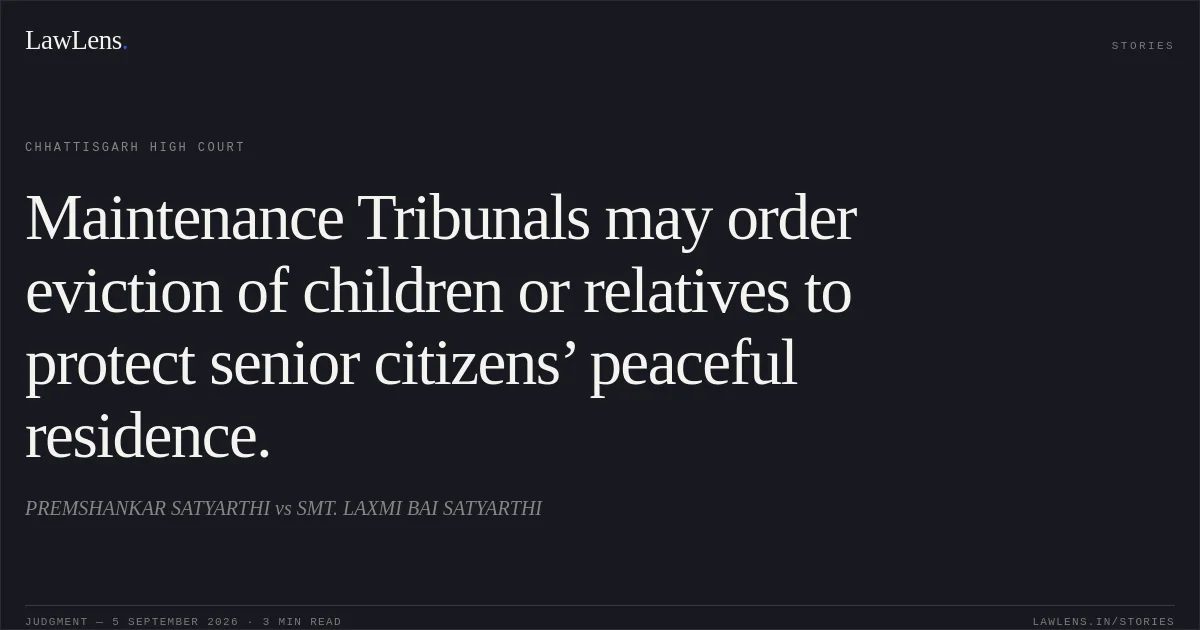
¶ 6, 8 · pp. 4–6The Court treated the Act as beneficial legislation intended to protect the life, property, dignity, welfare, and peaceful residence of senior citizens, and held that the Tribunal’s jurisdiction is not confined to granting monetary maintenance but may extend to consequential directions, including eviction of children or relatives, where necessary to protect the senior citizen.
¶ 6, 8 · pp. 4–6The Court considered Smt. S. Vanitha v. Deputy Commissioner, Bengaluru Urban District, (2021) 15 SCC 730, but held that it does not impose an absolute prohibition on entertaining eviction claims against a daughter-in-law; its application depends upon the facts and competing rights of the parties.
¶ 7 · p. 5The Court also applied the limited scope of judicial review under Article 226, under which the High Court does not reappreciate factual findings or substitute its own view absent jurisdictional error, perversity, breach of natural justice, or manifest illegality.
¶ 9 · p. 6Provisions in the judgment · 4 · Linked ones open on LawLens
Maintenance and Welfare of Parents and Senior Citizens Act, 2007 Section 8
Indian Penal Code, 1860 Section 420Section 467Section 471
04Reasoning
The Court found that the respondent claimed ownership of the property and that the statutory authorities had, after considering the material before them, accepted her allegations of harassment and granted eviction.
¶ 6 · p. 4The absence of elaborate oral evidence did not invalidate the proceedings because the Tribunal was authorised to adopt a summary procedure, and the petitioners failed to show either prejudice or failure of justice.
¶ 6 · p. 4The reliance on S. Vanitha was rejected because that decision was not understood as creating an absolute bar against eviction of a daughter-in-law under the 2007 Act; additionally, the petitioners failed to establish any independent right, title, or interest in the property.
¶ 7 · p. 5Applying the beneficial and purposive interpretation of the Act, the Court held that eviction could constitute an appropriate consequential measure for securing the respondent’s protection and peaceful residence.
¶ 8 · p. 6Since no jurisdictional error, perversity, violation of natural justice, or manifest illegality was demonstrated, the Court declined to interfere with the concurrent findings in writ jurisdiction.
¶ 9 · p. 605Holding
The High Court held that the Maintenance Tribunal was competent to direct eviction under the 2007 Act, that the summary procedure adopted did not cause demonstrable prejudice, and that S. Vanitha did not absolutely bar proceedings against the daughter-in-law in the circumstances of the case.
¶ 10–12 · p. 7Finding no ground for interference under Article 226, the Court dismissed the writ petition and upheld the Appellate Tribunal’s order dated 12 October 2023 affirming the Maintenance Tribunal’s eviction order dated 28 February 2022. No order was made as to costs.
¶ 10–12 · p. 7Original Court PDF
PREMSHANKAR SATYARTHIvsSMT. LAXMI BAI SATYARTHI
Click to open original judgment
Original judgment, available to read, download and summarize on LawLens.in