01Facts
The petitioner was an accused in GR Case No. 750 of 2020, arising from FIR No. 60 of 2020 dated 23 April 2020, registered at Police Station Bambooflat, South Andaman, under Sections 188, 269, 270, 271 and 34 of the IPC, along with Section 51(b) of the Disaster Management Act, 2005.
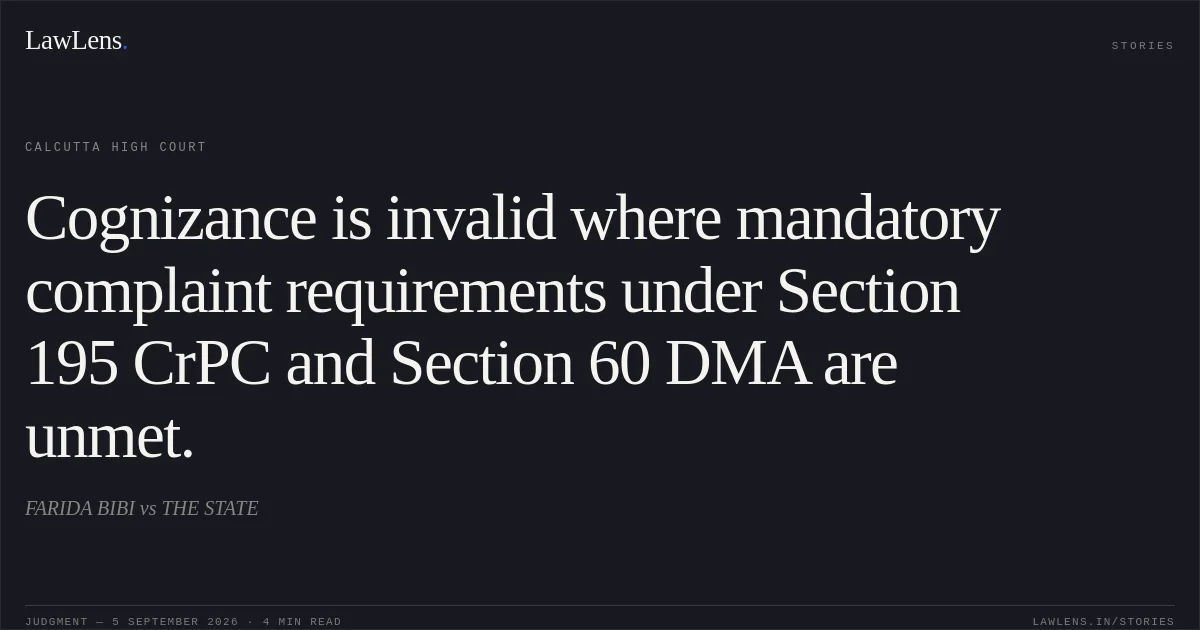
¶ 1–2The petitioner challenged the institution of the case and filing of the charge-sheet, contending that cognizance was barred because the statutory complaints required under Section 195(1)(a) CrPC and Section 60 of the Disaster Management Act had not been made by the competent authorities.
¶ 5–8Her application for discharge was rejected by the Chief Judicial Magistrate, Port Blair, by order dated 10 July 2026, leading to the present revision.
¶ 302Issues
i.Whether cognizance of the offences under Sections 188 and 51(b) of the Disaster Management Act could be taken without a complaint by the public servant or authority specified under Section 195(1)(a) CrPC and Section 60 of the Disaster Management Act?
¶ 12–16, 28–33ii.Whether the allegations arising from alleged violation of COVID-19 protocols disclosed the ingredients of offences under Sections 269, 270 and 271 IPC, independently of Sections 188 IPC and 51(b) of the Disaster Management Act?
¶ 16–28iii.Whether the Magistrate could proceed with the case merely because cognizance had already been taken, despite the statutory bar on cognizance?
¶ 29–3303Law Applied
The Court applied Section 195(1)(a) CrPC, which bars cognizance of offences under Sections 172–188 IPC, including Section 188, except upon a written complaint by the concerned public servant or a public servant administratively subordinate to him.
¶ 13It applied Sections 51(b) and 60 of the Disaster Management Act, 2005, under which prosecution for obstruction or refusal to comply with statutory directions requires a complaint by the specified governmental or statutory authority, or by a person who has complied with the prescribed notice requirement.
¶ 14–15The Court relied on E.S. Rajesh v. State, CRR 35 of 2022, for the principle that, in the context of COVID-protocol violations, Sections 269 and 270 IPC could not be invoked independently where the alleged conduct essentially constituted violation of Section 51(b) of the Disaster Management Act.
¶ 16It further applied the statutory ingredients of Sections 269 and 270 IPC—an act likely to spread an infection of a disease dangerous to life, accompanied respectively by negligence or malignancy and the requisite knowledge—and Section 271 IPC, which concerns knowing disobedience of Government quarantine rules relating to vessels or places where infectious disease prevails.
¶ 18–24Relying on Govind Mehta v. State of Bihar, AIR 1971 SC 1711, the Court held that the Magistrate must examine statutory bars before taking cognizance and lacks jurisdiction where Section 195 CrPC is not complied with.
¶ 31Provisions in the judgment · 27 · Linked ones open on LawLens
Indian Penal Code, 1860 22 provisions
Section 34Section 43Section 172Section 173Section 174Section 175Section 176Section 177Section 178Section 179Section 180Section 181Section 182Section 183Section 184Section 185Section 186Section 187Section 188Section 269Section 270Section 271Disaster Management Act, 2005 Section 51Section 60
Code of Criminal Procedure, 1973 Section 190Section 195
Railway Protection Force Act, 1957 Section 20
04Reasoning
The Court found that the prosecution case concerned an alleged violation of COVID-19 protocols and did not allege facts showing that the petitioner’s conduct independently satisfied Sections 269 or 270 IPC.
¶ 21–25In particular, there was no allegation that the house where the birthday party occurred contained a COVID-19 patient, or that the occupants had been directed to remain in quarantine; consequently, the essential elements of an unlawful or negligent/malignant act likely to spread a dangerous infection were absent.
¶ 21–25Section 271 IPC was also held inapplicable because the case did not involve a Government rule concerning quarantine of vessels or regulation of intercourse between quarantined vessels or places affected by infectious disease.
¶ 17–20In substance, the allegations related only to disobedience of directions issued under Section 188 IPC and Section 51(b) of the Disaster Management Act.
¶ 28–33Since the mandatory complaint requirements under Section 195(1)(a) CrPC and Section 60 of the Disaster Management Act had not been satisfied, the Magistrate lacked jurisdiction to take cognizance.
¶ 28–33The fact that cognizance had already been taken could not cure the jurisdictional defect or authorise continuation of proceedings contrary to the statutory bar.
¶ 28–3305Holding
The Court held that the allegations under Sections 188, 269, 270 and 271 IPC, read with Section 51(b) of the Disaster Management Act, 2005, were not legally sustainable against the petitioner.
¶ 34It quashed GR Case No. 750 of 2020 insofar as it concerned Farida Bibi and discharged her from the case.
¶ 36–37The Court clarified that no order was being passed regarding the other accused persons, who could seek appropriate relief before the trial court in accordance with law.
¶ 35The criminal revision was accordingly disposed of.
¶ 38Original Court PDF
FARIDA BIBIvsTHE STATE
Click to open original judgment
Original judgment, available to read, download and summarize on LawLens.in