01Facts
The petitioner, a Head Constable serving in the 5th Battalion, Chhattisgarh Armed Force, was accused in Crime No. 136 of 2025 registered at Police Station Frezarpur, Bastar, for offences under Sections 420, 409, 467, 468, 471 and 34 of the IPC.
¶ 2He was arrested and remained in custody. During the pendency of the criminal case, departmental proceedings were initiated against him and he was suspended on account of his arrest.
¶ 2The petitioner contended that, while incarcerated, he could not effectively participate in the departmental enquiry, collect or produce documents, engage with defence witnesses, or properly instruct his defence representative.
¶ 2He also stated that he had requested the Enquiry Officer, by representation dated 28 July 2026, to stay the enquiry, but the representation had not been considered.
¶ 2The respondents opposed the petition, submitting that incarceration did not, by itself, deprive the petitioner of an opportunity to participate in the departmental proceedings.
¶ 302Issues
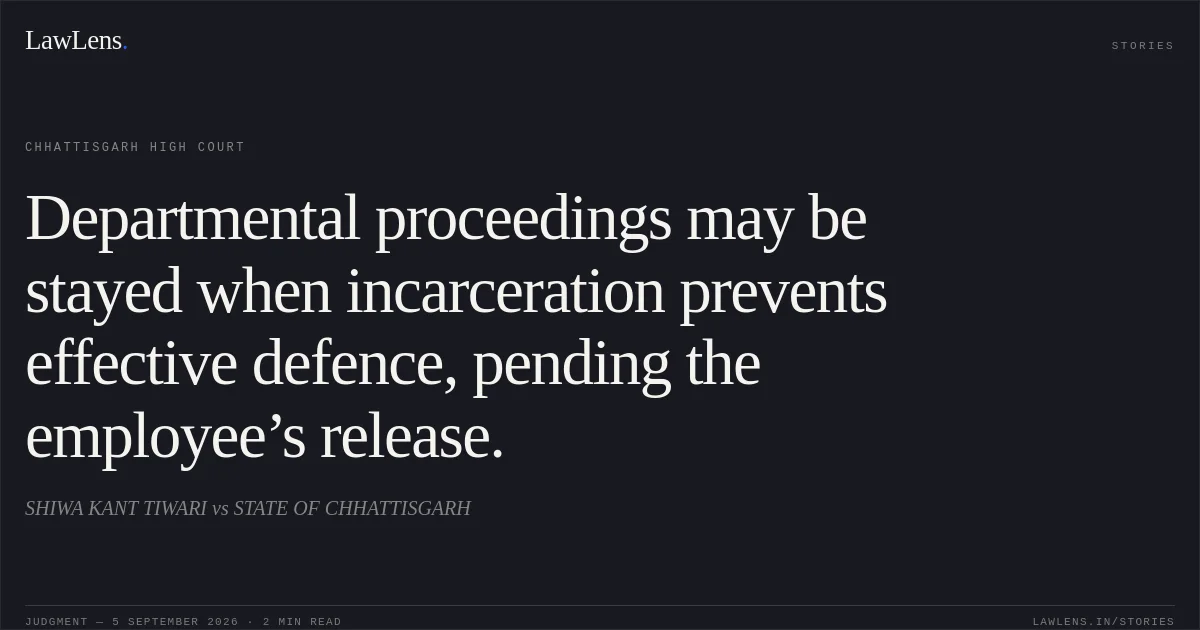
i.Whether the departmental enquiry should be stayed while the petitioner remained in custody in connection with the pending criminal case, on the ground that his incarceration impaired his ability to effectively defend himself?
¶ 2–5ii.Whether the chargesheet and consequential departmental proceedings should be kept in abeyance until the petitioner’s release from jail?
¶ 503Law Applied
The Court applied the principle of reasonable and effective opportunity of defence in disciplinary proceedings, holding that a delinquent employee must be practically capable of participating in the enquiry and presenting his defence.
¶ 2, 5Although the judgment does not cite any specific statutory provision, service rule, or judicial precedent, it recognises that continuation of disciplinary proceedings may be deferred where the employee’s incarceration prima facie prevents effective participation and may cause prejudice, including the possibility of an ex parte decision.
¶ 2, 5The Court also clarified that no opinion was expressed on the merits of either the criminal case or the departmental charges.
¶ 6Provisions in the judgment · 6 · Linked ones open on LawLens
Indian Penal Code, 1860 Section 420Section 409Section 467Section 468Section 471Section 34
04Reasoning
The Court noted that the petitioner was presently in jail and accepted that, in those circumstances, he might not be in a position to effectively defend himself in the departmental enquiry.
¶ 3–5Although the respondents argued that custody did not automatically prevent participation, the Court focused on the practical ability of the petitioner to collect documents, assist his defence, deal with witnesses, and instruct his representative.
¶ 3–5Finding a prima facie risk of prejudice, the Court considered it appropriate to keep the departmental chargesheet and consequential proceedings in abeyance rather than permit the enquiry to proceed during the petitioner’s incarceration.
¶ 3–505Holding
The petition was allowed.
¶ 5–6The chargesheet and all consequential departmental proceedings were directed to be kept in abeyance while the petitioner remained in jail.
¶ 5–6The respondents were permitted to resume the departmental enquiry after the petitioner’s release.
¶ 5–6The petitioner was directed to inform the disciplinary authority upon his release from custody.
¶ 5–6The Court expressly stated that it had not adjudicated the merits of the case.
¶ 5–6Original Court PDF
SHIWA KANT TIWARIvsSTATE OF CHHATTISGARH
Click to open original judgment
Original judgment, available to read, download and summarize on LawLens.in