01Facts
The petitioner-wife and respondent-husband were married on 10 May 2024. Following matrimonial disputes, the wife left the matrimonial home and began residing with her parents.
The husband instituted a petition under Section 13(1)(ia) of the Hindu Marriage Act, 1955, before the First Additional Principal Judge, Family Court, Durg, registered as Civil Suit No. HMA/1088/2025.
¶ 2The wife sought transfer of the proceedings to the Family Court, Rajnandgaon, stating that a proceeding under Section 144 of the Bharatiya Nyaya Sanhita, 2023, being Criminal MJC No. 260/2025, was already pending before that court and that the distance between Durg and Rajnandgaon was approximately 80 kilometres.
¶ 3She further asserted that she had no independent source of income and would face difficulty travelling to Durg.
¶ 3The husband opposed the transfer on the ground that evidence had commenced and the divorce proceedings were likely to conclude shortly.
¶ 402Issues
i.Whether the matrimonial proceeding pending before the Family Court, Durg, should be transferred to the Family Court, Rajnandgaon under Section 24 of the Code of Civil Procedure, 1908, having regard to the parties’ convenience and the ends of justice.
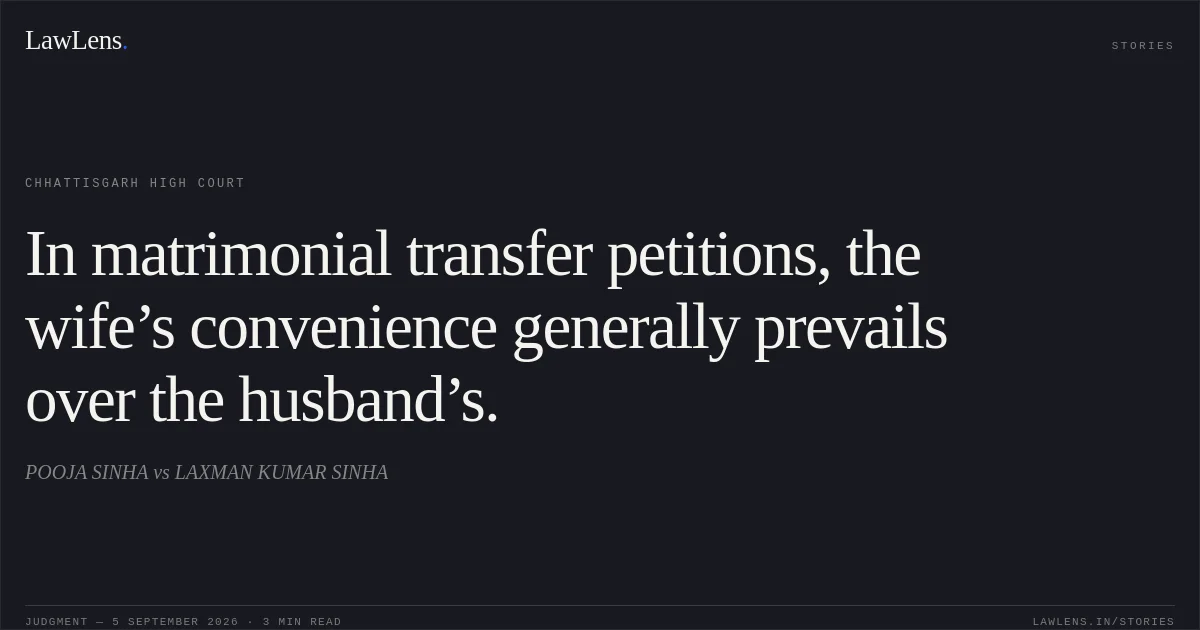
¶ 1, 5, 9ii.Whether, in a matrimonial transfer petition, the convenience of the wife should be preferred, particularly where she lacks an independent source of income and parallel proceedings are pending at the proposed transferee court.
¶ 3, 6–903Law Applied
The Court applied Section 24 of the Code of Civil Procedure, 1908, under which a proceeding may be transferred where the ends of justice so require.
¶ 1In matrimonial matters, the Court relied on N.C.V. Aishwarya v. A.S. Saravana Karthik, 2022 SCC OnLine SC 1199, which requires consideration of the parties’ economic position, social circumstances, livelihood, standard of living, and overall convenience, with the wife’s convenience generally receiving priority in the prevailing socio-economic context.
¶ 6The Court also relied on Sumita Singh v. Kumar Sanjay, (2001) 10 SCC 41, and Rajani Kishor Pardeshi v. Kishore Babulal Pardeshi, (2005) 12 SCC 237, for the principle that, where a husband institutes proceedings against his wife, the wife’s convenience is ordinarily to be preferred.
¶ 7The underlying matrimonial proceeding was instituted under Section 13(1)(ia) of the Hindu Marriage Act, 1955.
¶ 2Provisions in the judgment · 3 · Linked ones open on LawLens
Code of Civil Procedure, 1908 Section 24
Hindu Marriage Act, 1955 Section 13
Bharatiya Nyaya Sanhita, 2023 Section 144
04Reasoning
The Court found that the wife had demonstrated genuine inconvenience in attending proceedings at Durg, as she had no independent source of income and was required to travel approximately 80 kilometres from Rajnandgaon.
¶ 3The existence of a parallel proceeding at Rajnandgaon, in which the husband had already entered appearance, further supported transfer because the husband could attend both matters at the same place.
¶ 8Applying the settled principle that the wife’s convenience is ordinarily to be preferred in matrimonial transfer matters, the Court held that the husband’s objection regarding commencement of evidence did not outweigh the circumstances favouring transfer.
¶ 8–9The Court consequently considered the case fit for exercise of power under Section 24 CPC.
¶ 8–905Holding
The transfer petition was allowed.
¶ 10Civil Suit No. HMA/1088/2025, pending before the First Additional Principal Judge, Family Court, Durg, was ordered to be transferred to the Family Court, Rajnandgaon, for trial and disposal in accordance with law.
¶ 10The Family Court, Durg, was directed to transmit the record within 15 days, and the Family Court, Rajnandgaon, was directed to conclude the proceedings expeditiously, preferably within four months of receiving the record.
¶ 10–11The parties were directed to cooperate, and the husband could be permitted to appear through video conferencing where his personal appearance was unnecessary.
¶ 11Pending interlocutory applications, if any, were disposed of, with no order as to costs.
¶ 12Original Court PDF
POOJA SINHAvsLAXMAN KUMAR SINHA
Click to open original judgment
Original judgment, available to read, download and summarize on LawLens.in