Facts
Private respondent No. 4 initiated proceedings under the Haryana Canal and Drainage Act, 1974, alleging that an existing watercourse had been demolished by the appellant and seeking its restoration.
Source reference: pp. 2–4Following an inquiry by the canal field staff, the Sub-Divisional Canal Officer directed restoration of the watercourse on 31 May 2022. Although the appellant’s appeal was accepted on 22 September 2022, the revisional canal authority, on 22 December 2022, restored the order after finding that the watercourse was depicted in a 1983 site plan, that a sanctioned “Naka” existed under the warabandi decision dated 24 June 1991, and that photographs and field material established the existence of a dismantled watercourse along the road. The writ petition challenging the revisional order was dismissed by the learned Single Judge, leading to the present Letters Patent Appeal.
Source reference: pp. 2–4Issues
Whether the canal authorities were justified in ordering restoration of the watercourse on the basis of the field inquiry, site plan, photographs, warabandi record, and other documentary material.
Source reference: pp. 2–4Whether the learned Single Judge erred in declining to interfere with the concurrent findings of the statutory canal authorities under Article 226 of the Constitution.
Source reference: pp. 4–5Law Applied
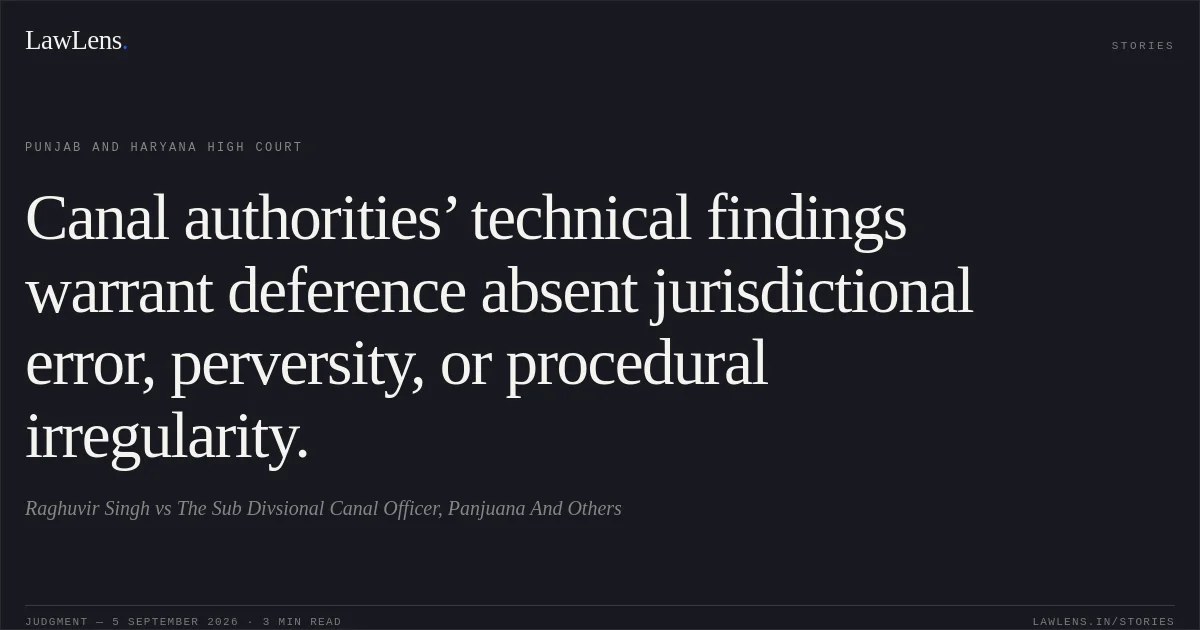
The Court applied the Haryana Canal and Drainage Act, 1974, under which the competent canal authorities may inquire into the existence and demolition of a watercourse and direct its restoration. It held that statutory canal authorities possessing technical and field expertise in matters concerning canal alignments, irrigation requirements, and spot conditions should not be lightly interfered with in writ jurisdiction, provided that the affected parties receive a fair opportunity of hearing and the decision is directed toward improving irrigation facilities.
Source reference: p. 4The Court relied on Sham Sunder v. Superintending Canal Officer, Ferozepur, 2001(4) RCR (Civil) 35, and Mohinder Singh v. State of Punjab, 2012(67) RCR (Civil) 760, on limited judicial interference with such technical determinations. It further relied on Ajit Singh v. Superintending Canal Officer, 2017(1) RCR (Civil) 279, and Brij Lal v. State of Punjab, 1985 RRR 76, for the principle that warabandi is the best evidence of a person’s turn to receive canal water for irrigation.
Source reference: pp. 3–4Reasoning
The Court found that the revisional authority’s conclusion was supported by objective material, including the 1983 site plan, photographs showing a “Naka” and culvert, the finding that a dismantled watercourse existed along the road, the absence of an alternative watercourse for the private respondent’s land, and the 1991 warabandi decision sanctioning the “Naka.” These materials, together with the Ziledar’s field report and the finding that the watercourse had operated for approximately two decades, established that it was a permanent watercourse that had been demolished.
Source reference: pp. 3–5The appellant’s reliance on subsequently produced revenue documents and an unverified chart or map could not displace the specific findings of the canal authorities. Since no jurisdictional error, perversity, procedural irregularity, or denial of hearing was demonstrated, the High Court declined to reappraise the technical findings in writ or intra-court appellate jurisdiction.
Source reference: pp. 3–5Holding
The Court answered the issues against the appellant and held that the canal authorities were justified in directing restoration of the demolished watercourse.
Finding no legal or jurisdictional infirmity in the orders upheld by the learned Single Judge, the Letters Patent Appeal was dismissed as meritless, with no order as to costs. Any pending miscellaneous applications were also disposed of.
Source reference: p. 5Original Court PDF
Raghuvir SinghvsThe Sub Divsional Canal Officer, Panjuana And Others
Click to open original judgment
Original judgment, available to read, download and summarize on LawLens.in