Facts
The petitioner’s mother, a teacher at Middle School, Dhansoi, died in harness on 13 November 2007.
Source reference: pp. 2–3, para. 3The petitioner applied for compassionate appointment as a School Assistant and was subsequently included in the panel prepared by the authorities.
Source reference: pp. 2–3, para. 3Verification reports issued in 2022 and 2023 recorded that no family member was in government or non-government service and that the deceased employee had left behind the petitioner and a son.
Source reference: pp. 2–3, para. 9Under the 2020 departmental guidelines, the petitioner’s name was placed at serial no. 1 in the list for compassionate appointment, and the District Education Officer recommended action by the Zila Parishad.
Source reference: pp. 12–13, para. 6The Zila Parishad also included her name in its provisional panel for appointment as School Assistant.
Source reference: pp. 13–16, paras. 7–8However, the State authorities raised an objection that she was a married daughter and not the only child of the deceased employee.
Source reference: pp. 15–20, paras. 8–12No final decision was taken despite the passage of nearly twenty years from the employee’s death.
Source reference: pp. 15–20, paras. 8–12Issues
Whether the petitioner’s claim for compassionate appointment could be withheld or rejected merely because she was a married daughter of the deceased employee.
Source reference: pp. 16–20, paras. 9–12Whether the petitioner’s status as not being the only child of the deceased employee constituted a valid ground to deny or defer consideration of her claim.
Source reference: pp. 15–20, paras. 8–12Whether the respondents were required to consider the petitioner’s claim for compassionate appointment on merits in accordance with the applicable eligibility conditions.
Source reference: pp. 20–21, paras. 12–13Law Applied
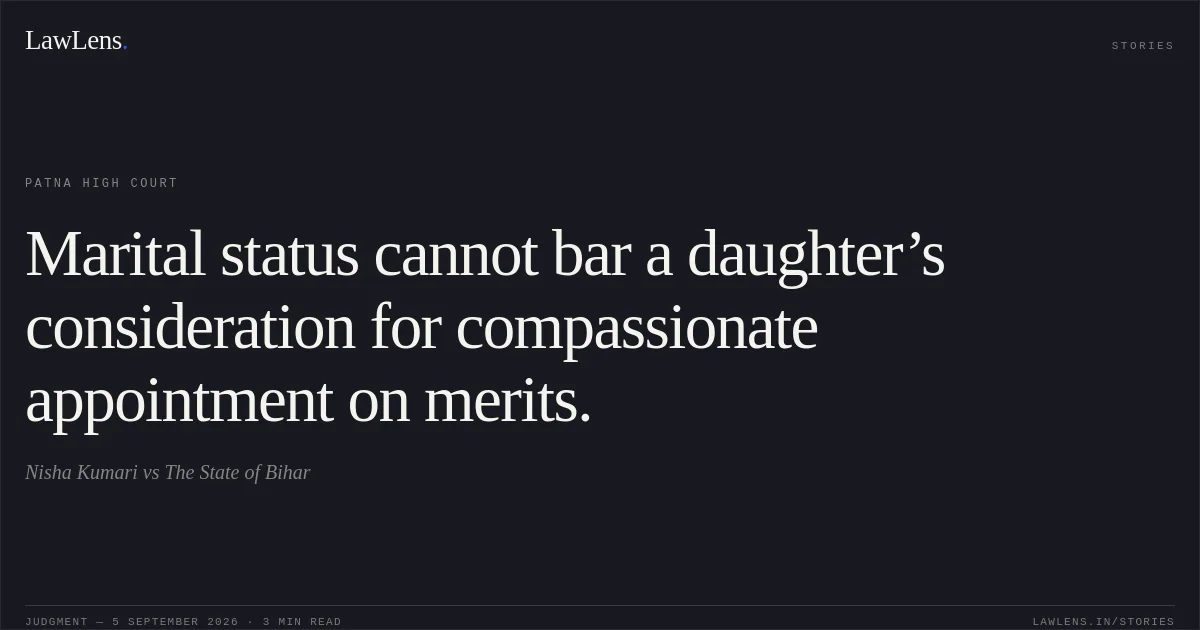
Compassionate appointment is to be considered under the applicable governmental scheme and on the basis of the prescribed eligibility conditions; marital status cannot, by itself, be used to exclude an otherwise eligible daughter.
Source reference: no citationRelying on Sayara Khatoon @ Shayara Khatoon v. State of Bihar & Ors., Civil Appeal No. 9779 of 2026, the Court applied the principle that a classification limiting eligibility to divorced or deserted daughters is constitutionally unsustainable, since marriage does not presumptively sever a daughter’s relationship with or dependency upon her parental family.
Source reference: pp. 4–6, 17–19, paras. 4, 10The Court further relied on Kulsum Nisha v. State of U.P. & Ors., 2026 INSC 617, which held that exclusion of married daughters from a welfare scheme violates Articles 14 and 15(1) where marital status has no rational nexus with dependency, financial need or the object of the scheme.
Source reference: pp. 6–12, paras. 5, 10The governing test is therefore actual dependency and fulfilment of the scheme’s other eligibility requirements, not marital status alone.
Source reference: no citationReasoning
The petitioner had been repeatedly considered by the authorities, found eligible for inclusion in the compassionate appointment panel, and recommended for appointment.
Source reference: pp. 16–20, paras. 9–12The only stated impediments were that she was married and that she was not the deceased employee’s only child.
Source reference: pp. 16–20, paras. 9–12Applying Sayara Khatoon and Kulsum Nisha, the Court held that marriage cannot create a conclusive presumption that the petitioner ceased to be dependent upon, or connected with, her parental family.
Source reference: pp. 19–21, paras. 10–13Likewise, the fact that she had a brother did not justify refusal to consider her claim, particularly when the authorities had not made a final determination on dependency or other eligibility requirements.
Source reference: pp. 19–21, paras. 10–13Since the petitioner’s claim had remained pending for an inordinate period and had not been adjudicated on its merits, the Court considered it appropriate to direct a fresh, lawful consideration rather than order immediate appointment.
Source reference: pp. 19–21, paras. 10–13Holding
The writ petition was disposed of with a direction to the respondent authorities to consider the petitioner’s claim for compassionate appointment on its merits, without being influenced by any provision or objection excluding married daughters, within eight weeks from receipt or production of the judgment.
The petitioner was also to be afforded an opportunity of hearing.
Source reference: pp. 20–21, paras. 12–14The Court did not grant an automatic appointment, arrears or compensation; those claims were left to be determined in the respondents’ merits-based consideration.
Source reference: p. 21, paras. 14–15Pending applications, if any, were also disposed of.
Source reference: p. 21, paras. 14–15Acts & Sections Cited
2 provisions across 1 statute referred to in this judgment. Linked provisions open on LawLens.
the 2016 Order (alias, unresolved)2
Original Court PDF
Nisha KumarivsThe State of Bihar
Click to open original judgment
Original judgment, available to read, download and summarize on LawLens.in