01Facts
The respondent-landlord filed an eviction petition concerning Shop No. 3/2793, Ground Floor, Ashoka Gali, Hamilton Road, Mori Gate, Delhi, claiming a bona fide requirement for carrying on and expanding his photography business, including washing and developing negatives, preparing photographs, and installing computers and other equipment.
p. 6 · ¶ 16The petitioner-tenant sought leave to defend, contending that the landlord had concealed his use of premises at 217-B, Bhai Parmanand Colony, Delhi, and that the premises constituted suitable alternative accommodation.
pp. 2–3 · ¶ 2–3By order dated 22 September 2017, the learned CCJ-cum-ARC dismissed the leave-to-defend application and passed an eviction order, holding that the landlord had established his bona fide requirement and that the tenant had failed to disclose a reasonably suitable alternative accommodation.
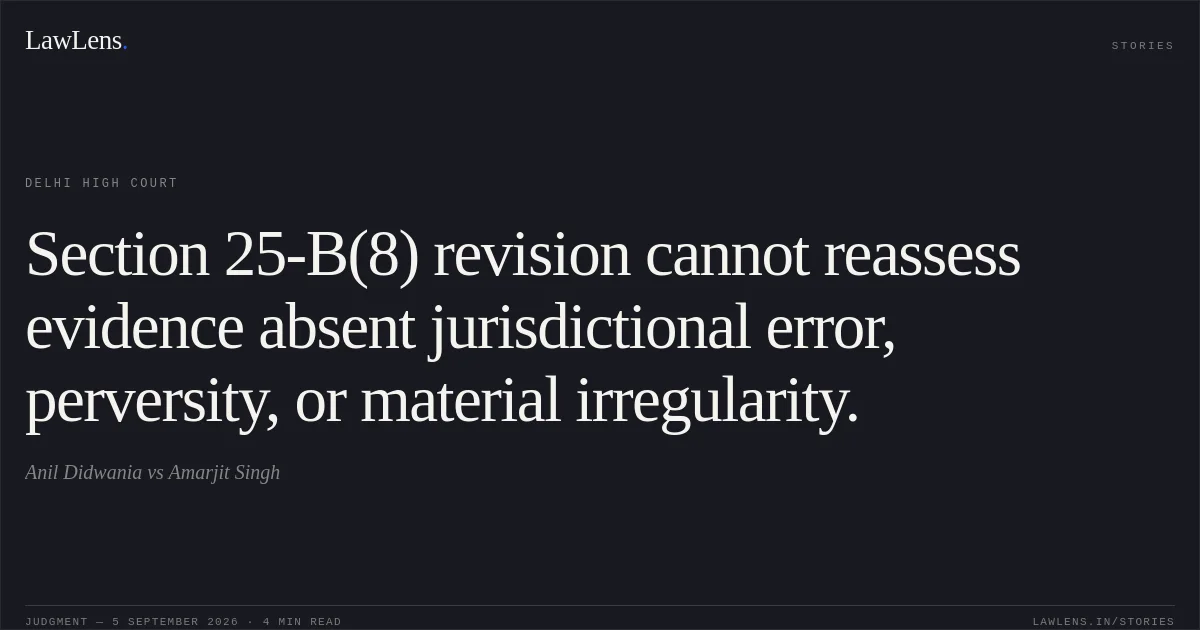
pp. 1, 6–10 · ¶ 1The tenant challenged that order under the proviso to Section 25-B(8) of the Delhi Rent Control Act, 1958.
02Issues
i.Whether the landlord concealed the existence and use of premises bearing No. 217-B, Bhai Parmanand Colony, thereby disentitling him from an eviction order.
pp. 2–3, 10–11 · ¶ 2, 17ii.Whether premises bearing No. 217-B, Bhai Parmanand Colony, or any other property relied upon by the tenant constituted reasonably suitable alternative accommodation for the landlord’s bona fide commercial requirement.
pp. 2–4, 7–11 · ¶ 3, 18–20iii.Whether the findings of the learned ARC disclosed a jurisdictional error, manifest illegality, material irregularity, perversity, or an error apparent on the face of the record warranting interference under the proviso to Section 25-B(8) of the Delhi Rent Control Act.
pp. 4–6, 10–12 · ¶ 9–15, 21–2303Law Applied
The Court applied the limited supervisory and revisional jurisdiction under the proviso to Section 25-B(8) of the Delhi Rent Control Act, 1958, holding that the High Court cannot exercise appellate jurisdiction or substitute its own view for that of the Rent Controller merely because another view is possible.
pp. 4–6 · ¶ 9–14Interference is justified only where the decision-making process suffers from jurisdictional error, manifest illegality, material irregularity, perversity, an erroneous legal premise, or an error apparent on the face of the record.
p. 5 · ¶ 12–14Relying on Sarla Ahuja v. United India Insurance Co. Ltd., (1998) 8 SCC 119, the Court recognised that the landlord is generally the best judge of his bona fide requirement and that a prima facie showing of bona fide need warrants a presumption in the landlord’s favour.
pp. 4, 7–8 · ¶ 10, 16The Court also considered Hindustan Petroleum Corporation Ltd. v. Dilbahar Singh, (2014) 9 SCC 78, Abid-Ul-Islam v. Inder Sain Dua, (2022) 6 SCC 30, Pankaj Pahwa v. Prem Wati, 2024:DHC:9322, and Sanjeev Hiranandani v. Sunny Grover, 2025:DHC:11285, on the restricted scope of revisional review.
pp. 4–6 · ¶ 10–14The principles in Ragavendra Kumar v. Firm Prem Machinery & Co., AIR 2000 SC 534, and Tarsem Singh v. Gurvinder Singh, 173 (2010) DLT 379, were applied to recognise the landlord’s prerogative to select premises suitable for his business.
p. 7 · ¶ 16The Court also referred to Prithipal Singh v. Satpal Singh, (2010) 2 SCC 15, holding that facts arising before the statutory period must be pleaded in the leave-to-defend application and cannot ordinarily be introduced for the first time in rejoinder.
pp. 8–9 · ¶ 16Provisions in the judgment · 1 · Linked ones open on LawLens
delhi rent control act, 1958 Section 14
04Reasoning
The High Court found no concealment because the ARC had expressly considered the premises at 217-B, Bhai Parmanand Colony, and the landlord’s explanation that it was a residential first-floor flat, partly used for residential purposes and unsuitable for the proposed commercial activities.
pp. 6–7, 10–11 · ¶ 16–18The fact that the landlord performed some photography-related work from a portion of his residence did not establish the availability of a suitable commercial alternative, particularly since his stated requirement involved equipment-intensive activities such as developing negatives and installing computers.
pp. 6–7, 10–11 · ¶ 16–20The ARC had also considered the other properties mentioned by the tenant, but found that the tenant had not produced reliable material showing that they were available to the landlord or reasonably suitable for the asserted business requirement; several properties were occupied by other tenants, while the remaining allegations were unsupported by adequate documentary proof.
pp. 7–10 · ¶ 16Since the ARC had considered the relevant pleadings and material and its conclusions were neither perverse nor legally unsustainable, the High Court held that reappreciation of the evidence was impermissible in revision.
pp. 5, 10–12 · ¶ 14, 19–2205Holding
The Court answered the issues against the tenant.
It held that the landlord had not concealed any material fact and that the tenant failed to establish the availability of reasonably suitable alternative accommodation.
pp. 10–11 · ¶ 17–20No jurisdictional error, manifest illegality, material irregularity, perversity, or error apparent on the face of the record was established.
Accordingly, the revision petition was dismissed, the eviction order dated 22 September 2017 was left undisturbed, and the pending applications were disposed of.
p. 12 · ¶ 22–24Original Court PDF
Anil DidwaniavsAmarjit Singh
Click to open original judgment
Original judgment, available to read, download and summarize on LawLens.in