Facts
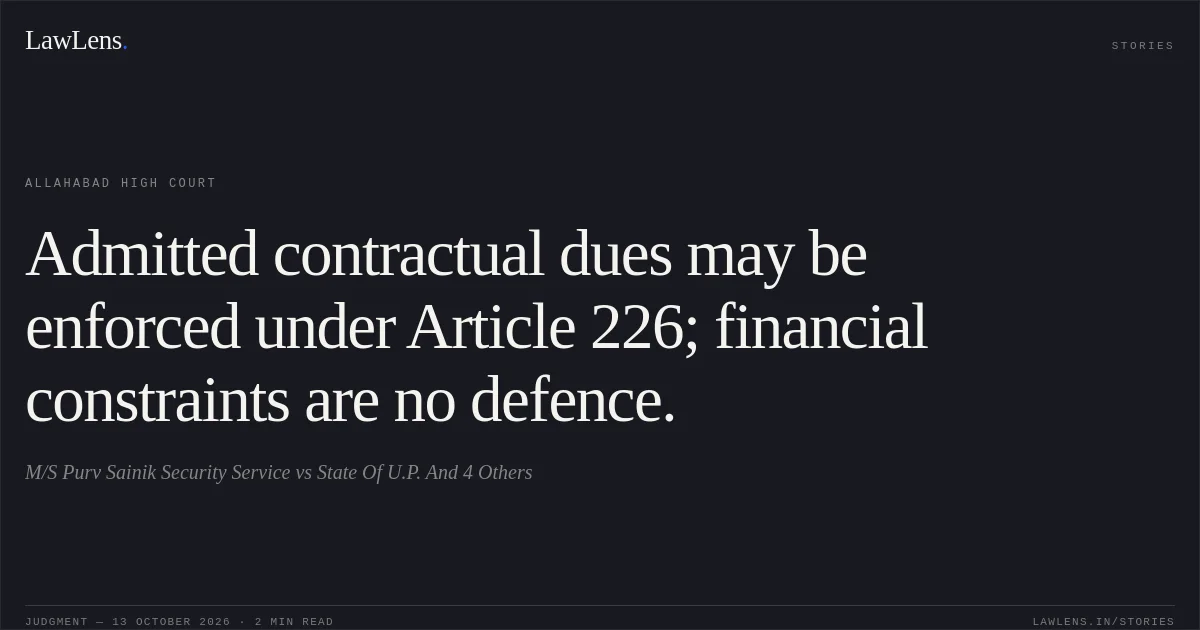
Respondent No. 5 engaged the petitioner to provide security services from 16 October 2018 until 31 May 2021; the petitioner claimed that Rs. 18,59,197 remained unpaid, in addition to a Rs. 20,000 security deposit.
Source reference: paras. 26.2–30Respondent No. 5 admitted both the petitioner’s performance and the outstanding contractual dues, but stated that financial difficulties and lack of funds prevented payment.
Source reference: paras. 34–36The petitioner sought a mandamus for payment. At the hearing, respondent No. 5’s instructions again acknowledged the outstanding amount and the security deposit.
Source reference: paras. 37–38Issues
1. Whether the respondents could withhold admitted contractual dues on grounds of paucity of funds, financial constraints or administrative difficulties.
Source reference: para. 3(i)2. Whether a writ petition under Article 226 seeking payment of admitted contractual dues was maintainable and entertainable despite the contractual nature of the dispute and the availability of an alternative remedy.
Source reference: para. 3(ii)Law Applied
Article 226 confers plenary jurisdiction; the availability of an alternative remedy ordinarily bears on the High Court’s discretion to entertain a petition, but does not by itself make the petition not maintainable (Godrej Sara Lee Ltd. v. Excise and Taxation Officer-cum-Assessing Authority; Radha Krishan Industries v. State of Himachal Pradesh).
Source reference: paras. 6–7Contractual monetary claims are ordinarily unsuitable for writ adjudication where liability or quantum is genuinely disputed and requires detailed evidence (Bridge & Roof Co. (India) Ltd.; Hindustan Petroleum Corporation Ltd. v. Dolly Das; Kerala State Electricity Board v. Kurien E. Kalathil).
Source reference: paras. 10–12However, a writ may be maintained and entertained in an appropriate case involving a State or its instrumentality, including for monetary relief, particularly where dues are admitted and no extensive fact-finding is required (ABL International Ltd. v. Export Credit Guarantee Corporation of India Ltd.; Kanika Construction v. State of U.P.; M/s Utkal Highways Engineer and Contractors v. Chief General Manager).
Source reference: paras. 15–18The governing distinction is between admitted, readily ascertainable liability and disputed claims requiring a roving evidentiary inquiry.
Source reference: paras. 21–23Reasoning
The Court found that respondent No. 5 had expressly admitted the petitioner’s services and the outstanding liability of Rs. 18,59,197, and had also acknowledged the Rs. 20,000 security deposit; no detailed evidentiary inquiry was therefore needed.
Source reference: paras. 34–38The claim fell within the recognised exception for admitted contractual dues, making the petition both maintainable and appropriate for consideration under Article 226.
Source reference: para. 46The respondents’ stated financial difficulties did not provide a legally sustainable basis to retain payment for services received.
Source reference: paras. 39–42Holding
The Court held that the writ petition was maintainable and entertainable because the contractual liability was unequivocally admitted and its determination required no roving inquiry.
It directed respondent No. 5 to pay Rs. 18,79,197, comprising the admitted dues and security deposit, with interest, within three months; interest at 6% per annum was to accrue until payment.
Source reference: paras. 38, 47–48The writ petition was allowed, with no order as to costs.
Source reference: para. 49Acts & Sections Cited
1 provisions across 1 statute referred to in this judgment. Each provision opens on LawLens.
Code of Civil Procedure, 19081
Original Court PDF
M/S Purv Sainik Security ServicevsState Of U.P. And 4 Others
Click to open original judgment
Original judgment, available to read, download and summarize on LawLens.in