Facts
The informant alleged that, following a dispute over land in Bihta and the restoration of possession to him, the petitioners threatened to obstruct construction of a boundary wall and committed other offences.
Source reference: p. 2–7The FIR was registered as Bihta P.S. Case No. 284 of 2012.
Source reference: p. 2–7Although it initially alleged offences including extortion, criminal intimidation and theft, the police filed a charge-sheet against the petitioners only under Section 504 IPC.
Source reference: p. 2–7The Magistrate took cognizance of that offence on 18 October 2016.
Source reference: p. 2–7The petitioners sought to quash the cognizance order, principally arguing that it was barred by the one-year limitation under Section 468 CrPC because cognizance was taken more than four years after the alleged occurrence.
Source reference: p. 2–7The informant maintained that the FIR had been filed within time and that the land dispute did not negate the alleged criminal conduct.
Source reference: p. 2–7Issues
1. Whether cognizance of the offence under Section 504 IPC was barred by limitation under Section 468 CrPC because the Magistrate took cognizance more than one year after the alleged occurrence.
Source reference: pp. 4, 7–82. Whether the allegations and materials warranted quashing the cognizance order in the exercise of the High Court’s jurisdiction.
Source reference: pp. 7–9Law Applied
Section 504 IPC criminalises intentional insult of a kind intended or known to be likely to provoke a breach of the peace, and carries a maximum sentence of one year; Section 468 CrPC bars cognizance after the prescribed limitation period.
Source reference: p. 7Relying on Sarah Mathew v. Institute of Cardio Vascular Diseases, (2014) 2 SCC 62, the Court stated that the relevant date for limitation is the date of filing the complaint or FIR, rather than the date on which the Magistrate takes cognizance.
Source reference: p. 7The Court also considered whether the allegations and investigation materials disclosed a prima facie basis to proceed, rather than undertaking a mini-trial on the parties’ competing versions.
Source reference: pp. 8–9Reasoning
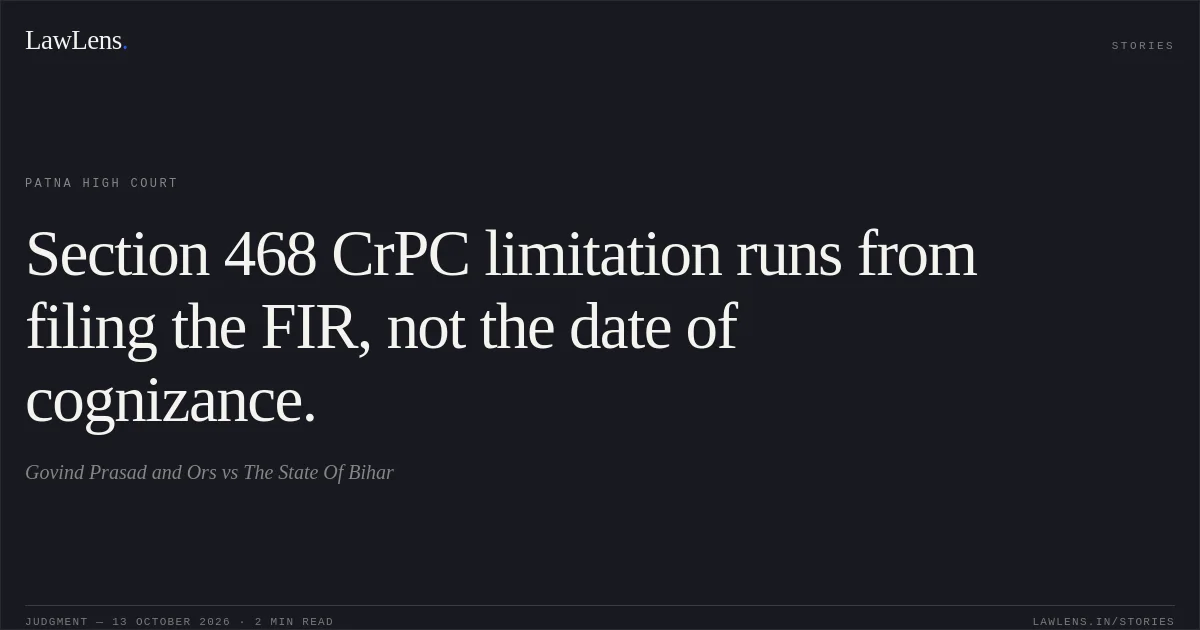
The Court rejected the limitation objection because the FIR was filed on 6 September 2012, the date it identified as the date of the incident; the Magistrate’s later action did not make the prosecution time-barred under the principle in Sarah Mathew.
Source reference: p. 7It also treated the land dispute as distinct from the alleged conduct, noting the informant’s asserted title and formal restoration of possession, and concluded that alleged threats and obstruction of boundary-wall construction could constitute a separate criminal act.
Source reference: p. 7Although the police had dropped the more serious allegations, the Court considered the charge-sheet’s retention of Section 504 IPC sufficient to disclose a prima facie case.
Source reference: pp. 8–9It further noted that the petitioners’ counter-case had been quashed, treating that circumstance as weakening their position.
Source reference: pp. 8–9Holding
The Court held that the limitation objection failed and found no basis to interfere with the cognizance order.
It dismissed the application to quash the order dated 18 October 2016, taking cognizance under Section 504 IPC in Bihta P.S. Case No. 284 of 2012.
Source reference: p. 9Acts & Sections Cited
9 provisions across 2 statutes referred to in this judgment. Each provision opens on LawLens.
Indian Penal Code, 18607
Code of Criminal Procedure, 19732
Original Court PDF
Govind Prasad and OrsvsThe State Of Bihar
Click to open original judgment
Original judgment, available to read, download and summarize on LawLens.in
![Pension must be recalculated on the Passenger Attendant Grade-I scale, not merely the Group-C Porter scale.. DINESHWAR PRASAD TIWARI vs NORTH CENTRAL RAILWAY. CAT - ['Allahabad']. LawLens](/stories/thumbnails/pension-must-be-recalculated-on-the-passenger-attendant-grade-i-scale-not-merely-the-group-97c58c85243d433bb520084af94a02bd.webp)
![Delayed IPR filing cannot independently disqualify an employee from promotion absent an applicable rule.. Bhupendra Kumar vs DELHI DEVELOPMENT AUTHORITY. CAT - ['Delhi']. LawLens](/stories/thumbnails/delayed-ipr-filing-cannot-independently-disqualify-an-employee-from-promotion-absent-an-ap-da80816741284e10afeaa1e45c382f9b.webp)