Facts
The Respondent (plaintiff) filed a civil suit for specific performance against the Petitioners (defendants) based on a contract dated 26.07.2022.
Source reference: para. 2Initially, the defendants were sued in their individual capacities. However, Defendant No. 2 suffers from 45% mental disablement.
Source reference: para. 2The defendants filed an application under Order 7 Rule 11 of the CPC for rejection of the plaint, arguing the suit was unmaintainable without a next friend for Defendant No. 2.
Source reference: para. 2Concurrently, the Respondent filed applications under Order 32 Rule 3 and Order 6 Rule 17 of the CPC to appoint Defendant No. 1 (the father) as the next friend of Defendant No. 2 and to amend the plaint.
Source reference: para. 4The Trial Court allowed the Respondent’s applications and dismissed the Petitioners' application under Order 7 Rule 11.
Source reference: para. 1The Petitioners challenged this order via a writ petition under Article 227 of the Constitution.
Source reference: para. 1Issues
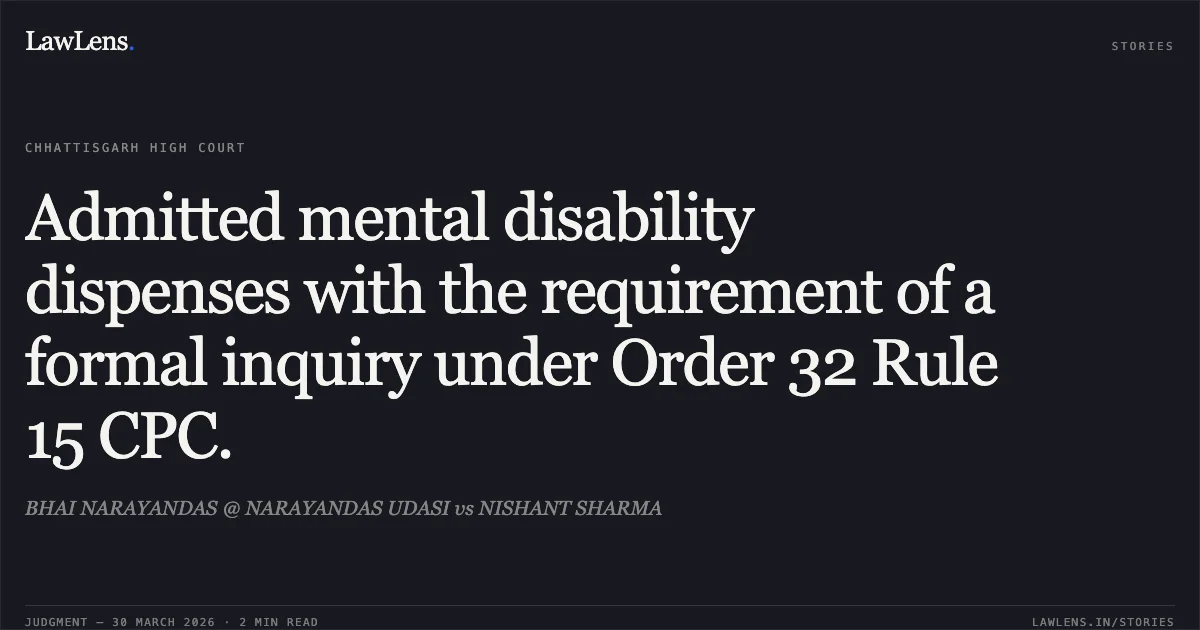
1. Whether the Trial Court was mandated to hold a formal inquiry under Order 32 Rule 15 of the CPC before appointing a next friend when the disability was admitted by the defendants themselves.
Source reference: para. 42. Whether the initial failure to sue a mentally disabled person through a next friend constitutes a non-curable defect necessitating the rejection of the plaint under Order 7 Rule 11 of the CPC.
Source reference: para. 5Law Applied
Order 32 Rule 3 of the CPC regarding the appointment of a guardian ad litem for a minor or person of unsound mind.
Source reference: para. 4Order 32 Rule 15 of the CPC, which extends these protections to persons who, though not adjudged to be of unsound mind, are found by the Court on inquiry to be incapable of protecting their interests.
Source reference: para. 4Order 7 Rule 11 of the CPC regarding the rejection of a plaint and the supervisory jurisdiction of High Courts under Article 227 of the Constitution.
Source reference: para. 1, 5Reasoning
The primary purpose of an inquiry under Order 32 Rule 15 of the CPC is to ascertain the mental status of a party to ensure their interests are protected.
Source reference: para. 4In this case, the defendants themselves averred in their Order 7 Rule 11 application that Defendant No. 2 was 45% mentally disabled and unable to understand court proceedings, supporting this with a medical certificate.
Source reference: para. 4The Court held that when the disability is admitted by the parties and supported by their own documentation, a separate formal inquiry by the Trial Court is unnecessary, as no prejudice is caused.
Source reference: para. 4Regarding the Order 7 Rule 11 application, the Court found that once the Trial Court appointed Defendant No. 1 (the father) as the next friend, the procedural defect was cured.
Source reference: para. 5Therefore, the suit could proceed, and there was no ground to reject the plaint.
Source reference: para. 5Holding
The High Court dismissed the writ petition, affirming the Trial Court's order.
It held that the appointment of the next friend was proper given the admitted mental disability and that such a procedural defect does not warrant the rejection of the plaint once a legal guardian is appointed to defend the suit.
Source reference: para. 4-5No perversity or illegality was found in the lower court's exercise of jurisdiction.
Source reference: para. 5Acts & Sections Cited
4 provisions across 1 statute referred to in this judgment. Each provision opens on LawLens.
Code of Civil Procedure, 19084
Original Court PDF
BHAI NARAYANDAS @ NARAYANDAS UDASIvsNISHANT SHARMA
Click to open original judgment
Original judgment, available to read, download and summarize on LawLens.in