Facts
The petitioner (accused) sought to set aside concurrent judgments of conviction under Section 138 of the Negotiable Instruments (NI) Act passed by the Trial Magistrate and the First Appellate Court
Source reference: para 2, 9The complainant alleged that the accused borrowed ₹7,00,000 in October 2018 and issued a cheque (Ex.P.1) for repayment, which was dishonored for "Funds Insufficient"
Source reference: para 3.1, 3.2A statutory notice was served on the accused, but she neither replied nor complied
Source reference: para 3.3The accused, a school teacher, admitted her signature on the cheque but contended she borrowed only ₹1,00,000 and that the complainant misused a blank security cheque by filling in ₹7,00,000
Source reference: para 11, 16, 17Issues
1. Whether the Trial Court was justified in raising the statutory presumption under Section 139 of the NI Act when the accused pleaded that the instrument was inchoate under Section 20
Source reference: para 21, 322. Whether the oral testimony of the accused and her husband was sufficient to rebut the presumption of a legally recoverable debt
Source reference: para 40, 413. Whether the High Court, in its revisional jurisdiction, should interfere with the concurrent findings regarding the complainant’s lending capacity
Source reference: para 42, 44Law Applied
The court applied Sections 20, 118, 138, and 139 of the Negotiable Instruments Act
Source reference: para 20, 26, 27Section 118 presumes that every negotiable instrument was made for consideration, while Section 139 mandates a presumption that the holder received the cheque for the discharge of a debt or liability
Source reference: para 26-28The court relied on Rangappa v. Mohan and Rajesh Jain v. Ajay Singh, which established that once the signature on a cheque is admitted, the presumption shifts the evidential burden to the accused to prove the non-existence of debt by a preponderance of probabilities
Source reference: para 33, 43It further cited Sanjabij Tari v. Kishore S. Borcar, affirming that revisional courts should not upset concurrent factual findings absent perversity
Source reference: para 44Reasoning
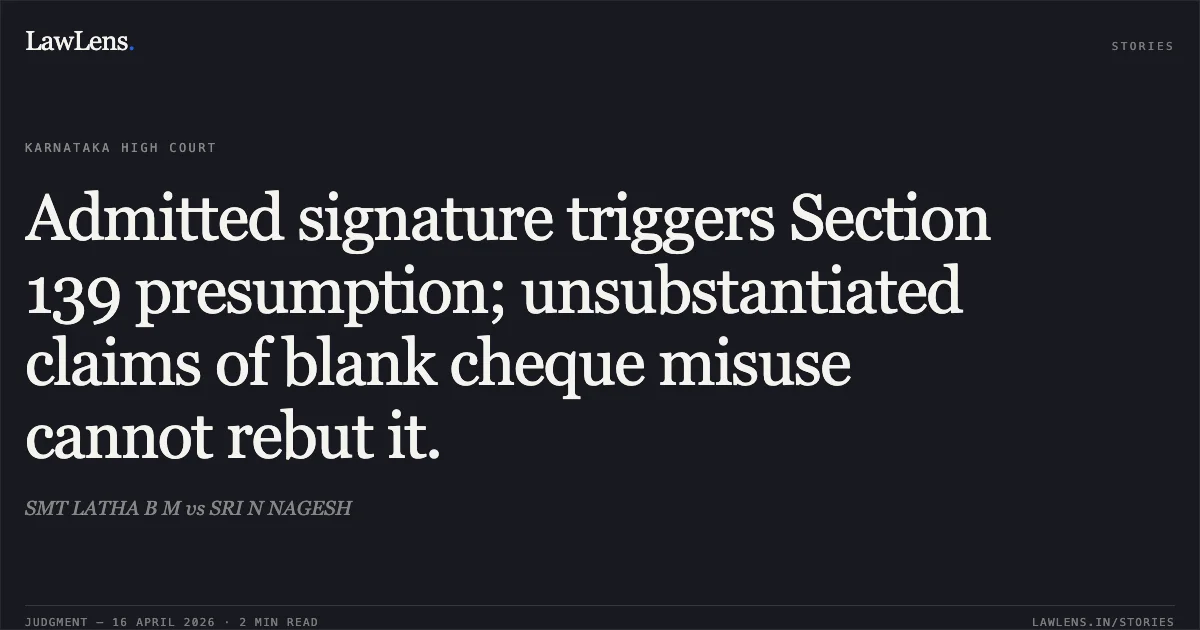
The court found that since the accused admitted her signature on Ex.P.1, the trial court correctly invoked the statutory presumption under Section 139
Source reference: para 16, 29, 32The burden of proof shifted to the accused to provide rebuttal evidence
Source reference: para 29The court noted that the accused (a teacher) and her husband (an Income Tax employee) failed to reply to the statutory notice despite service, which weakened their defense
Source reference: para 35-39The court characterized the defense of "misuse of a blank cheque" as "illusory and moonshine" because the accused took no legal action against the complainant for the alleged fraud
Source reference: para 41Following the ratio in Rajesh Jain, the court held that the focus must remain on the accused's failure to discharge the evidential burden rather than questioning the complainant's lending capacity once the foundational facts (signature and issuance) were established
Source reference: para 43, 45Holding
The court answered the issues in the negative, holding that the accused failed to rebut the statutory presumption with cogent evidence
The High Court found no jurisdictional error or perversity in the lower courts' findings
Source reference: para 46The revision petition was dismissed, and the orders of conviction and sentence (including the fine of ₹8,05,000) were confirmed
Source reference: para 7, 47Acts & Sections Cited
9 provisions across 3 statutes referred to in this judgment. Each provision opens on LawLens.
Negotiable Instruments Act, 18814
Code of Criminal Procedure, 19734
Bharatiya Nagarik Suraksha Sanhita, 20231
Original Court PDF
SMT LATHA B MvsSRI N NAGESH
Click to open original judgment
Original judgment, available to read, download and summarize on LawLens.in