01Facts
The petitioner was given in adoption to Smt. Renuka Bhandari under a registered adoption deed executed on 01.02.2017.
¶ 7At that time, Smt. Bhandari was an Assistant Teacher. She died in harness three years later.
¶ 7The petitioner applied for appointment on compassionate grounds and sought release of terminal benefits.
¶ 3.1The authorities rejected the claim on the ground that an adopted child is not entitled to compassionate appointment under the Karnataka Civil Service (Appointment on Compassionate Grounds) Rules, 1996 ("the Rules").
¶ 3.2, 8The Karnataka State Administrative Tribunal, Belagavi, upheld the rejection by order dated 26.02.2026, holding that the Rules in force on the date of death did not permit adopted children to seek such appointment.
¶ 3.2 · p. 4The petitioner challenged that order under Articles 226 and 227.
The parties did not dispute that the application was submitted in accordance with law.
¶ 1002Issues
i.1. Whether the Tribunal erred in rejecting the petitioner's claim for compassionate appointment solely on the ground that she is an adopted child.
¶ 4 · ¶ 8ii.2. Whether the Rules in force on the date of death, which excluded adopted children, govern the claim, or whether the subsequent amendment to the Rules dated 09.04.2021 and the binding Division Bench view in Girish apply.
¶ 9 · ¶ 1003Law Applied
Rule 3(3) of the Rules, as interpreted by co-ordinate Benches, under which adopted children were held eligible for consideration if the application was otherwise compliant.
¶ 4 · ¶ 9Girish v. State of Karnataka, W.A. No. 100362 of 2022 (decided 04.11.2022), holds that the object of compassionate appointment is to relieve financial distress caused by the death of the earning member.
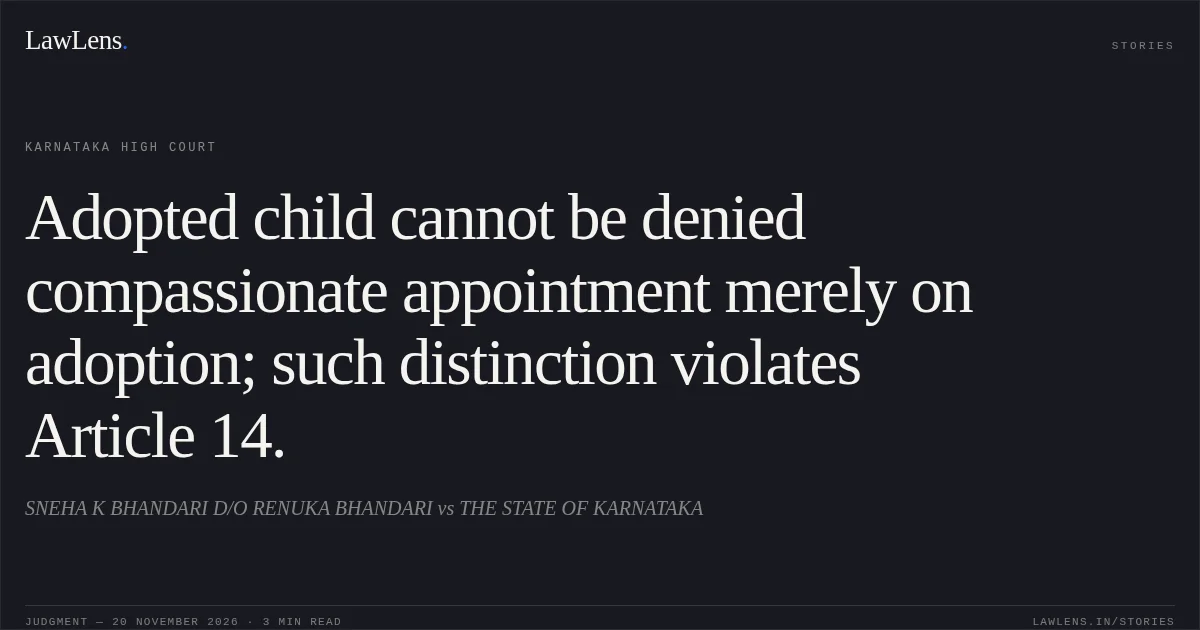
¶ 10, quoting Girish · ¶ 12–13Girish holds that any distinction between natural and adopted children is artificial and violates Article 14 of the Constitution.
¶ 10, quoting Girish · ¶ 15Girish holds that the rules applicable on the date of application, which is the date the artificial distinction would otherwise apply, cannot be used to deny consideration.
¶ 10, quoting Girish · ¶ 16The 09.04.2021 amendment to the Rules removed the distinction between natural and adopted children, as recorded in Girish.
¶ 10, quoting Girish · ¶ 7, 15The single-Bench decision in W.P. No. 211068/2020 (23.02.2022), cited in Girish, was relied upon.
¶ 10, quoting Girish · ¶ 704Reasoning
The facts, including the 2017 adoption, the death in harness, and the timely and compliant application, were undisputed.
¶ 7, 10The sole ground for rejection was adoption status, which the Tribunal upheld because the Rules in force on the date of death excluded adopted children.
¶ 8The Court held that this reasoning could not stand in light of Girish, which treated the adoptive relationship as equivalent to a natural one and rejected the State's reliance on the earlier Rules.
¶ 10Because the petitioner's claim was otherwise compliant and the only objection was the invalid distinction, the Tribunal's order was unsustainable.
¶ 10The Court did not decide on the merits of the petitioner's financial need or eligibility, and directed fresh consideration, leaving those questions to the authorities.
¶ 11(iii)05Holding
1. The Tribunal erred in rejecting the claim solely because the petitioner is an adopted child.
¶ 102. Following Girish, the artificial distinction cannot govern the claim, and the State's reliance on the pre-amendment Rules is rejected.
¶ 10The writ petition is allowed and the Tribunal's order is set aside.
¶ 11(i)–(ii)The State must consider the petitioner's claim for compassionate appointment if she is otherwise eligible, without relying on her adoption status, within eight weeks of receiving a copy of the order.
¶ 11(iii)–(iv)Original Court PDF
SNEHA K BHANDARI D/O RENUKA BHANDARIvsTHE STATE OF KARNATAKA
Click to open original judgment
Original judgment, available to read, download and summarize on LawLens.in