Facts
The Appellant (Plaintiff) filed a suit for declaration and possession of immovable properties belonging to the deceased, Bhovanbhai.
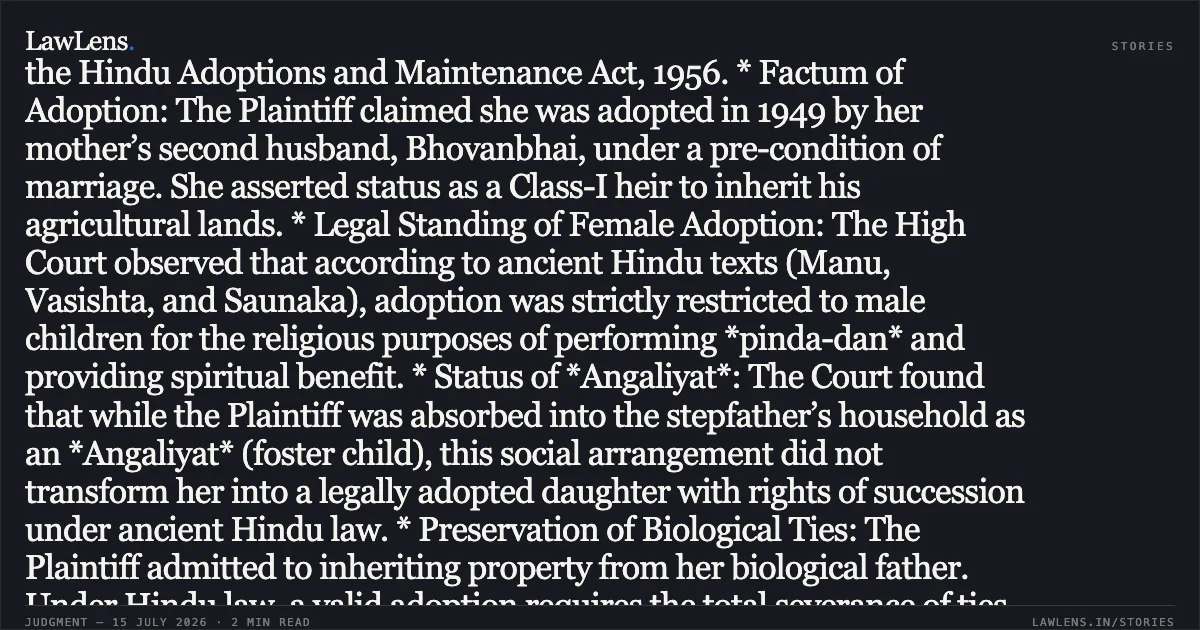
Source reference: para 3The Appellant’s mother, Maniben, married Bhovanbhai as his second wife in 1949, bringing the Appellant (then six months old) from her previous marriage as an Angaliyat child.
Source reference: para 3.1The Appellant claimed she was legally adopted by Bhovanbhai per a pre-marriage agreement.
Source reference: para 3.1The Respondents (Defendants), who are the brother’s son and grandsons of the deceased, claimed ownership based on a registered Will and argued that ancient Hindu law did not recognize the adoption of a female child.
Source reference: para 3.3, 6The Trial Court dismissed the suit, holding the adoption invalid under Shastric law despite the long cohabitation.
Source reference: para 4Issues
1. Whether, prior to the enactment of the Hindu Adoptions and Maintenance Act, 1956, it was legally permissible to adopt a daughter under ancient Hindu Law?
Source reference: para 7, 112. Whether the Plaintiff proved her status as a legally adopted daughter entitled to inherit as a Class-I heir?
Source reference: para 4, 113. Whether the entry of the Appellant's name in revenue records created a legal title in her favor?
Source reference: para 24Law Applied
Shastric/Ancient Hindu Law texts, including the works of Manu, Vasishta, and the treatises Dattaka Mimamsa and Dattaka Chandrika, which establish that the object of adoption was to provide a "substitute for a son" for spiritual benefits (pind-dan) and lineage.
Source reference: paras 12, 14, 16Amarendra Mansingh v. Sanatan Singh [AIR 1933 PC 155] to emphasize that the essence of adoption was the spiritual necessity of a male child.
Source reference: para 22The principle that revenue entries do not confer title in the absence of a valid legal document or valid adoption, as seen in The Special Secretary (Appeals), Revenue Department v. Boricha Ashokbhai Palabhai [LPA No. 1217 of 2023].
Source reference: para 25Reasoning
The Court observed that under ancient Hindu Law (pre-1956), adoption was strictly restricted to male children to satisfy religious obligations toward ancestors.
Source reference: paras 12, 18The Appellant was characterized as an Angaliyat (a child taken to a stepfather's home), which at most conferred the status of a "foster child" but lacked the legal status of an "adopted daughter" since the law then did not permit female adoption.
Source reference: paras 19, 20The Court further noted that the Appellant failed to prove she had renounced her biological family, as she admitted to receiving an inheritance from her biological father, which is inconsistent with the legal effect of a valid adoption.
Source reference: para 26The Court held that mutation entries in revenue records made on the mistaken theory of adoption were insufficient to create property rights in the absence of a valid legal foundation.
Source reference: paras 24, 25Holding
The High Court answered the issues in the negative, holding that the adoption of a female child was not recognized under Hindu Law prior to 1956.
The Court upheld the Trial Court’s judgment, dismissed the First Appeal, and vacated all interim reliefs.
Source reference: para 29Acts & Sections Cited
2 provisions across 2 statutes referred to in this judgment. Each provision opens on LawLens.
Code of Civil Procedure, 19081
Hindu Succession Act, 19561
Original Court PDF
HIRUBEN PPARBATBHAI SATASIYAvsBHAGWANJIBHAI POPATBHAI RANPARIA
Click to open original judgment
Original judgment, available to read, download and summarize on LawLens.in