Facts
Following a search operation under Section 132 of the Income Tax Act, 1961 on September 20, 2001, the assessee initially disclosed an undisclosed income of ₹30 Lacs, later revised to ₹25 Lacs and then ₹14.15 Lacs in the return of income.
Source reference: p. 5-7The Assessing Officer (AO) determined the undisclosed investment in the assessee’s house at ₹44.20 Lacs based on a ₹1 Crore valuation found in an insurance application.
Source reference: p. 9The AO also made additions of ₹26.21 Lacs for unaccounted cash receipts found in a diary and ₹3.82 Lacs for unexplained Fixed Deposit Receipts (FDRs).
Source reference: p. 10-12The CIT(A) reduced the house investment addition to ₹22.10 Lacs and granted the benefit of "telescoping" (offsetting cash receipts against investments).
Source reference: p. 13The ITAT subsequently increased the house investment value to ₹85 Lacs, sustained the cash receipt addition of ₹26.21 Lacs, and revoked the telescoping benefit.
Source reference: p. 15-18Issues
1. Whether the ITAT was legally correct in determining the investment in the house at ₹85 Lacs and undisclosed investment at ₹55.868 Lacs?
Source reference: p. 2, Question 12. Whether the addition of ₹26,21,100 on account of unexplained cash receipts was sustainable?
Source reference: p. 2, Question 23. Whether the ITAT was right in denying the benefit of telescoping to the appellant?
Source reference: p. 3, Question 34. Whether the addition of ₹82,567 as unexplained investment in FDR was legally valid?
Source reference: p. 3, Question 4Law Applied
The court applied the provisions of the Income Tax Act, 1961, specifically Section 132 (search and seizure) and Section 158BC (block assessment).
Source reference: p. 5It relied on the principle that additions to income must be based on cogent evidence rather than arbitrary estimates.
Source reference: p. 40The doctrine of telescoping was considered, which allows an assessee to argue that undisclosed income from one source (e.g., cash receipts) was utilized to fund an undisclosed investment (e.g., house construction), provided there is a verifiable nexus in timing and substance between the two.
Source reference: p. 37Reasoning
Regarding Issue 1, the Court found the ITAT’s valuation of ₹85 Lacs for the house to be arbitrary. While the AO relied on an inflated insurance proposal and the ITAT on a mid-point estimate, the Court held that the assessee's own admission in an affidavit of ₹70 Lacs was the most reasonable basis, as the Revenue failed to provide concrete evidence for a higher valuation.
Source reference: p. 40-41Regarding Issue 2, the Court sustained the addition of ₹26.21 Lacs because the assessee failed to provide evidence (like hostel books) to prove the cash was merely held for "safe custody".
Source reference: p. 21-22, 42On Issue 3, the Court denied telescoping because the assessee failed to establish a temporal link; the house was built years before the search, whereas the cash receipts were found during the search period.
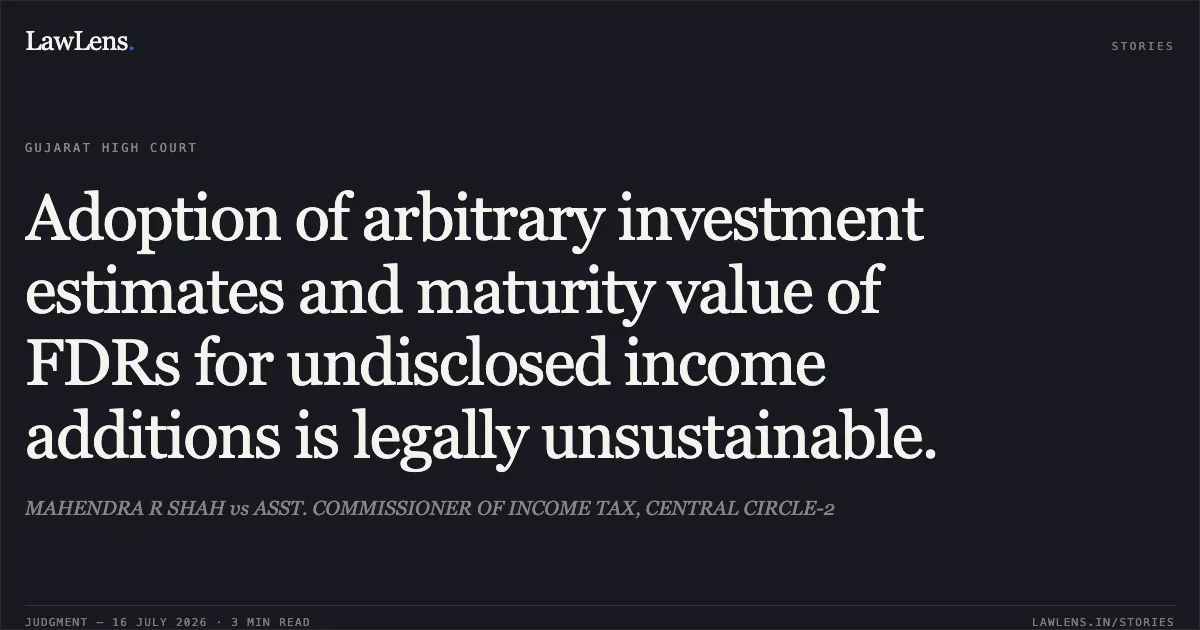
Source reference: p. 37-38Lastly, on Issue 4, the Court found a factual error in the FDR calculation: the authorities taxed the maturity value (₹82,567) instead of the actual initial investment (₹40,665), which is the only portion that constitutes "undisclosed investment".
Source reference: p. 43-44Holding
The High Court partly allowed the appeals. Questions 1 and 4 were answered in favor of the assessee; Questions 2 and 3 were answered in favor of the Revenue.
The house investment value is fixed at ₹70 Lacs, resulting in a modified addition of ₹23,19,308; the addition of ₹26,21,000 for unexplained cash is sustained; the benefit of telescoping is denied; and the FDR addition is reduced from the maturity value to the actual investment amount of ₹40,665.
Source reference: p. 39, 41-44Acts & Sections Cited
5 provisions across 1 statute referred to in this judgment. Linked provisions open on LawLens.
Income Tax Act, 19615
Original Court PDF
MAHENDRA R SHAHvsASST. COMMISSIONER OF INCOME TAX, CENTRAL CIRCLE-2
Click to open original judgment
Original judgment, available to read, download and summarize on LawLens.in