Facts
The deceased, Toran Suresh Punamiya, travelled to Sikkim with her husband, Suresh Punamiya, and their two minor children.
Source reference: p.2, para.4The vehicle in which they were travelling, insured by the Appellant, fell approximately 700 feet from a cliff near Lachung, North Sikkim, causing the instantaneous death of all four occupants.
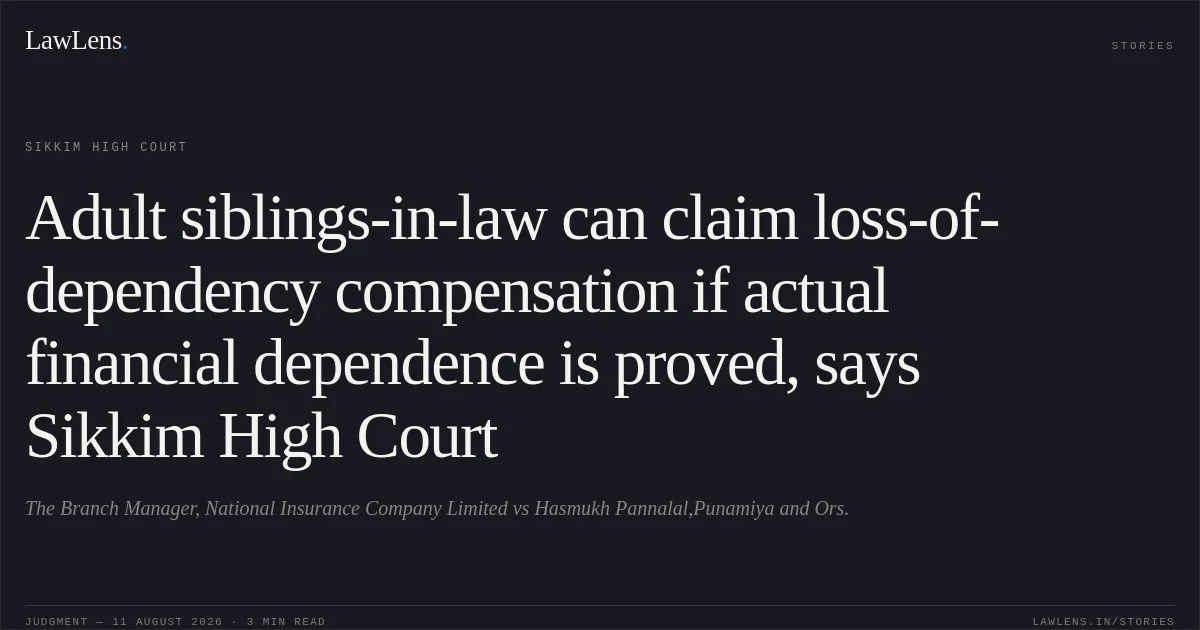
Source reference: p.2, para.4The Respondent-Claimants, who were siblings of the deceased’s husband and thus the deceased’s brothers-in-law and sister-in-law, filed a claim under Section 166 of the Motor Vehicles Act, 1988, asserting financial dependency upon the income generated by the deceased and her husband’s jointly conducted business.
Source reference: p.2, paras.3–5; p.6, para.12The Motor Accident Claims Tribunal awarded ₹85,59,880 with interest at 6% per annum from the date of filing of the claim petition.
Source reference: p.2, para.2The insurer appealed, contending that the adult Claimants were not dependents and that they had inherited or continued the deceased’s business, thereby suffering no actual dependency loss.
Source reference: p.3, para.6Issues
Whether the Respondent-Claimants, although not the immediate legal heirs of the deceased, were “legal representatives” entitled to maintain a claim under Section 166 of the Motor Vehicles Act, 1988.
Source reference: p.4, paras.8–11Whether the Claimants established financial dependency upon the deceased so as to claim compensation under the head of loss of dependency.
Source reference: p.5, para.11; p.6, para.12Whether the alleged inheritance or continuation of the deceased’s business by the Claimants negated their claim for loss of dependency.
Source reference: p.3, para.6; p.6, para.12Whether, in the alternative, the Claimants could succeed to the deceased’s compensation claim by operation of the statutory presumption concerning simultaneous deaths under Section 21 of the Hindu Succession Act, 1956.
Source reference: p.7, paras.13–14Law Applied
Section 166 of the Motor Vehicles Act permits a “legal representative” of the deceased to maintain a compensation claim, and such representative need not necessarily be a legal heir in the strict sense.
Source reference: p.5, para.9The expression “legal representative” is to be construed broadly to include a person who represents the estate or suffers loss on account of the death; however, entitlement to compensation for loss of dependency depends upon proof of actual financial dependency and is a question of fact.
Source reference: p.5, paras.9–11The Court relied on Montford Brothers of St. Gabriel v. United India Insurance Co., Gujarat State Road Transport Corporation v. Ramanbhai Prabhathbhai, N. Jayasree v. Cholamandalam MS General Insurance Co. Ltd., and other authorities concerning legal representation and dependency.
Source reference: p.3, para.7; p.6, para.11Under Section 21 of the Hindu Succession Act, 1956, where it is uncertain which of two persons died first, the younger is presumed to have survived the elder for purposes affecting succession.
Source reference: p.7, para.13Sections 15 and 21 of the Hindu Succession Act were therefore relevant to the possible devolution of the deceased mother’s estate and compensation claim through her children to the present Claimants.
Source reference: p.5, para.10; p.7, paras.13–14Reasoning
The Court held that the Claimants fell within the broad expression “legal representatives” and could maintain the claim, even though they were not the deceased’s immediate legal heirs.
Source reference: p.5, paras.9–11On dependency, the Claimants specifically pleaded and supported through evidence that they depended upon the income from the business jointly conducted by the deceased and her husband.
Source reference: p.6, para.12The Income Tax Returns established that the business was the relevant source of income, while the insurer neither effectively cross-examined the Claimants on dependency nor produced evidence that they had independent income.
Source reference: p.6, para.12The insurer also failed to prove that the Claimants had inherited or continued the business after the accident.
Source reference: p.6, para.12In those circumstances, the Tribunal was justified in accepting the claim of dependency and applying the established principles for computing compensation.
Source reference: p.6, para.12Independently, the Court observed that Section 21 of the Hindu Succession Act could result in the deceased mother being presumed to have predeceased her children; the children would then have succeeded to her estate and compensation claim, which could subsequently devolve upon the Claimants.
Source reference: p.7, paras.13–14This provided an additional basis on which the Claimants could arguably have claimed compensation.
Source reference: p.7, paras.13–14Holding
The Court answered the principal questions in favour of the Claimants.
It held that they were competent legal representatives, that their financial dependency was sufficiently established, and that the insurer failed to prove either independent income or continuation of the deceased’s business by them.
Source reference: p.5, para.11; p.6, para.12Finding no reason to interfere with the Tribunal’s award of ₹85,59,880 with 6% annual interest, the Court dismissed the appeal.
Source reference: p.8, paras.15–16There was no order as to costs, and the Tribunal’s records were directed to be remitted forthwith.
Source reference: p.8, paras.17–18Acts & Sections Cited
3 provisions across 2 statutes referred to in this judgment. Each provision opens on LawLens.
Motor Vehicles Act, 19881
Hindu Succession Act, 19562
Original Court PDF
The Branch Manager, National Insurance Company LimitedvsHasmukh Pannalal,Punamiya and Ors.
Click to open original judgment
Original judgment, available to read, download and summarize on LawLens.in