01Facts
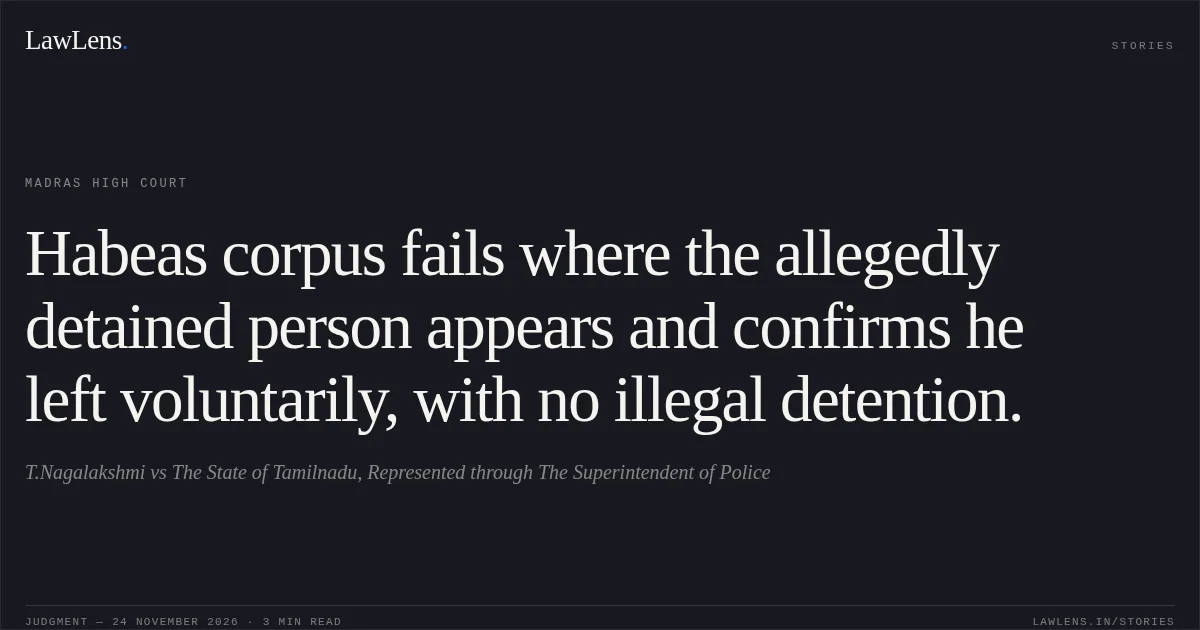
The petitioner, the mother of the detenue Kavya (a B.A. Sociology graduate of Rani Anna Women's College, Tirunelveli), sought production of her daughter under a habeas corpus prayer.
Kavya was reported missing on 16.09.2026, after the petitioner dropped her at an Anganwadi Centre at about 9.40 a.m. and returned at about 2.30 p.m. to find her and the two-wheeler (TN 76 BE 5046) gone.
¶ 2 · p. 2A missing-woman case was registered as Crime No. 325 of 2026 at Thiruvattar Police Station.
¶ 2 · p. 2The petitioner made a representation to the Superintendent of Police on 17.10.2026, and when Kavya was still not traced, filed the petition.
¶ 2 · p. 2Kavya appeared virtually with counsel, who stated that he is a transgender person working for transgender welfare.
¶ 3 · pp. 2–3 · ¶ 4 · p. 3Counsel stated that Kavya and her classmate Maharasi had earlier left home, were traced by Nagercoil Police, and were returned to their parents after separation.
¶ 4 · p. 3 · ¶ 5 · pp. 3–4They re-established contact in April 2026, left their homes on 16.09.2026, faced alleged threats, and have been sheltered at Urimaikural Trust, Chennai, for about one and a half months.
¶ 5 · pp. 3–4Earlier, on mention before the Principal Seat, oral directions had been issued for police protection to both women, and counsel stated there was no present threat.
¶ 7 · p. 4The Court interacted with Kavya, who confirmed that she was neither illegally nor forcibly detained and had left home voluntarily with Maharasi.
¶ 6 · p. 4The State (learned APP) reported that Kavya was traced at Selaiyur, Chennai, that she identifies as a transgender person, and that Maharasi is also a major, both being about 21 years old.
¶ 8 · pp. 4–502Issues
i.1. Whether the detenue, Kavya, is under illegal or forcible detention so as to warrant the relief of production and release sought in habeas corpus.
¶ 6 · p. 4 · ¶ 8 · pp. 4–5 · ¶ 9 · p. 5ii.2. Whether the court should interfere with the choice of an adult detenue to live with another adult of her choice, where she has voluntarily left her parental home.
¶ 8 · pp. 4–5 · ¶ 9 · p. 5iii.3. Whether any further orders, including protection or facilitation of parental contact, are required to dispose of the petition.
¶ 7 · p. 4 · ¶ 10 · p. 5 · ¶ 11 · p. 603Law Applied
The judgment does not cite any statutory provision, constitutional article, or precedent expressly.
The core habeas corpus principle that the writ lies only where the person is under illegal or forcible detention, which the Court tested by direct interaction with the detenue.
¶ 6 · p. 4 · ¶ 9 · p. 5The principle that a major is entitled to make her own life choices, including the choice of residence and companionship, which the Court treated as determinative where that choice is voluntary.
¶ 8 · pp. 4–5 · ¶ 9 · p. 5The State's obligation to protect persons at risk, as reflected in the oral directions for police protection.
¶ 7 · p. 404Reasoning
The Court first examined whether any detention existed. Kavya appeared in person through virtual mode, was interacted with directly, and confirmed that she was neither illegally nor forcibly detained and had left home voluntarily.
¶ 6 · p. 4The State's report that she was traced in Chennai and was living under the Trust's care was consistent with this.
¶ 8 · pp. 4–5Because the detenue herself disclaimed any restraint, the foundational requirement of illegal or forcible detention was absent, and the production relief in the petition could not be granted.
¶ 9 · p. 5The Court relied on the fact that both women are majors, aged about 21. It held that, as majors who have formed their own preferences, they are entitled to decide where and with whom to live, and found no basis to interfere with that choice.
¶ 8 · pp. 4–5 · ¶ 9 · p. 5On the third point, the Court noted that police protection had already been directed and that there was no present threat. To address the petitioner's wish to see her daughter, the Court recorded counsel's submission that she may approach Selaiyur Police Station for assistance or approach the Trust for a meeting.
¶ 7 · p. 4 · ¶ 10 · p. 5With no live grievance remaining, the Court found nothing further to adjudicate.
¶ 11 · p. 605Holding
The Court held that the detenue is neither under illegal nor forcible detention, is a major who has voluntarily chosen her life path, and that no ground exists to interfere with that choice or pass further orders.
¶ 9 · p. 5The petition was closed as nothing further survived for consideration. The petitioner was left free to meet her daughter through the Selaiyur Police Station or the Urimaikural Trust.
¶ 10 · p. 5 · ¶ 11 · p. 6The order directs the police protection already in place to continue, and the order was copied to the Superintendent of Police, Kanyakumari; the Inspector, Thiruvattar Police Station (Cr. No. 325/2026); and the Additional Public Prosecutor.
p. 7Original Court PDF
NagakanivsThe State of Tamilnadu
Click to open original judgment
Original judgment, available to read, download and summarize on LawLens.in