01Facts
The petitioner, wife of Thirumaran (aged 41, ex-serviceman), complained that he had been missing since 09.09.2026. They were married in 2011 and have three minor children. She alleged an illicit relationship, periodic UPI/Google Pay transfers to a suspected number, and an agricultural loan.
p. 2 · ¶ 1 of the quoted orderPolice registered CSR No. 476 of 2026 on 04.10.2026 but took no further action, and the petitioner filed a habeas corpus petition.
pp. 2–3 · ¶ 2–3The State stated the CSR was based on her complaint.
p. 3 · ¶ 4The Court directed the third respondent to file a detailed status report.
p. 3 · ¶ 5The status report disclosed that Thirumaran had contacted police on 17.11.2026 and submitted a digital video statement.
p. 3 · ¶ 2In the digital video statement, he stated that he had not gone missing, that his wife's family had tried to kill him for his money and property, that he had left voluntarily, and that he was working in Kolkata.
pp. 3–5He appeared virtually, confirmed the statement, said he had left his matrimonial home on his own volition due to marital discord and fear for his life, and confirmed he was not under illegal detention.
p. 5 · ¶ 4The petitioner's counsel produced photographs allegedly showing he was in a relationship with another woman.
pp. 5–6 · ¶ 502Issues
i.1. Whether the husband is under illegal detention so as to warrant the issue of a writ of habeas corpus.
p. 5 · ¶ 5 · p. 6 · ¶ 5ii.2. Whether the mutual allegations and counter-allegations between the spouses can be adjudicated within the habeas corpus proceedings.
p. 6 · ¶ 603Law Applied
The judgment cites no statute, rule, or precedent.
The writ of habeas corpus, invoked under the general (non-statutory) jurisdiction of the High Court, is directed at ascertaining whether a person is held in unlawful detention and securing his production before the court.
p. 1, prayer · p. 6 · ¶ 5The Court's inquiry turned on the factual question of whether the person is under detention, which it may determine by direct interaction with the person.
p. 5 · ¶ 4Disputes of a matrimonial or criminal nature are left to be pursued by the parties through remedies known to law.
p. 6 · ¶ 604Reasoning
The Court entertained the petition because the wife and minor children had no information about the husband's whereabouts, so its purpose was to confirm his safety and detention status.
p. 6 · ¶ 5The status report and the husband's virtual appearance resolved that inquiry: he confirmed the statement, explained that he had left voluntarily because of marital discord and fear for his life, and stated he was not under detention. On that basis, the Court held that the central question of illegal detention was answered in the negative.
p. 5 · ¶ 4 · p. 6 · ¶ 5The counter-allegations of assault, threats, murder plans, and the alleged illicit relationship were disputed factual matters outside the summary scope of habeas corpus, so the Court declined to adjudicate them and left them to the parties' remedies in law.
p. 6 · ¶ 6The photographs produced by the petitioner were noted but not examined. Because the detention question was resolved, the Court held that nothing further survived for adjudication.
pp. 5–6 · ¶ 5 · p. 6 · ¶ 705Holding
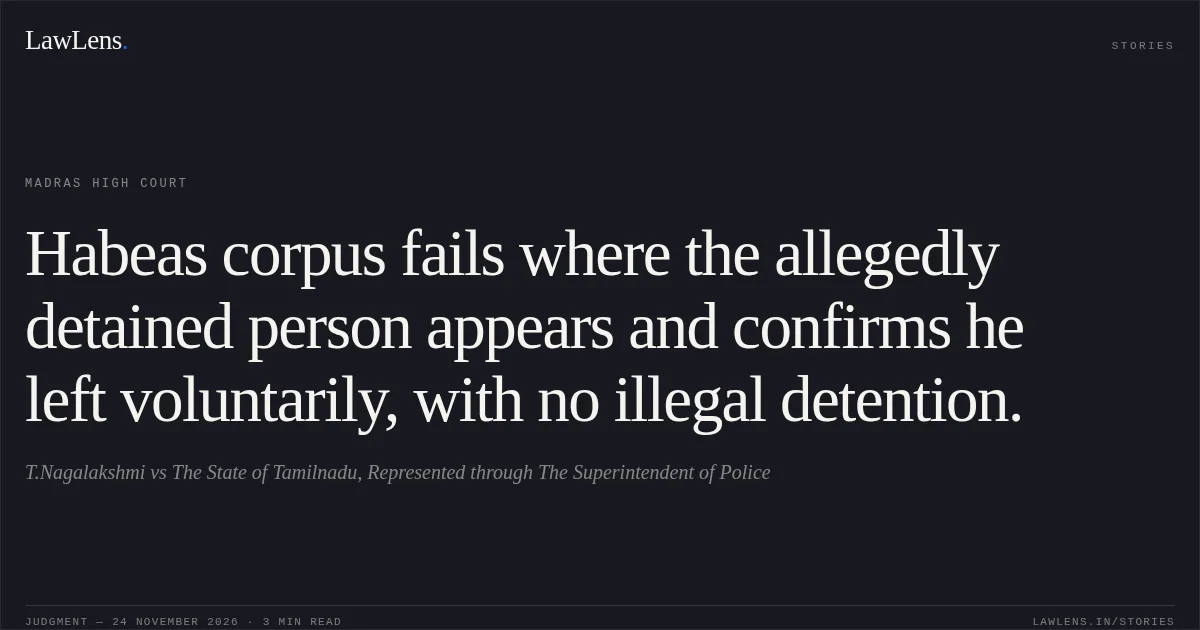
The Court held that the husband is not under illegal detention, having left his matrimonial home voluntarily, and that the habeas corpus petition therefore required no further adjudication.
p. 6 · ¶ 5, 7The allegations and counter-allegations between the spouses are to be pursued by the parties in the manner known to law.
p. 6 · ¶ 6The petition was closed with no further directions.
p. 6 · ¶ 7Original Court PDF
T.NagalakshmivsThe State of Tamilnadu, Represented through The Superintendent of Police
Click to open original judgment
Original judgment, available to read, download and summarize on LawLens.in