Facts
The petitioners sought protection of their life and personal liberty, stating that they had voluntarily lived together in a live-in relationship for three months and feared threats from private respondents opposed to their relationship.
Source reference: paras. 3–4, pp. 1–2The petitioners disclosed that their respective marriages were subsisting; petitioner no. 1 had three children living with the couple, while petitioner no. 2 stated that his wife and children lived separately and that he paid maintenance. They undertook to take steps to register their relationship under the Uniform Civil Code, Uttarakhand, and its Rules.
Source reference: paras. 3–4, pp. 1–2The Court confined its consideration to protection of life and personal liberty and did not adjudicate the validity of the marriages or related civil consequences.
Source reference: para. 5, p. 3Issues
Whether the petitioners, who stated that they were voluntarily living together, were entitled to protection of their life and personal liberty against apprehended threats.
Source reference: paras. 5–6, p. 3Whether the concerned police authorities should examine the petitioners’ representation, assess any threat, and take appropriate protective measures in accordance with law.
Source reference: para. 7, p. 3Law Applied
Relying on Lata Singh v. State of U.P. and Another, (2006) 5 SCC 475, the Court applied the principle that persons are entitled to protection of their life and personal liberty in accordance with law.
Source reference: para. 6, p. 3The Court’s determination was limited to such protection; it expressed no opinion on the validity of the petitioners’ marriages or the parties’ inter se rights.
Source reference: paras. 5, 7, pp. 3–4Reasoning
The petitioners were present before the Court and stated that their relationship and cohabitation were voluntary.
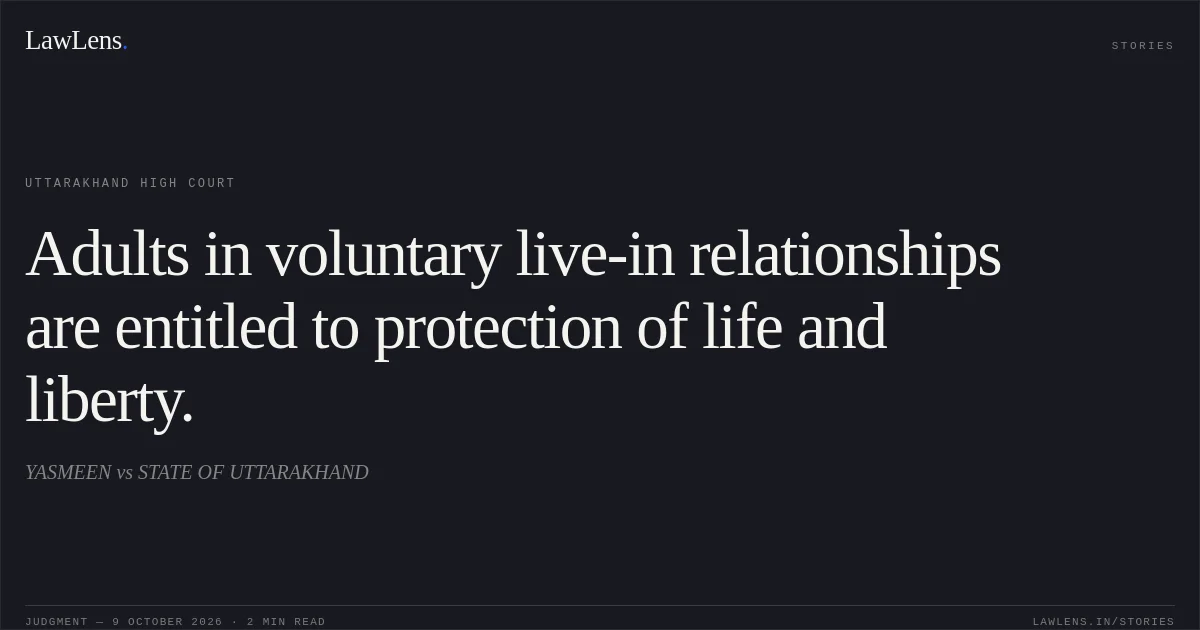
Source reference: para. 4, pp. 2–3Given their apprehension of threats, the Court held that they were entitled to protection of life and personal liberty under the principle in Lata Singh.
Source reference: paras. 3, 6, pp. 1, 3Rather than determine any matrimonial or civil issue, it directed the police to examine the representation and assess whether a real and imminent threat existed, with protective action to follow if warranted.
Source reference: paras. 5, 7, pp. 3–4Holding
The Court disposed of the writ petition, directing the Station House Officer, Police Station Gangnahar, Roorkee, District Haridwar, to examine the petitioners’ representation and assess the threat perception.
If a real and imminent threat is found, the police must take appropriate measures in accordance with law to protect the petitioners. The authorities must also ensure that no person takes the law into their own hands or unlawfully interferes with, intimidates, harasses, or coerces the petitioners on account of their relationship. The Court expressed no opinion on the validity of any marriage or the parties’ inter se rights.
Source reference: paras. 7–8, p. 4Original Court PDF
YASMEENvsSTATE OF UTTARAKHAND
Click to open original judgment
Original judgment, available to read, download and summarize on LawLens.in
![Former railway contract labourers must prove eligibility; absorption is not automatic.. K SATHYA vs SOUTH CENTRAL RAILWAY. CAT - ['Hyderabad']. LawLens](/stories/thumbnails/former-railway-contract-labourers-must-prove-eligibility-absorption-is-not-automatic-8492ee7facef4a47ad97c4fe0856acd2.webp)