Facts
Sobran Singh instituted a suit for declaration of title and permanent injunction, which was dismissed by the Trial Court on 22 August 2012.
Source reference: no citationHe applied for a certified copy on 7 September 2012, received it on 26 September 2012, and filed the first appeal on 30 January 2013, with a delay of 131 days.
Source reference: no citationAn application under Section 5 of the Limitation Act, 1963, was filed seeking condonation of delay.
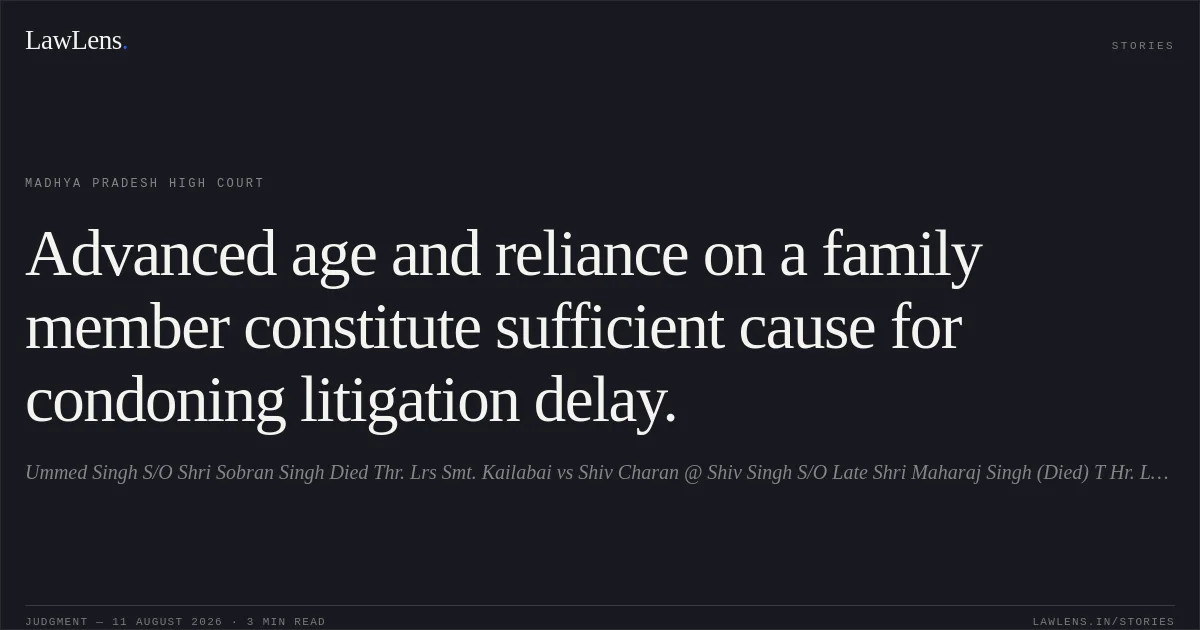
Source reference: no citationSobran Singh asserted that he was approximately 89 years old, suffering from paralysis, and dependent on his son, Ummed Singh, to conduct the litigation.
Source reference: no citationUmmed Singh allegedly remained in custody from 11 September 2012 to 25 October 2012, while the counsel was stated to have been indisposed from 21 October 2012 to 24 December 2012.
Source reference: no citationSobran Singh subsequently died during the pendency of the first appeal and was substituted by his legal representatives, who reiterated the explanation for delay in a further application dated 5 February 2021.
Source reference: para. 4–7The First Appellate Court rejected the applications under Section 5 on the ground that no documentary evidence had been produced to establish Ummed Singh’s confinement or the counsel’s illness, and consequently dismissed the first appeal as barred by limitation.
Source reference: para. 3, 7Issues
1. Whether the First Appellate Court erred in dismissing the appellants’ first appeal on the ground of limitation.
Source reference: para. 22. Whether the explanation relating to the advanced age and illness of Sobran Singh, the confinement of his son, and the illness of counsel constituted “sufficient cause” for condoning the 131-day delay under Section 5 of the Limitation Act, 1963.
Source reference: para. 5–7, 14–17Law Applied
The Court applied Section 5 of the Limitation Act, 1963, under which delay may be condoned where “sufficient cause” is established.
Source reference: no citationRelying on Ram Nath Sao v. Gobardhan Sao, (2002) 3 SCC 195, the Court held that “sufficient cause” must receive a liberal construction to advance substantial justice where negligence, inaction, or lack of bona fides is not attributable to the applicant; acceptance of the explanation should ordinarily be the rule and rejection the exception, while balancing the accrued rights of the opposite party.
Source reference: para. 12The Court further relied on S. Ganesharaju v. Narasamma, (2013) 11 SCC 341, which states that limitation rules are not intended to destroy substantive rights, that matters should ordinarily be decided on merits, and that delay should generally be condoned absent mala fides, negligence, or callousness.
Source reference: para. 13Reasoning
The Court found that Sobran Singh’s advanced age of approximately 89 years and his paralysis made it reasonable for him to depend upon his son to pursue the litigation.
Source reference: para. 15–16Although no documentary proof was produced regarding Ummed Singh’s custody or the counsel’s illness, the First Appellate Court adopted an unduly technical approach by rejecting the explanation solely for want of supporting documents.
Source reference: para. 16–17The Court emphasized that Sobran Singh had no apparent advantage in deliberately delaying the appeal and that the explanation had to be assessed in the context of his age, ill health, and dependence on his son.
Source reference: para. 16–17Applying the liberal and justice-oriented interpretation of “sufficient cause” laid down in Ram Nath Sao and S. Ganesharaju, the Court held that the appellants had acted with sufficient diligence and that the delay did not demonstrate mala fides or deliberate inaction.
Source reference: para. 12–17Holding
The Court answered the substantial question of law in favour of the appellants and held that the First Appellate Court erred in dismissing the appeal on limitation.
The judgment dated 11 February 2021 of the Fourth Additional District Judge, Gwalior, was set aside; the 131-day delay in filing the first appeal was condoned; and the matter was remanded to the First Appellate Court for adjudication on merits after issuing notice to the respondents.
Source reference: para. 17–18The lower-court record was directed to be returned forthwith.
Source reference: para. 19Acts & Sections Cited
1 provisions across 1 statute referred to in this judgment. Each provision opens on LawLens.
Limitation Act, 19631
Original Court PDF
Ummed Singh S/O Shri Sobran Singh Died Thr. Lrs Smt. KailabaivsShiv Charan @ Shiv Singh S/O Late Shri Maharaj Singh (Died) T Hr. Lrs Smt. Baikunthi Bai
Click to open original judgment
Original judgment, available to read, download and summarize on LawLens.in