Facts
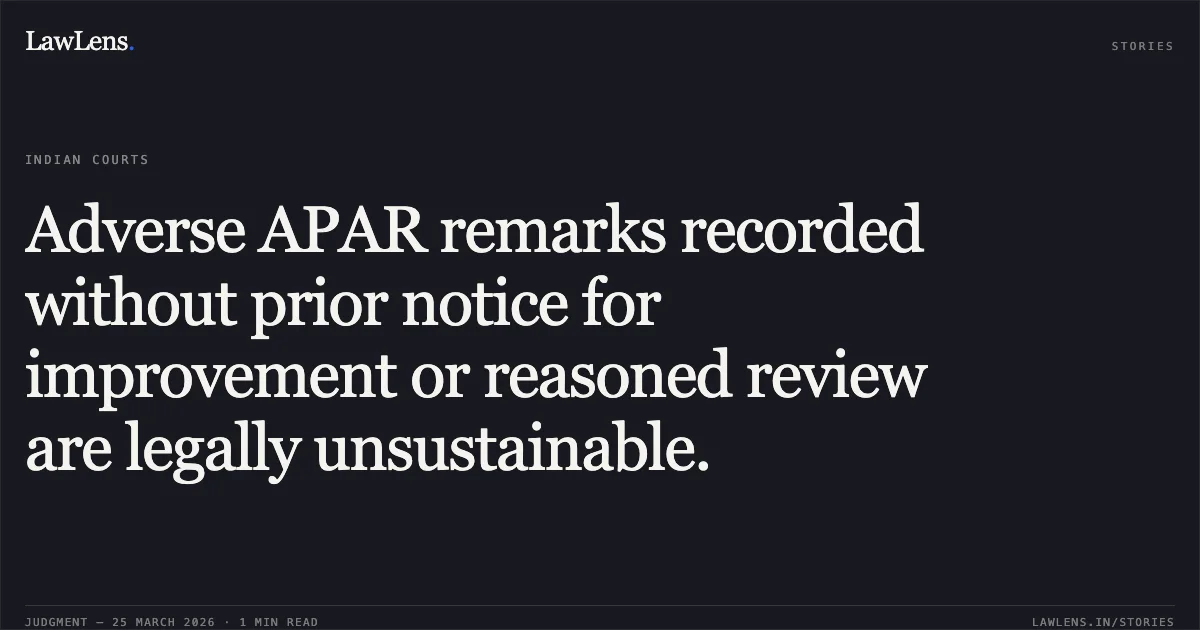
The applicant, a Sub-Inspector (Executive) in the Delhi Police, challenged the adverse remarks and "Below Average" grading recorded in his Annual Performance Appraisal Report (APAR) for the period from 01.04.2019 to 31.10.2019
Source reference: p. 2The Reporting Officer (RO) graded the applicant "Below Average" primarily citing the initiation of a Departmental Enquiry (DE) regarding pending investigation files
Source reference: p. 4-5, 11-12The Reviewing Officer (RevO) accepted this assessment by merely initialing the report without providing independent reasons
Source reference: p. 5, 22The applicant’s representation for upgradation was rejected by the Appellate Authority on 31.08.2021 (communicated on 01.09.2021), citing the DE and a subsequent temporary punishment of forfeiture of service
Source reference: p. 6-7The applicant contended that the remarks were arbitrary, lacked specific grounds for disagreement with his self-assessment, and violated principles of natural justice as no prior notice to improve was given
Source reference: p. 6, 16Issues
1. Whether the APAR grading and the subsequent rejection of the representation were legally sustainable given the lack of reasoning by the Reviewing Officer and the predetermined nature of the remarks
Source reference: p. 5, 16, 222. Whether the initiation of a Departmental Enquiry can be the sole basis for an adverse APAR grading without following the procedural requirement of providing an opportunity for improvement
Source reference: p. 16, 18Law Applied
DoPT Office Memorandum dated 14.05.2009, which mandates transparency and objectivity in APARs and requires the competent authority to decide representations based on material evidence within 30 days
Source reference: p. 13-15State of U.P. v. Yamuna Shankar Misra (1997), which established that the objective of ACRs is to allow public servants to improve and requires reporting officers to share information with the officer before recording adverse remarks
Source reference: p. 7-8, 18-19Sukhdev Singh v. Union of India (2013), affirming that every entry must be communicated to ensure natural justice
Source reference: p. 23Union of India v. G.R. Meghwal (2022), which emphasizes that rejection of representations against ACRs must contain valid reasons
Source reference: p. 8-10Reasoning
The Tribunal observed that the APAR was written with a "predetermined mind," as the RO’s remarks were based entirely on the initiation of a DE without specifying dates or details, treating the applicant as guilty before the conclusion of proceedings
Source reference: p. 16The Reviewing Officer failed to apply his mind, merely initialing the form without recording any reasons for accepting the RO’s assessment, which the Tribunal termed a "stereotyped copy" that violated settled law
Source reference: p. 22The court noted that the applicant had previously secured "Outstanding" and "Very Good" ratings, and the sudden drop to "Below Average" was unsupported by any record of prior warnings or guidance to improve efficiency
Source reference: p. 16Consequently, the failure to follow the 2009 DoPT OM and the lack of independent appraisal by the RevO rendered the process arbitrary and procedurally flawed
Source reference: p. 16, 22Holding
The Tribunal allowed the Original Application, quashing the appellate order dated 31.08.2021 and the APAR for the period 01.04.2019 to 31.10.2019
The court held that the impugned APAR shall not be taken into consideration for any future service conditions or career prospects of the applicant
Source reference: p. 24No order was made as to costs
Source reference: p. 24Acts & Sections Cited
13 provisions across 2 statutes referred to in this judgment. Each provision opens on LawLens.
Protection of Children from Sexual Offences Act, 20123
Original Court PDF
PRAMODH KUMARvsCOMMISSIONER OF POLICE
Click to open original judgment
Original judgment, available to read, download and summarize on LawLens.in