Facts
The petitioner, a practicing advocate, filed a petition under Section 482 of the Cr.P.C. seeking to set aside an order dated 19.01.2023 passed by the Additional Sessions Judge, Rohini Courts
Source reference: para. 1The impugned order had remanded a matter to the Trial Court for the reappreciation of pre-summoning evidence
Source reference: para. 1Along with the petition, the petitioner filed an application (CRL.M.A. 17791/2024) seeking condonation of a delay of approximately 412 days
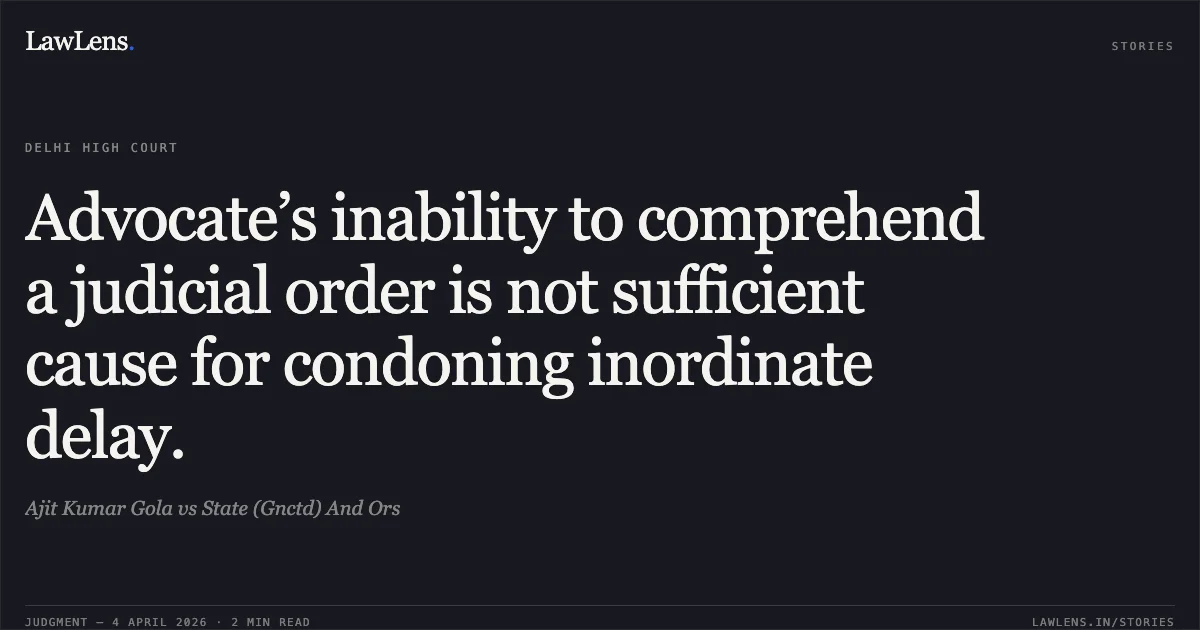
Source reference: para. 2The petitioner contended that the delay was not intentional, asserting that he initially struggled to comprehend the legal implications of the order and required extensive legal research
Source reference: para. 3He further argued that Section 482 has no prescribed limitation period and the application was filed merely out of abundant caution
Source reference: para. 3Issues
1. Whether the petitioner established "sufficient cause" to condone a delay of over one year in filing a petition under Section 482 of the Cr.P.C.
Source reference: para. 6, 92. Whether the lack of a statutory limitation period for Section 482 petitions exempts a litigant from the requirement of approaching the Court within a reasonable time
Source reference: para. 16-17Law Applied
The Court applied the principle that condonation of delay is a matter of judicial discretion, not a right, and requires a "sufficient cause" rather than a "mere excuse," as established in State of Odisha v. Managing Committee of Namatara Girls High School
Source reference: para. 10While Section 482 of the Cr.P.C. does not prescribe a specific limitation period, the court relied on Londhe Prakash Bhagwan v. Dattatraya Eknath Mane, which mandates that remedies must be sought within a "reasonable time"
Source reference: para. 17Furthermore, drawing from Rajesh Chetwal v. State, the Court noted that a period of 90 days—at par with a revision petition—is generally treated as a reasonable timeframe for filing a Section 482 petition, beyond which any delay must be cogently explained
Source reference: para. 18Reasoning
The Court rejected the petitioner’s explanation for the delay, characterizing it as unsatisfactory
Source reference: para. 13It specifically noted that the petitioner is a practicing advocate; therefore, the plea that he required over a year to understand a judicial order and conduct legal research was untenable
Source reference: para. 15The Court reasoned that if "difficulty in understanding an order" were accepted as sufficient cause, the law of limitation and the doctrine of laches would become otiose
Source reference: para. 15, 21The Court emphasized that a self-represented litigant, especially a lawyer, must exercise due diligence and reasonable promptitude
Source reference: para. 15Since the petitioner failed to provide a day-to-day or even stage-wise explanation for the intervening 14 months, the Court found a complete lack of diligence
Source reference: para. 11-12, 20Holding
The Court held that the petitioner failed to demonstrate sufficient cause for the inordinate delay
The Court dismissed the application for condonation of delay
Source reference: para. 23Consequently, the main petition under Section 482 of the Cr.P.C. was dismissed as being barred by delay and laches
Source reference: para. 24All pending applications were disposed of accordingly
Source reference: para. 24Acts & Sections Cited
1 provisions across 1 statute referred to in this judgment. Each provision opens on LawLens.
Code of Criminal Procedure, 19731
Original Court PDF
Ajit Kumar GolavsState (Gnctd) And Ors
Click to open original judgment
Original judgment, available to read, download and summarize on LawLens.in