Facts
The petitioners, accused in Sessions Case No. 5/2026 pending before the I Additional District and Sessions Judge, Koppal, sitting at Gangavathi, had earlier sought transfer of the Sessions case under Section 407 CrPC and Section 447 BNSS.
Source reference: paras. 1–6; pp. 5–9The transfer petition was dismissed by order dated 16 April 2026, with costs, and the Court also directed that proceedings be considered against Sri S. Rangaswamy, Advocate, who had appeared for the accused and was alleged to have behaved disrespectfully, threatened the Sessions Court, and obstructed the conduct of the trial.
Source reference: paras. 1–6; pp. 5–9The earlier order directed consideration of criminal contempt proceedings, action by the Karnataka State Bar Council, and initiation of criminal proceedings under the IPC/BNSS against the Advocate.
Source reference: para. 5; pp. 7–9Subsequently, the Advocate sought expunging of the directions and, pursuant to the Court’s direction, appeared and filed an affidavit tendering an apology.
Source reference: paras. 7–10; pp. 9–10On 14 July 2026, the matter was heard on the apology and the submissions of the learned Senior Counsel and the Additional Advocate General seeking a lenient view.
Source reference: paras. 8–14; pp. 10–13Issues
Whether the affidavit of apology tendered by Sri S. Rangaswamy, Advocate, ought to be accepted and the directions initiating contempt, disciplinary, and criminal proceedings recalled?
Source reference: paras. 7–14, 44–47; pp. 9–13, 49–52Whether, despite recalling the coercive proceedings, a nominal fine and a direction to plant and maintain 1,000 fruit-bearing saplings could be imposed as a cautionary and corrective measure?
Source reference: paras. 46–47; pp. 50–52Whether the observations and other directions contained in the order dated 16 April 2026 should remain undisturbed?
Source reference: paras. 44–47; pp. 49–52Law Applied
The Court applied the principle that an advocate is an officer of the Court and owes primary duties to the Court, the client, the legal profession, and society; advocacy must be conducted with dignity, courtesy, restraint, and respect for the administration of justice.
Source reference: paras. 18, 24, 30–33; pp. 16–17, 22–24, 29–41Relying on Chetak Construction Ltd. v. Om Prakash, the Court reiterated that lawyers and litigants cannot browbeat, intimidate, or terrorise judges, while judges must act impartially and courteously.
Source reference: para. 15; pp. 13–15Mahabir Prasad Singh v. M/s. Jacks Aviation Pvt. Ltd. established the reciprocal duty of courtesy between the Bench and the Bar, without permitting advocates to obstruct judicial proceedings.
Source reference: para. 16; pp. 15–16The Court also relied on Sanjeev Datta v. Unknown, Indian Council of Legal Aid and Advice v. Bar Council of India, U.P. Sales Tax Service Association v. Taxation Bar Association, Shambhu Ram Yadav v. Hanum Das Khatry, and the Bar Council of India Rules to emphasise the noble and public-utility character of the legal profession and the obligation to maintain professional standards.
Source reference: paras. 19–21, 31, 34; pp. 17–20, 30–42Under Supreme Court Bar Association v. Union of India, contempt jurisdiction and disciplinary jurisdiction are distinct: professional misconduct is ordinarily dealt with by the Bar Council, although courts may bring established contumacious conduct to its notice.
Source reference: para. 25; pp. 23–26The Court further referred to Lt. Col. S.J. Chaudhary v. State (Delhi Administration) for the principle that Sessions trials should ordinarily proceed continuously and day-to-day to prevent delay and procedural manoeuvring.
Source reference: paras. 22–23; pp. 20–22Reasoning
The Court held that the conduct recorded in the Sessions Court’s order sheet justified the earlier protective directions, as permitting intimidation or obstruction of the District Judiciary would undermine judicial dignity and public confidence.
Source reference: paras. 12–13, 17–18; pp. 11–17At the same time, after considering the Advocate’s apology and the submissions requesting leniency, the Court exercised restraint and accepted that a harsh continuation of contempt, disciplinary, and criminal proceedings was unnecessary.
Source reference: paras. 8–14, 44; pp. 10–13, 49–50The Court therefore recalled only those portions of the 16 April 2026 order that initiated proceedings against the Advocate, while preserving the remaining observations, orders, and findings.
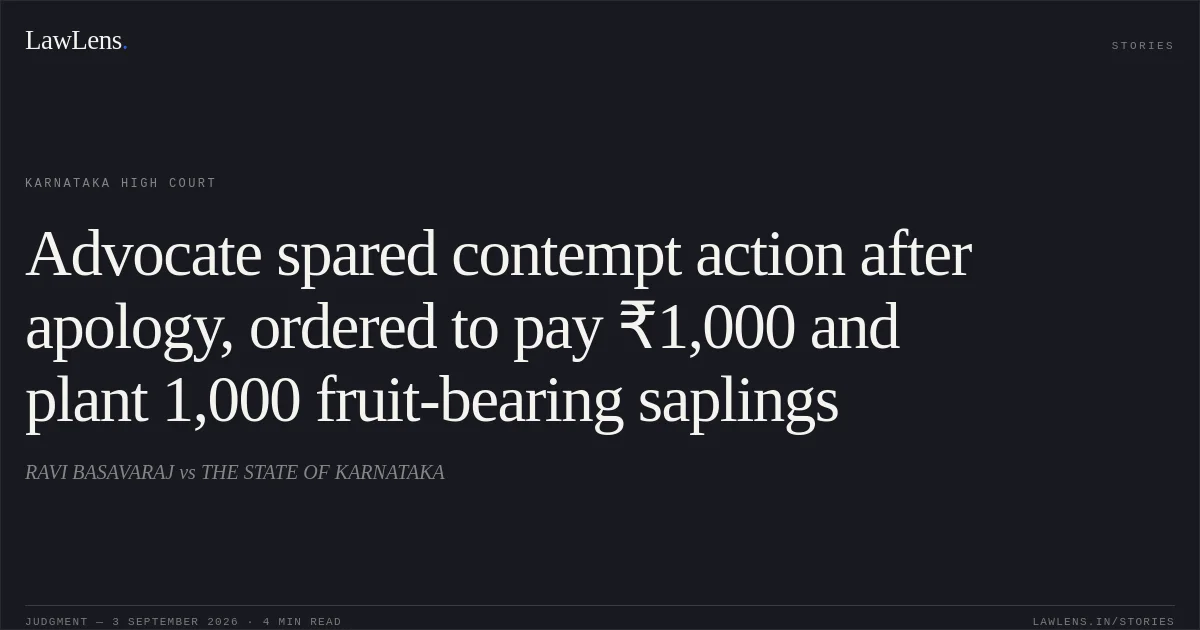
Source reference: paras. 44–45; pp. 49–50As a warning and symbolic corrective measure, it imposed a fine of Rs.1,000 payable to the District Legal Services Authority, Ballari, and directed the Advocate to plant and maintain 1,000 fruit-bearing saplings.
Source reference: paras. 46–47; pp. 50–52The direction was linked to the Court’s objective of ensuring future professional discipline without imposing the harsher consequences originally contemplated.
Source reference: paras. 46–47; pp. 50–52Holding
The Court accepted Sri S. Rangaswamy’s affidavit of apology and recalled the portions of the order dated 16 April 2026 directing initiation of criminal contempt proceedings, action by the Karnataka State Bar Council, and criminal proceedings under the IPC/BNSS.
The Advocate was directed to pay a nominal fine of Rs.1,000 to the District Legal Services Authority, Ballari, plant and maintain 1,000 fruit-bearing saplings, and file an affidavit of compliance by 31 October 2026.
Source reference: para. 47(iv), (vii); pp. 51–52The other observations, orders, and findings in the order dated 16 April 2026—including the dismissal of the transfer petition—were kept intact, and the matter was posted for compliance on 2 November 2026.
Source reference: paras. 45, 47(vi)–(viii); pp. 50–52Acts & Sections Cited
18 provisions across 5 statutes referred to in this judgment. Each provision opens on LawLens.
Code of Criminal Procedure, 19731
Bharatiya Nagarik Suraksha Sanhita, 20231
Bharatiya Nyaya Sanhita, 2023
Indian Penal Code, 18602
Advocates Act, 19612
Original Court PDF
RAVI BASAVARAJvsTHE STATE OF KARNATAKA
Click to open original judgment
Original judgment, available to read, download and summarize on LawLens.in