Facts
The deceased left home for Hyderabad and became unreachable. Two days later, his father (PW1) received a ransom call demanding ₹2,00,000 and deposited ₹1,50,000 into an account held in the name of Geetanjali. PW1 thereafter lodged a police complaint.
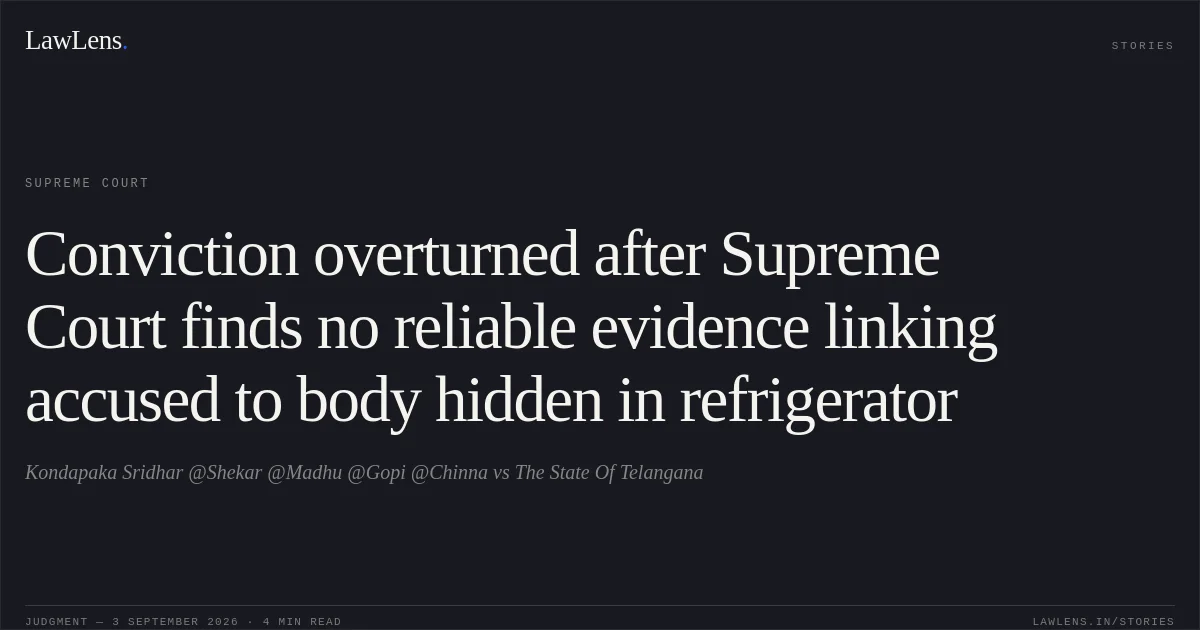
Source reference: p.1On the basis of alleged analysis of call records, the Investigating Officer apprehended A6, who allegedly led the police to a flat where the deceased’s body was found concealed inside a refrigerator and allegedly confessed to the involvement of A1 to A5.
Source reference: pp.1–2A4 died during trial. The Trial Court convicted A1, A2, A3, A5 and A6; the High Court acquitted A2, A3, A5 and A6 but affirmed A1’s conviction, principally relying on the testimony of PW3 and A1’s failure to explain the presence of the body in the flat allegedly leased by him, invoking Section 106 of the Indian Evidence Act, 1872.
Source reference: p.2The prosecution also relied on alleged ransom-related withdrawals, CCTV footage, call records, recoveries, the lease of Flat No. 402, PW3’s last-seen evidence and test-identification-parade evidence.
Source reference: pp.3–4Issues
1. Whether A1’s conviction for kidnapping and murder could be sustained on the basis of PW3’s testimony, the alleged last-seen circumstance, and the supposed lease or occupation of the flat where the body was recovered?
Source reference: pp.5–72. Whether A1’s failure to explain the presence of the deceased’s body in the flat could, by itself, constitute an incriminating circumstance under Section 106 of the Indian Evidence Act, 1872?
Source reference: pp.6–73. Whether the alleged call records, CCTV footage, ATM withdrawals, recoveries and statements or disclosures attributed to A6 constituted legally admissible and reliable evidence connecting A1 with the offence?
Source reference: pp.4, 7–84. Whether the prosecution had established a complete and reliable chain of circumstances sufficient to sustain A1’s conviction beyond reasonable doubt?
Source reference: pp.7–9Law Applied
The Court applied the principle that a conviction based on circumstantial evidence requires reliable proof of each incriminating circumstance and a complete chain pointing only to the guilt of the accused.
Source reference: pp.6–7Section 106 of the Indian Evidence Act, 1872 does not relieve the prosecution of its primary burden to prove the foundational facts; an adverse inference cannot be drawn unless the prosecution first establishes the accused’s connection with the relevant place or circumstance.
Source reference: pp.6–7Electronic evidence, including call-detail records and CCTV footage, must satisfy the statutory requirements of Section 65B of the Evidence Act and be properly proved through competent evidence.
Source reference: pp.4, 7–8Confessional statements made to the police cannot be used as substantive evidence to inculpate the accused, and a disclosure or discovery allegedly made by an acquitted co-accused cannot, without independent corroboration, incriminate another accused.
Source reference: pp.2, 7Evidence regarding recoveries must also establish a credible nexus between the recovered material and the crime.
Source reference: pp.7–8Reasoning
The Court held that the prosecution failed to establish that A1 had leased or occupied Flat No. 402. PW3 did not satisfactorily prove his employment as a watchman, the ownership of the flat, the alleged entrustment of its keys, or the presence of A1 and the other accused; no lease deed, ownership document, visitor register or testimony from other residents was produced.
Source reference: pp.5–6These deficiencies also undermined PW3’s last-seen account and made Section 106 inapplicable, since the foundational fact that A1 was in exclusive or established occupation of the flat had not been proved.
Source reference: pp.6–7The call records were not proved through the service provider’s nodal officer and lacked the required Section 65B certificate; the CCTV footage similarly lacked proper certification and did not clearly identify the accused.
Source reference: pp.4, 7–8The money recovered from A1 and A6 was not traced to the alleged ransom payment, the bank account holder was not examined, and the relevant bank records were not properly proved.
Source reference: p.8Further, the prosecution case substantially rested on police confessions, and A6’s alleged disclosure could not independently incriminate A1, particularly after A6 had been acquitted.
Source reference: pp.2, 7Consequently, apart from proving that the deceased died from smothering associated with strangulation and that his body was found in a refrigerator, the prosecution produced no dependable evidence connecting A1 with the kidnapping, ransom demand, murder or flat.
Source reference: p.9Holding
The Supreme Court answered the issues in favour of A1 and held that the prosecution had failed to prove a complete chain of circumstances or establish A1’s guilt beyond reasonable doubt.
The High Court’s order affirming A1’s conviction was set aside, and the appeal was allowed.
Source reference: p.9A1 was directed to be released forthwith if still in custody and not required in any other case; if already released, his bail bonds were ordered to stand cancelled.
Source reference: p.9Acts & Sections Cited
2 provisions across 1 statute referred to in this judgment. Linked provisions open on LawLens.
Indian Evidence Act, 18722
Original Court PDF
Kondapaka Sridhar @Shekar @Madhu @Gopi @ChinnavsThe State Of Telangana
Click to open original judgment
Original judgment, available to read, download and summarize on LawLens.in