01Facts
The petitioner, a contractual employee appointed as Sub-Engineer on 12 October 2006 and subsequently entrusted with the charge of Assistant Engineer, challenged the order dated 1 January 2026 by which his works were taken over, effectively placing him under suspension.
¶ 2The action followed a show-cause notice dated 29 December 2025 alleging that he had granted technical sanction for work relating to a Gram Panchayat outside his jurisdiction. The petitioner submitted his reply on 31 December 2025, asserting that he was competent to grant the sanction under the applicable Government directions and circulars.
¶ 2He contended that the disciplinary procedure prescribed under Clause 7 of the M.P. State Employment Guarantee Council policy dated 24 June 2025 had not been followed, that no enquiry had been conducted, and that he had not received subsistence allowance during suspension.
¶ 2The State defended the impugned order and objected to the writ petition on the ground that the petitioner had an alternative statutory appellate remedy.
¶ 302Issues
i.Whether the High Court should entertain the writ petition under Article 226 when the petitioner had an alternative statutory remedy of appeal.
¶ 3, 5–10ii.Whether the legality and merits of the impugned order dated 1 January 2026, including the alleged non-compliance with the prescribed disciplinary procedure and the petitioner’s competence to grant technical sanction, should be examined in the writ petition.
¶ 2, 11–1203Law Applied
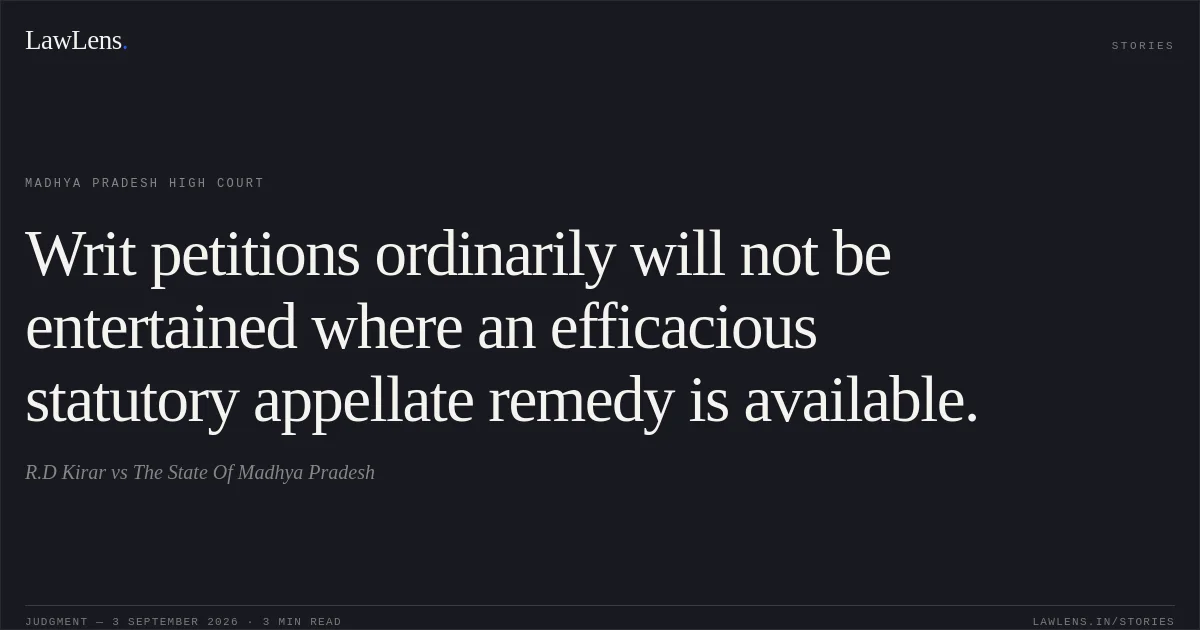
The existence of an alternative statutory remedy does not oust the jurisdiction of the High Court under Article 226, but ordinarily the writ court should decline to exercise its discretionary jurisdiction where the alternative remedy is adequate and efficacious.
¶ 5–7Relying on State of Uttar Pradesh v. Md. Nooh, AIR 1958 SC 86; Titaghur Paper Mills Co. Ltd. v. State of Orissa, (1983) 2 SCC 433; and Godrej Sara Lee Ltd. v. Excise and Taxation Officer-cum-Assessing Authority, 2023 SCC OnLine SC 95, the Court recognised that maintainability and entertainability are distinct concepts and that alternative remedy is generally a rule of discretion.
¶ 6Under Thansingh Nathmal v. A. Mazid, Superintendent of Taxes, AIR 1964 SC 1419, the High Court should not ordinarily permit statutory machinery to be bypassed through Article 226.
¶ 7The Court also relied on A.V. Venkateswaran, Collector of Customs v. Ramchand Sobhraj Wadhwani, AIR 1961 SC 1506, which holds that a litigant who has failed to avail a statutory remedy cannot ordinarily invoke that failure to obtain discretionary relief under Article 226.
¶ 804Reasoning
The Court treated the statutory appeal as the appropriate and efficacious forum for examining the petitioner’s challenges to the impugned order, including the alleged procedural violations, the applicability of the 2025 policy, and the petitioner’s authority to grant technical sanction.
¶ 2, 9–10Since the petitioner had not first invoked that remedy, the Court declined to bypass the statutory appellate mechanism and did not undertake an adjudication on the merits of the suspension-related grievance.
¶ 9–12The Court nevertheless preserved the petitioner’s right to pursue the appeal by granting a specific period for its filing and directing expeditious consideration.
05Holding
The writ petition was disposed of without expressing any opinion on the merits of the case.
¶ 11–12The petitioner was directed to file an appeal before the competent appellate authority within two weeks from the date of the order.
¶ 11If filed within that period, the appellate authority was directed to decide the appeal on merits by a reasoned and speaking order, after granting the petitioner a personal hearing, within one month from receipt of the certified copy of the order.
¶ 11Original Court PDF
R.D KirarvsThe State Of Madhya Pradesh
Click to open original judgment
Original judgment, available to read, download and summarize on LawLens.in