Facts
The National Council for Teacher Education (NCTE), constituted under the National Council for Teacher Education Act, 1993, issued a Public Notice dated 22 September 2019 requiring all NCTE-recognised Teacher Education Institutions (TEIs) to submit an annual online Performance Appraisal Report (PAR), including audited accounts, and to pay prescribed amounts of ₹5,000 or ₹15,000, depending on the category of institution.
Source reference: para. 8The notice stated that non-submission would attract action under Section 17(1) of the NCTE Act.
Source reference: para. 8The TEIs challenged the notice, contending that the Executive Committee or Member Secretary lacked authority to introduce the PAR requirement and that the prescribed proforma had not been approved by the Council.
Source reference: para. 9Although the Single Judge dismissed the challenge, the Division Bench of the Delhi High Court allowed the appeals and quashed the notice on the ground that the proforma had neither been evolved nor approved by the Council and that no valid delegation had been established.
Source reference: para. 9The NCTE appealed to the Supreme Court.
Source reference: no citationIssues
1. Whether the NCTE possessed statutory and ancillary regulatory power to require recognised TEIs to submit annual Performance Appraisal Reports.
Source reference: paras. 10, 21–222. Whether the Executive Committee, acting through its Member Secretary, was competent to implement the Council’s decision requiring submission of PARs.
Source reference: paras. 14–15, 18–213. Whether the requirement of payment of ₹5,000 or ₹15,000 along with the PAR was legally sustainable as an incidental or process fee.
Source reference: para. 25Law Applied
The Court applied the NCTE Act, 1993, particularly its preambular object of achieving the planned and coordinated development of teacher education and maintaining its norms and standards.
Source reference: para. 11Section 12, including Section 12(k), empowers the Council to evolve suitable performance-appraisal systems, norms and mechanisms for enforcing accountability on recognised institutions.
Source reference: para. 12Section 19, under which the Executive Committee is constituted to discharge functions assigned by the Council or determined by regulations.
Source reference: para. 14Sections 14–17 establish the regulatory framework governing recognition and compliance by TEIs.
Source reference: paras. 6, 8The Court held that a statutory regulator possesses powers incidental and ancillary to the effective discharge of its express statutory functions, even where a particular measure is not expressly specified in the statute.
Source reference: para. 22It further relied on the principles of administrative accountability—responsibility, answerability and enforceability—as essential to effective regulation.
Source reference: para. 23The Court also referred to Dinesh Biwaji Ashtikar v. State of Maharashtra, 2026 SCC OnLine SC 56, regarding the central importance of qualified teachers and teacher-education institutions to the constitutional right to education.
Source reference: paras. 4–7The Court also referred to Vijay Rajmohan v. CBI, (2023) 1 SCC 329, concerning accountability in administrative law.
Source reference: para. 23Reasoning
The Court treated the PAR requirement as a regulatory measure directly connected with the NCTE’s statutory mandate to monitor standards and enforce accountability among recognised TEIs.
Source reference: paras. 11–12, 21The Council’s 48th meeting had considered the impracticality of annual renewal of recognition and expressly approved substituting PAR for that requirement, authorising the NCTE to proceed through a proforma to be developed for the purpose.
Source reference: para. 18Accordingly, the Executive Committee, as the executive arm of the Council, was competent to implement that decision through the Member Secretary.
Source reference: paras. 19–21The High Court adopted an unduly technical approach by focusing on the absence of a separately approved proforma, instead of examining whether the impugned action transgressed any mandatory statutory provision or exceeded the NCTE’s regulatory jurisdiction.
Source reference: para. 10The Court held that requiring information necessary for performance assessment was not only authorised by Section 12(k), but was also incidental and ancillary to the NCTE’s regulatory functions.
Source reference: para. 22The accompanying payments were characterised as process fees connected with the regulatory exercise and therefore also fell within the regulator’s incidental powers.
Source reference: para. 25Holding
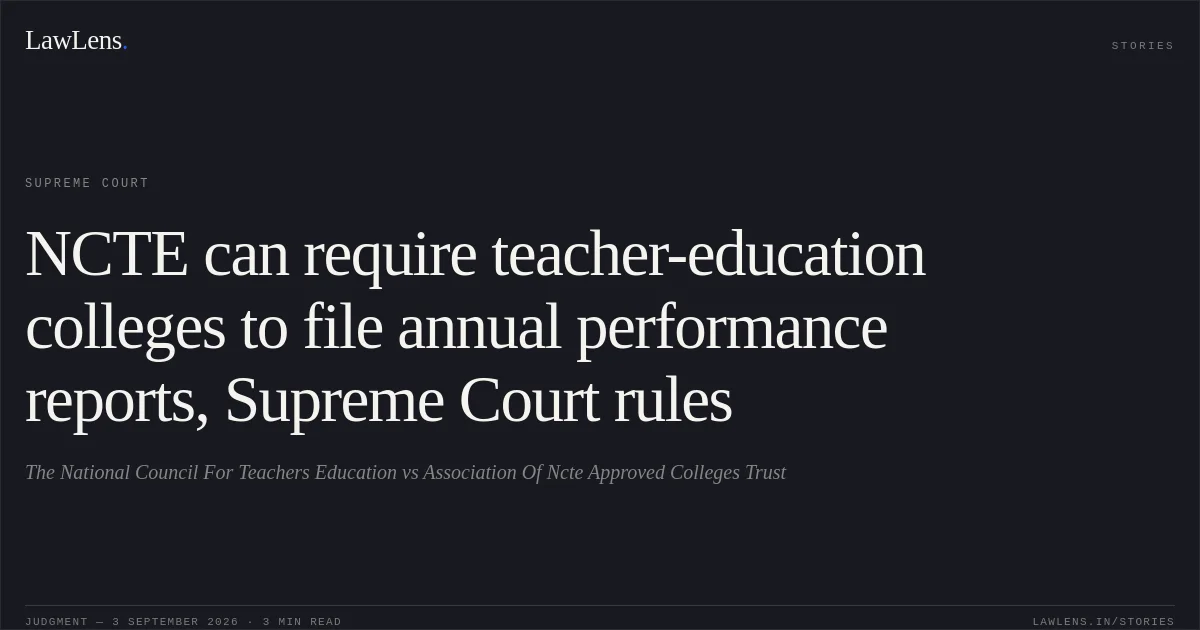
The Supreme Court held that the NCTE and its Executive Committee were within their jurisdiction to require NCTE-recognised TEIs to upload annual PARs and that the Public Notice dated 22 September 2019 was legal and valid.
The Court set aside the judgment of the Delhi High Court in LPA No. 190 of 2021 dated 13 March 2023 and allowed the appeal.
Source reference: para. 26There was no order as to costs.
Source reference: para. 26Acts & Sections Cited
18 provisions across 2 statutes referred to in this judgment. Each provision opens on LawLens.
Right of Children to Free and Compulsory Education Act, 20096
National Council for Teacher Education Act, 1993
Original Court PDF
The National Council For Teachers EducationvsAssociation Of Ncte Approved Colleges Trust
Click to open original judgment
Original judgment, available to read, download and summarize on LawLens.in