Facts
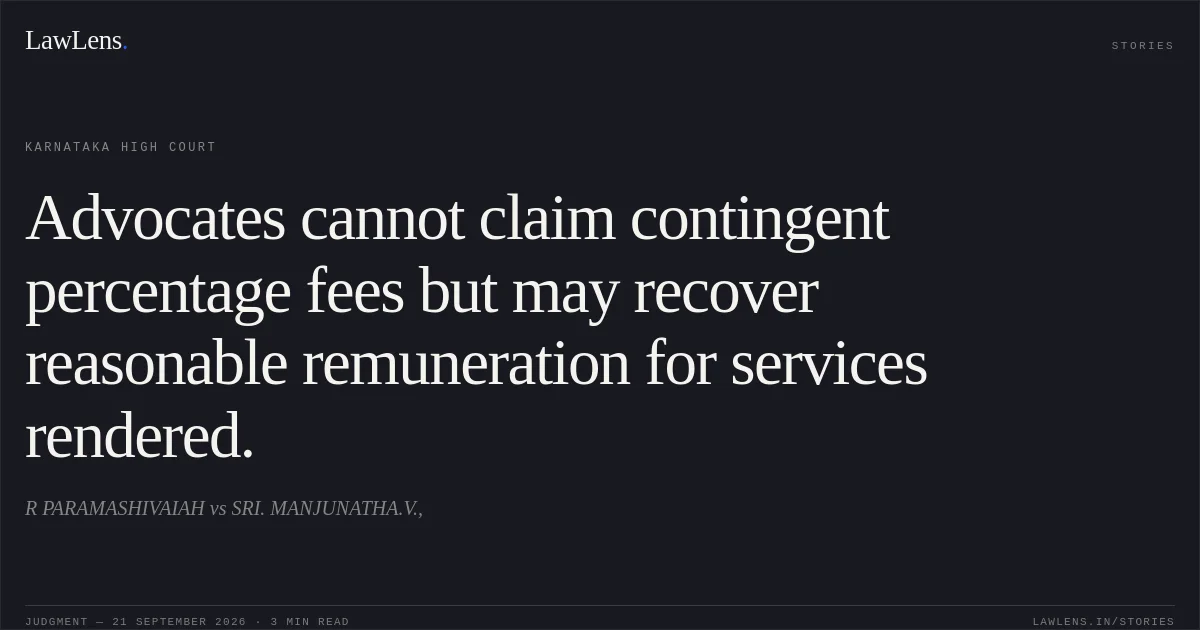
The respondent-plaintiff, an advocate, was engaged by the appellants-defendants in land-acquisition cases concerning their acquired lands.
Source reference: paras. 4–5, pp. 4–5The plaintiff claimed that the defendants had agreed to pay professional fees equivalent to 2% of the compensation received, but failed to pay the fees despite the plaintiff’s professional services in the relevant LAC proceedings.
Source reference: paras. 4–5, pp. 4–5The defendants denied both the alleged engagement and their liability to pay.
Source reference: para. 6, p. 5The Trial Court found that the defendants had availed themselves of the plaintiff’s legal services, but held that a fee calculated as a percentage of the compensation was impermissible.
Source reference: para. 9, pp. 6–7It nevertheless awarded the plaintiff a lump sum of Rs.5,00,000/- as reasonable professional fees, with interest at 6% per annum from the date of suit until realization.
Source reference: para. 9, pp. 6–7The defendants challenged that decree under Section 96 read with Order XLI Rule 1 CPC, contending that the amount was arbitrary and excessive.
Source reference: paras. 2, 10–11, pp. 3, 7–9Issues
Whether the plaintiff proved that he rendered professional services to the defendants in the land-acquisition cases, thereby enabling them to obtain compensation?
Source reference: para. 14(i), pp. 10–11Whether the Trial Court’s determination of Rs.5,00,000/- as professional fees was arbitrary or excessive?
Source reference: para. 14(ii), pp. 10–11Whether the defendants proved that they had not availed themselves of the plaintiff’s services in relation to their land-acquisition cases?
Source reference: para. 14(iii), pp. 10–11Whether the judgment and decree of the Trial Court required interference in appeal?
Source reference: para. 14(iv), pp. 10–11Law Applied
The Court applied Section 96 read with Order XLI Rule 1 of the Code of Civil Procedure, 1908, governing a first appeal against a decree.
Source reference: p. 3It relied principally on B. Sunitha v. State of Telangana, (2018) 1 SCC 638, which held that an advocate’s claim based on a share or percentage of the subject matter or outcome of litigation amounts to professional misconduct and is contrary to professional ethics.
Source reference: paras. 16–18, pp. 12–14The Court also referred to Rule 20, Part VI, Chapter II, Section II of the Standards of Professional Conduct and Etiquette, which provides that an advocate shall not stipulate for a fee contingent on the result of litigation or agree to share its proceeds.
Source reference: para. 16, pp. 12–13At the same time, the Court recognized that an advocate who has rendered professional services may be awarded reasonable professional remuneration assessed with reference to the work performed and the circumstances of the case.
Source reference: paras. 20–22, pp. 19–22Reasoning
The High Court found that the documentary and oral evidence established that the plaintiff had represented the defendants in LAC Nos.147 and 262 of 2019 and had undertaken work including filing vakalats, applications and claim statements, attending Court, and conducting the proceedings.
Source reference: para. 20, p. 19Although the alleged agreement for payment of 2% of the compensation could not lawfully support a fee award because contingent or percentage-based fees violate Rule 20 and the principle stated in B. Sunitha, the plaintiff was not disentitled from receiving reasonable remuneration for services actually rendered.
Source reference: paras. 15–18, pp. 11–14The Court held that the Trial Court had not enforced the percentage-based fee arrangement.
Source reference: paras. 20–22, pp. 19–22Instead, it independently assessed the professional work undertaken and awarded Rs.5,00,000/- as a lump-sum fee.
Source reference: paras. 20–22, pp. 19–22Considering the nature and volume of the legal work, the duration of the engagement, and the absence of any demonstrated perversity or arbitrariness, the High Court found the amount reasonable and justified.
Source reference: paras. 20–22, pp. 19–22The defendants’ challenge therefore failed.
Source reference: no citationHolding
The High Court answered the issue concerning the plaintiff’s rendering of professional services in the affirmative and rejected the defendants’ objections regarding the quantum of fees and the Trial Court’s decree.
The appeal was dismissed with costs of Rs.25,000/-, and the defendants were additionally directed to pay the costs incurred in the suit.
Source reference: paras. 23–24, pp. 21–22The judgment and decree dated 23 September 2025 in O.S. No.8412/2023, awarding Rs.5,00,000/- with 6% interest per annum from the date of suit until realization, were confirmed.
Source reference: paras. 23–24, pp. 21–22Acts & Sections Cited
1 provisions across 1 statute referred to in this judgment. Each provision opens on LawLens.
Code of Civil Procedure, 19081
Original Court PDF
R PARAMASHIVAIAHvsSRI. MANJUNATHA.V.,
Click to open original judgment
Original judgment, available to read, download and summarize on LawLens.in