Facts
The appellants, being the owner and driver of the offending vehicle, challenged the award dated 15 September 2022 passed by the Motor Accidents Claims Tribunal in Case No. 1392/2019 (MACC).
Source reference: p.1The appeal was filed with a delay of 1,065 days, accompanied by I.A. No. 8998/2025 seeking condonation of delay.
Source reference: p.1The appellants contended that their counsel before the Tribunal had not timely informed them about the award and that they became aware of it only upon receiving notice of execution proceedings on 4 November 2025.
Source reference: p.1They claimed to have filed the appeal without further delay after acquiring such knowledge.
Source reference: p.1Issues
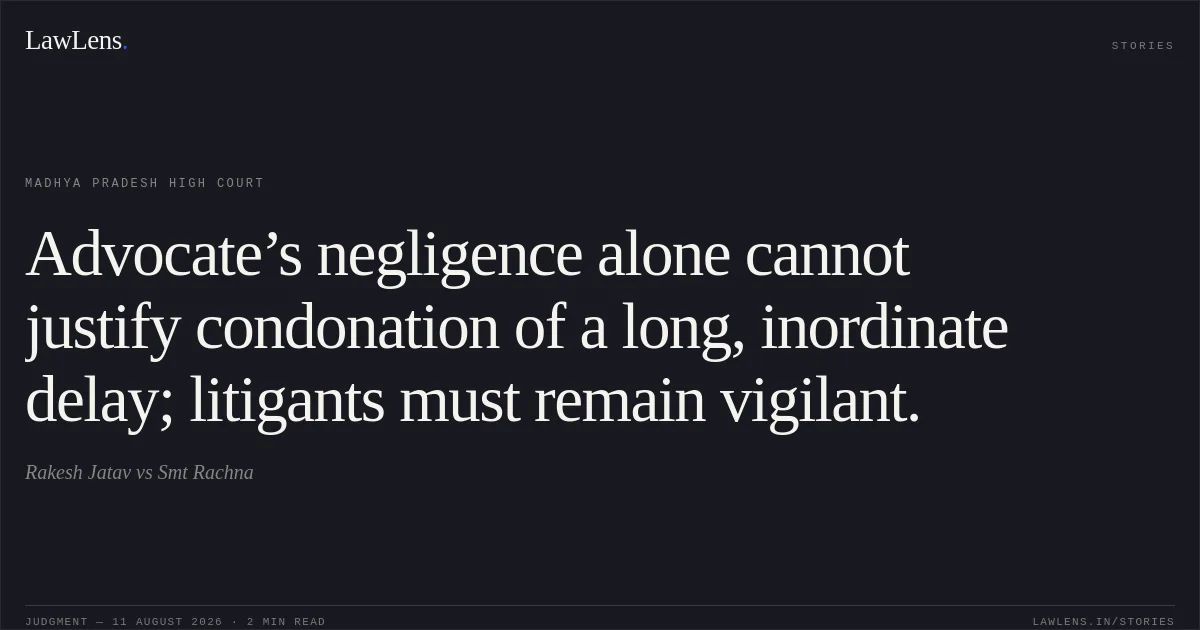
Whether the appellants had shown sufficient cause for condoning the delay of 1,065 days in filing the miscellaneous appeal, solely on the ground that their counsel failed to communicate the passing of the award.
Source reference: pp.1–2Whether negligence or non-communication by counsel, by itself, justified condonation of such a long and inordinate delay when the appellants were represented before the Tribunal.
Source reference: pp.1–3Law Applied
The Court applied the principle that a litigant must remain vigilant regarding his own rights and pending judicial proceedings, and that negligence or carelessness of counsel, by itself, cannot justify condonation of long and inordinate delay, as held in Rajneesh Kumar v. Ved Prakash, 2024 SCC OnLine SC 3380.
Source reference: pp.1–2, paras 10–13Relying on Salil Dutta v. T.M. & M.C. Private Ltd., (1993) 2 SCC 185, the Court reiterated that an advocate is the agent of the party, but there is no absolute rule permitting a litigant to disown counsel and seek relief on that basis.
Source reference: p.2, para. 11The Court also relied on Bharat Barrel & Drum Mfg. Co. v. Employees’ State Insurance Corporation, (1971) 2 SCC 860, which explains that limitation law requires litigants to assert their rights within a reasonable time, discourages stale claims, and embodies the principle vigilantibus non dormientibus jura subveniunt—the law assists the vigilant, not those who sleep over their rights.
Source reference: p.3, para. 12Reasoning
The appellants admittedly had legal representation before the Tribunal, yet attributed the entire 1,065-day delay to their counsel’s failure to communicate the award.
Source reference: p.1Applying Rajneesh Kumar, the Court held that such an allegation, even if accepted, did not discharge the appellants’ duty to remain vigilant about proceedings initiated by them or affecting their rights.
Source reference: pp.1–2, para. 10The principles in Salil Dutta further prevented the appellants from completely disowning their advocate to obtain condonation as of right.
Source reference: p.2, para. 11In light of the exceptionally long delay and the absence of any adequate justification beyond alleged non-communication by counsel, the Court found no sufficient cause for condonation.
Source reference: p.4Holding
The Court answered the issues against the appellants and held that no case was made out for condoning the delay of 1,065 days.
I.A. No. 8998/2025 was rejected, and consequently, Miscellaneous Appeal No. 9153 of 2025 was dismissed. Any pending applications were also disposed of.
Source reference: p.4Original Court PDF
Rakesh JatavvsSmt Rachna
Click to open original judgment
Original judgment, available to read, download and summarize on LawLens.in