Facts
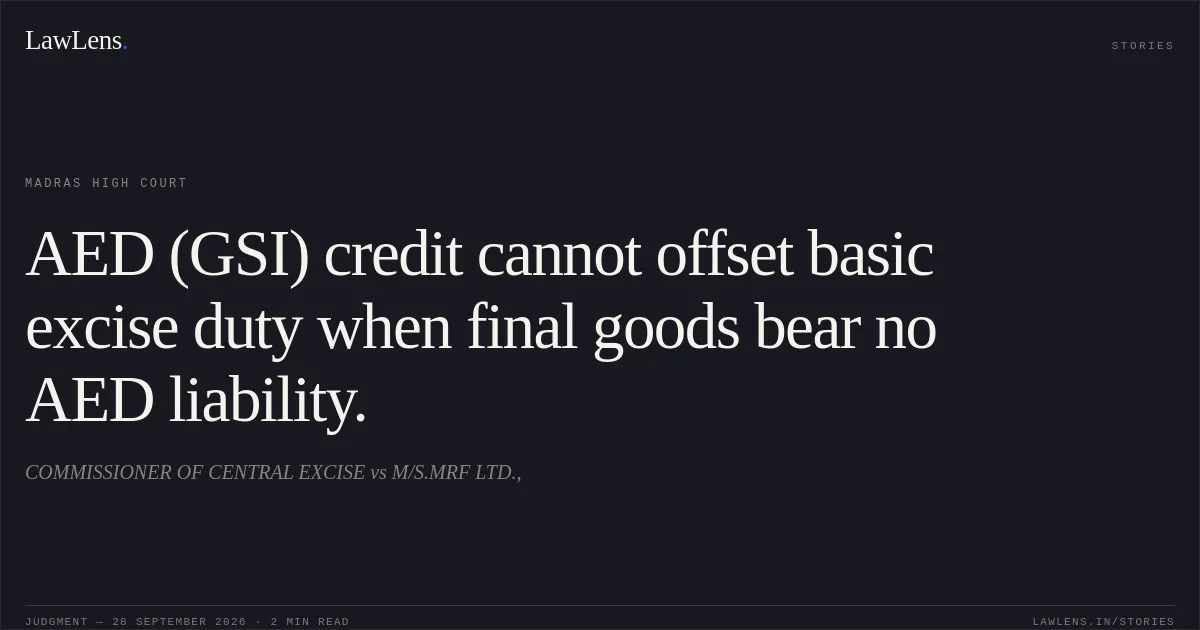
MRF used unprocessed nylon tyre-cord fabric, on which Additional Excise Duty (Goods of Special Importance) [AED (GSI)] had been paid, to manufacture tyre-cord wrap sheets (TCWS) and tyres. It claimed MODVAT credit for AED (GSI) paid on the inputs during June 1998–March 1999 and sought refunds relating to inputs used in tyres that were exported.
Source reference: paras. 4–5, 19The Assistant Commissioner disallowed the credits and rejected the refund claims; the Commissioner (Appeals) affirmed those decisions.
Source reference: paras. 7–10, 20–21CESTAT allowed MRF’s appeals, holding that the credit could be used towards basic excise duty (BED) on tyres and granting a refund under Rule 57F(13) of the Central Excise Rules, 1944. The Revenue appealed, while MRF sought a direction to implement CESTAT’s orders.
Source reference: paras. 1, 12, 21Issues
Whether MRF was eligible to take credit of AED (GSI) paid on inputs when the final product was exempt from AED (GSI), having regard to Rule 57C of the Central Excise Rules, 1944.
Source reference: p. 8, para. 13Whether CESTAT could direct a refund of the AED (GSI) credit under Rule 57F(13) when MRF was not eligible for that credit under Rule 57C.
Source reference: p. 8, para. 13Law Applied
Rule 57C of the Central Excise Rules, 1944 disallows credit of specified duty on inputs used to manufacture final products exempt from the whole of excise duty or chargeable to nil duty.
Source reference: p. 17, para. 25The second proviso to Notification No. 5/94-CE(NT) restricted credit attributable to AED (GSI) to payment of AED (GSI) on the final product, or on inputs cleared under Rule 57F.
Source reference: p. 18, para. 26The Court treated Rule 57F(13) as unavailable where the underlying credit was not allowable.
Source reference: para. 38It also considered Section 88 of the Finance Act, 2004, which retrospectively permitted specified AED (GSI) credit paid on or after 1 April 2000 to be used towards duties under the Central Excise Tariff Act; the Court held that this provision did not cover the periods at issue, which pre-dated that cutoff.
Source reference: pp. 24–27, paras. 34–37Reasoning
The Court held that the Notification confined AED (GSI) credit to discharging AED (GSI) liability, not BED. TCWS was exempt from AED (GSI), while tyres were not chargeable to AED (GSI); accordingly, neither product provided a basis for using the input credit under the applicable rule and Notification.
Source reference: pp. 19–22, paras. 28–32The Court therefore rejected MRF’s claim that the credit could be applied to BED on tyres. It also held that the later Notification and Board Circular relied on by CESTAT could not retrospectively create an entitlement for the disputed periods.
Source reference: pp. 22–23, para. 33Section 88 did not assist MRF because the relevant credit related to duty paid before 1 April 2000.
Source reference: p. 27, para. 37Without valid credit, MRF was not entitled to the consequential refund under Rule 57F(13).
Source reference: para. 38Holding
The Court answered both substantial questions of law in favour of the Revenue.
It allowed the civil miscellaneous appeals, set aside CESTAT’s common order dated 25 November 2003, dismissed MRF’s writ petition seeking implementation of that order, and made no order as to costs.
Source reference: para. 41Acts & Sections Cited
5 provisions across 2 statutes referred to in this judgment. Each provision opens on LawLens.
Central Excise Act, 19443
Central Goods and Services Tax Act, 20172
Original Court PDF
COMMISSIONER OF CENTRAL EXCISEvsM/S.MRF LTD.,
Click to open original judgment
Original judgment, available to read, download and summarize on LawLens.in