01Facts
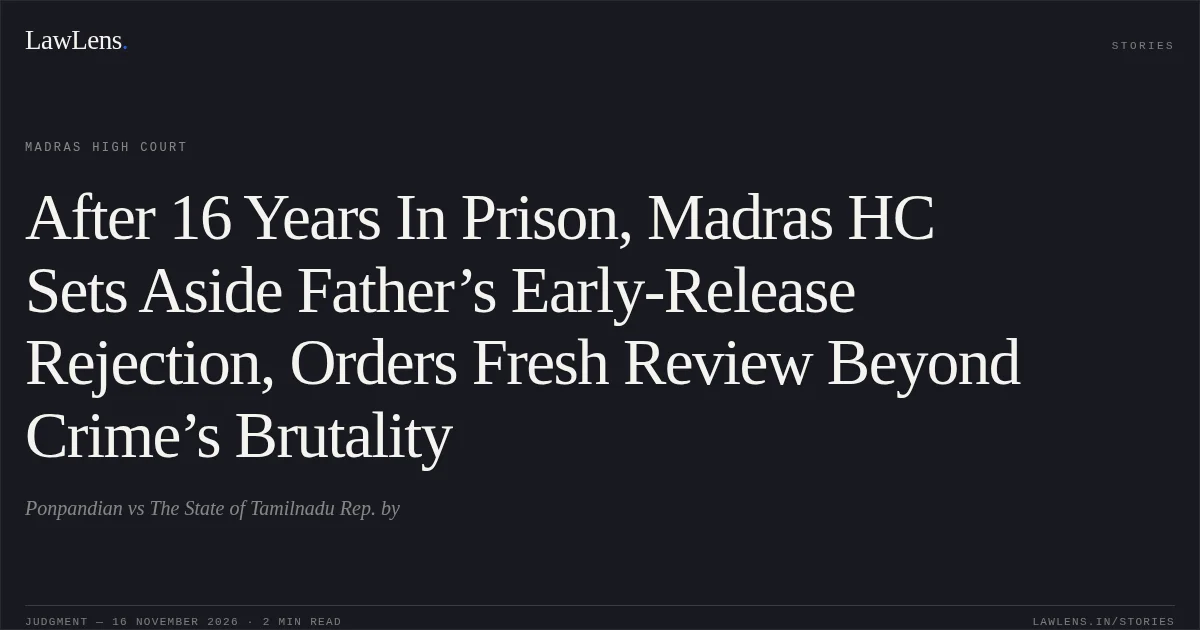
The petitioner sought premature release of his father, Palpandi, a life convict serving a sentence for murder under Section 302 of the Indian Penal Code.
¶ 3The trial court convicted him in 2010, and the Madras High Court dismissed his appeal that year.
¶ 10–11After he had undergone more than 16 years of actual imprisonment, the District Collector, police and revenue officials, Probation Officer, and trial court judge gave favourable reports on his conduct, reformation, family support, and prospects of reintegration.
¶ 4–5, 13, 19The State Level Committee declined to recommend release, citing the crime’s seriousness, concerns about impulsive violence, and other factors; the Government accepted that recommendation and rejected his request by G.O.(D) No. 92 dated 27 January 2026.
¶ 5, 13The petitioner challenged that order under Article 226 of the Constitution.
¶ 1–202Issues
i.Whether the Government’s rejection of premature release could stand where it relied predominantly on the gravity and brutality of the offence without adequately addressing the favourable reports on the prisoner’s present conduct, reformation, and prospects of reintegration.
¶ 16–18, 24ii.Whether the appropriate relief was to order release or to direct fresh consideration by the State Level Committee.
¶ 2503Law Applied
Under the Tamil Nadu Prison Rules, 2024, the State Level Committee considers premature-release cases under Rule 350, and its decision is forwarded to the Government for consideration under Rule 353(1).
¶ 2The Supreme Court held in Rohit Chaturvedi v. State of Uttarakhand, 2026 SCC OnLine SC 865, that the heinousness of an offence cannot be the sole ground for denying remission; the decision must reflect a holistic assessment of the prisoner’s conduct, reformation, prospects of reintegration, and societal interests.
¶ 17–18The reformative purpose of punishment, including rehabilitation and reintegration, is also recognised in Mohd. Giasuddin v. State of A.P., (1977) 3 SCC 287.
¶ 22The authorities must therefore assess relevant present circumstances and give cogent reasons when rejecting favourable recommendations.
¶ 18, 20Provisions in the judgment · 1 · Linked ones open on LawLens
Indian Penal Code, 1860 Section 302
04Reasoning
The Court found that the field-level authorities and trial court judge had assessed the prisoner’s conduct, institutional discipline, family support, and rehabilitation prospects favourably, while the State Level Committee and Government had not cogently explained why those assessments were rejected.
¶ 16, 19–20The impugned decision relied predominantly on the offence’s gravity and brutality, matters already considered at sentencing, rather than undertaking an adequate independent assessment of the prisoner’s present circumstances.
¶ 16, 24Applying Rohit Chaturvedi, the Court held that the offence’s nature could be relevant but could not, by itself, justify denial of premature release.
¶ 17–18It also treated the period of actual imprisonment and the prisoner’s medical condition as relevant circumstances, without treating either as automatically determinative.
¶ 21, 23–2405Holding
The Court set aside G.O.(D) No. 92 dated 27 January 2026 and directed the first respondent to place the prisoner’s case before the State Level Committee at its next meeting for fresh consideration.
¶ 25The Committee must independently and objectively assess the relevant materials, including the favourable reports, in light of the Court’s observations and Rohit Chaturvedi, and the matter was disposed of without costs.
¶ 25–26The Court did not order the prisoner’s immediate release.
¶ 25Original Court PDF
PonpandianvsThe State of Tamilnadu Rep. by
Click to open original judgment
Original judgment, available to read, download and summarize on LawLens.in