01Facts
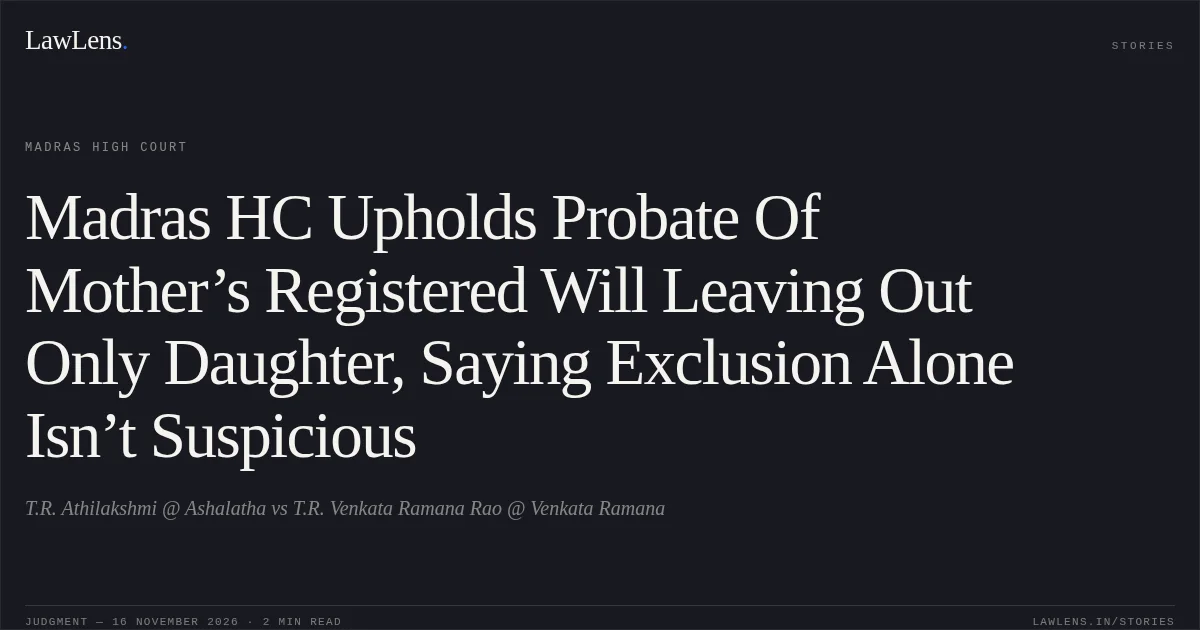
The respondent, one of the sons of T.R. Sugunabhushanam, sought probate of her registered Will dated 17 March 2008. The appellant, the testatrix’s only daughter, contested the Will, alleging it was not genuine and raising, among other matters, her mother’s alleged illiteracy, prior eye surgery, and her exclusion from the bequest.
pp. 2–3The Original Petition was converted into a Testamentary Original Suit following the caveat. The Single Judge found the Will proved and granted probate; the daughter appealed.
pp. 2–3The appeal was brought under Order XXXVI Rule 1 of the Original Side Rules, Clause 15 of the Letters Patent, and Section 384 of the Indian Succession Act.
p. 102Issues
i.Whether the Will dated 17 March 2008 was proved in a manner known to law
p. 4ii.Whether suspicious circumstances surrounded the Will’s execution and, if so, whether the propounder satisfactorily dispelled them
p. 403Law Applied
The propounder bears the initial burden of proving due execution and attestation of a Will and establishing the testator’s testamentary capacity.
p. 5If suspicious circumstances are established, the burden returns to the propounder to dispel them; absent such circumstances, the initial burden remains confined to proof of execution, attestation, and capacity.
p. 5The appeal was considered under Section 384 of the Indian Succession Act, but the judgment did not specify the substantive statutory provisions governing execution and proof of a Will.
p. 5It considered Joseph Antony Lazarus (Dead) by LRs v. A.J. Francis, distinguishing that decision on its facts.
p. 7Provisions in the judgment · 2 · Linked ones open on LawLens
Patents Act, 1970 Section 15
Indian Succession Act, 1925 Section 384
04Reasoning
The Court relied on the testimony of both attesting witnesses, who stated that the testatrix signed the Will in their presence, that they signed in hers, and that she was of sound mind. Their evidence was not discredited, and the execution and attestation were not specifically challenged.
p. 6The Will was registered on the date of execution, and the testatrix lived for more than four years thereafter; the Court held that the alleged 2005 eye surgery, without evidence that she was totally blind or lacked capacity, did not establish a suspicious circumstance.
pp. 5–6Nor did the daughter’s exclusion, by itself, make the Will suspect.
p. 6The Court therefore found the Will duly proved and distinguished Joseph Antony Lazarus, which involved registration a year after execution and other suspicious circumstances.
p. 705Holding
The Court answered the issues in favour of the propounder, finding that the Will was proved and that no suspicious circumstances remained to be dispelled.
p. 8It dismissed the appeal, made no order as to costs, and closed the connected miscellaneous petitions.
p. 8Original Court PDF
T.R. Athilakshmi @ AshalathavsT.R. Venkata Ramana Rao @ Venkata Ramana
Click to open original judgment
Original judgment, available to read, download and summarize on LawLens.in