01Facts
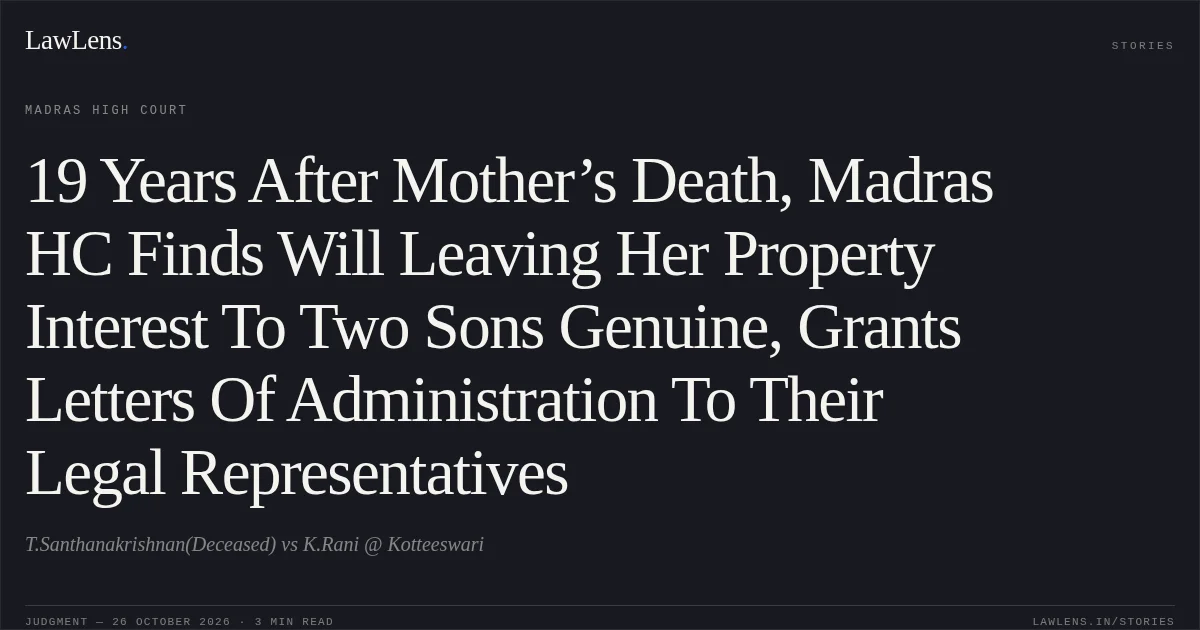
The plaintiffs sought probate of a registered Will dated 5 March 1980, allegedly executed by T. Kannammal in favour of her two sons, who were named as executors and beneficiaries.
pp. 3–6 · ¶ 1–11Kannammal died in 1998.
pp. 3–6 · ¶ 1–11Her younger daughter, the defendant, disputed the Will, alleged forgery, and claimed that Kannammal died intestate.
pp. 3–6 · ¶ 1–11The probate petition was filed in 2017 and converted into a testamentary suit after the defendant contested it.
pp. 3–6 · ¶ 1–11The sons were examined as P.W.1 and P.W.2; P.W.2 identified the signature of his deceased father, an attesting witness, while P.W.1 identified the testatrix’s signature.
pp. 7, 16–18 · ¶ 13, 27, 31–37Both original plaintiffs died during the proceedings, and their legal representatives were substituted.
pp. 7, 16–18 · ¶ 13, 27, 31–3702Issues
i.1. Whether the Will dated 5 March 1980 was genuine, valid, and duly proved, including whether the plaintiffs had established execution and attestation under the applicable evidentiary rules.
p. 7 · ¶ 12 · pp. 15–16 · ¶ 30ii.2. Whether Kannammal died intestate on 19 December 1998.
p. 7 · ¶ 12iii.3. What testamentary relief could be granted after the named executors died during the proceedings.
pp. 25–26 · ¶ 53–5603Law Applied
Under Section 63 of the Indian Succession Act, 1925, a Will must be executed and attested as prescribed by law; the propounder bears the burden of proving due execution, testamentary capacity, and voluntary execution, and must satisfactorily explain any suspicious circumstances.
p. 15 · ¶ 30Where the attesting witnesses cannot be called, Section 69 of the Indian Evidence Act, 1872 permits proof through evidence that an attesting witness’s handwriting and the executant’s signature are in their respective handwriting; the Court held that these facts may be proved by different witnesses.
pp. 16–18 · ¶ 32, 37, 43Registration alone does not prove a Will, and delay or exclusion of an heir may be relevant to suspicion but is not, by itself, conclusive against validity.
pp. 15, 22–23 · ¶ 30, 48–49The Court considered V. Kalyanaswamy v. L. Bakthavatsalam, (2021) 16 SCC 543, and distinguished the evidentiary circumstances in Jaswant Kaur v. Amrit Kaur, (1977) 1 SCC 369; Kashibai v. Parwatibai, (1995) 6 SCC 213; Janki Narayan Bhoir v. Narayan Namdeo Kadam, (2003) 2 SCC 91; and K. Laxmanan v. Thekkayil Padmini, (2009) 1 SCC 354.
pp. 18–21 · ¶ 38–43Under Section 222 of the Succession Act, probate is granted only to an executor appointed by the Will; the executor’s office does not pass to their legal representatives, though letters of administration with the Will annexed may be granted to persons otherwise entitled.
p. 26 · ¶ 54–55Provisions in the judgment · 3 · Linked ones open on LawLens
Indian Succession Act, 1925 Section 222Section 276Section 63
04Reasoning
The Court accepted P.W.2’s identification of his father’s attesting signature, supported by documents establishing their relationship, the attesting witness’s death, and matching identifying details across the relevant records.
pp. 16–18 · ¶ 32–37, 43It accepted P.W.1’s identification of the testatrix’s signature as the other element required by Section 69, and held that the two identifications could be supplied by different witnesses.
pp. 16–18 · ¶ 32–37, 43It found that the defendant’s allegations were unsupported by evidence; the Will’s use of English did not establish that Kannammal failed to understand it, particularly given that the sale deed in her favour was also in English.
pp. 21–24 · ¶ 44–49, 52The Court treated the daughter’s exclusion and the delay in seeking probate as circumstances requiring consideration, but found them insufficient to displace the Will once due execution and capacity were established.
pp. 21–24 · ¶ 44–49, 52The ownership dispute concerning the property was left open, since the testamentary grant could extend only to Kannammal’s legally held interest.
pp. 24–25 · ¶ 50–51As the named executors had died, probate could not issue to their legal representatives; the Court instead considered them eligible to receive letters of administration with the Will annexed.
p. 26 · ¶ 53–5505Holding
The Court held that the Will was genuine and duly proved, and answered the issues concerning the Will and intestacy in the plaintiffs’ favour.
pp. 25–26 · ¶ 52It decreed the suit and directed that letters of administration with the Will annexed be granted to plaintiffs 3–9, limited to Tamil Nadu and to Kannammal’s interest in the scheduled property.
p. 26 · ¶ 56The plaintiffs were directed to furnish security of ₹25,000 each, file an inventory within six months of the grant, and render accounts within one year.
p. 26 · ¶ 56Original Court PDF
T.Santhanakrishnan(Deceased)vsK.Rani @ Kotteeswari
Click to open original judgment
Original judgment, available to read, download and summarize on LawLens.in