Facts
The plaintiff sought probate of his mother’s Will dated 28 August 2019, naming him as executor.
Source reference: pp. 2–6, paras. 1–12His brother contested the Will, alleging lack of testamentary capacity, coercion and fabrication, and relying on an earlier Will and a 2016 registered settlement deed in his favour concerning the Chennai property.
Source reference: pp. 2–6, paras. 1–12The defendant also disputed the plaintiff’s claim to fixed deposits, which had been addressed in separate proceedings at Kalaburagi.
Source reference: pp. 2–6, paras. 1–12The probate petition was converted into a Testamentary Original Suit following the caveat.
Source reference: pp. 2–6, paras. 1–12The plaintiff and one attesting witness testified; the parties also produced the Will, medical records, the settlement deed and the Kalaburagi judgment and decree.
Source reference: pp. 2–6, paras. 1–12Issues
1. Whether the Will dated 28 August 2019 was true and genuine, including whether it was duly executed and attested by a testatrix possessing testamentary capacity and acting freely.
Source reference: p. 6, para. 10; pp. 12–23, paras. 22–492. Whether the plaintiff was entitled to probate and, if so, the scope of the grant in light of the settlement deed and the Kalaburagi decree concerning the fixed deposits.
Source reference: pp. 23–24, paras. 50–52Law Applied
Sections 222 and 276 of the Indian Succession Act, 1925, provide the basis for a grant of probate to the executor named in a Will and for the probate petition, respectively.
Source reference: p. 2, para. 1; p. 23, para. 50A Will’s propounder must prove due execution and attestation, the testator’s testamentary capacity, and that the instrument represents the testator’s free and voluntary intention; where suspicious circumstances arise, the propounder must satisfactorily explain them.
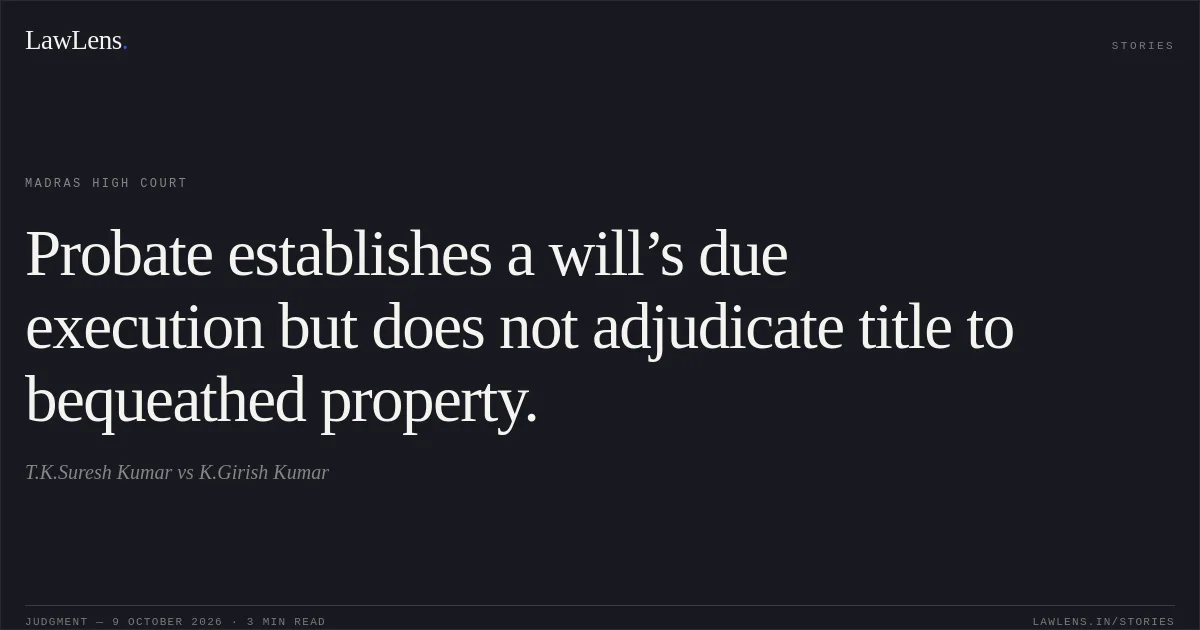
Source reference: p. 12, para. 22Probate jurisdiction determines the genuineness and due execution of the Will, not competing questions of title to property.
Source reference: pp. 8–9, para. 16; pp. 18–19, paras. 38–39The Court relied on Kanwarjit Singh Dhillon v. Hardyal Singh Dhillon (2007) 11 SCC 357 and Pasupati Nath Das (Dead) v. Chanchal Kumar Das (Dead) by Legal Representatives (2018) 18 SCC 547 for that limitation.
Source reference: pp. 8–9, para. 16; pp. 18–19, paras. 38–39Reasoning
The Court accepted the attesting witness’s direct evidence that the testatrix initiated the Will, dictated and reviewed its contents, signed it in the presence of both witnesses, and understood its effect; the witness also described how the original Will came into the plaintiff’s custody.
Source reference: pp. 13–15, paras. 24–28The medical discharge summary and, significantly, the defendant’s admission that his mother was mentally and physically fit on the date of execution supported testamentary capacity.
Source reference: pp. 15–22, paras. 29–48The defendant did not establish coercion or undue influence, and the Court found that the earlier Will, absence of a separate medical certificate, alleged signature variations and lack of detailed deposit particulars did not displace the attesting witness’s evidence.
Source reference: pp. 15–22, paras. 29–48The Court left the legal effect of the settlement deed and the parties’ property rights open, and held that the probate grant would not disturb rights determined by the Kalaburagi decree concerning the fixed deposits.
Source reference: pp. 18–20, paras. 38–42Holding
The Court found that the Will was duly executed and attested, that the testatrix had testamentary capacity, and that the allegations of coercion, undue influence and fabrication were not proved.
It decreed the suit and granted probate to the plaintiff as executor, while clarifying that the grant did not adjudicate title to the Chennai property or affect rights under the Kalaburagi decree; the plaintiff was directed to file the inventory and accounts within six months of receiving a copy of the order.
Source reference: pp. 23–24, paras. 50–52Acts & Sections Cited
4 provisions across 2 statutes referred to in this judgment. Each provision opens on LawLens.
Indian Succession Act, 19253
Code of Civil Procedure, 19081
Original Court PDF
T.K.Suresh KumarvsK.Girish Kumar
Click to open original judgment
Original judgment, available to read, download and summarize on LawLens.in