Facts
On 11 March 2007, six-year-old Gaurav went missing after attending a village marriage. His body was recovered from a well the following morning, and the post-mortem attributed death to asphyxia caused by smothering and cervical spinal injury.
Source reference: para. 3–4The prosecution alleged that the appellant was last seen with the deceased after purchasing namkeen and cold tablets, sexually assaulting and smothering him, and throwing his body into the well. It further relied on an alleged extra-judicial confession made by the appellant to the village Sarpanch on 14 March 2007, a disclosure statement, identification of the alleged places of occurrence, recovery of namkeen and other articles, and forensic evidence of semen.
Source reference: para. 2, 11–13, 17The Sessions Court convicted the appellant under Sections 302, 201 and 377 of the Indian Penal Code and imposed concurrent sentences, including life imprisonment for murder.
Source reference: para. 1, 14The High Court of Punjab and Haryana dismissed his appeal on 18 October 2022, principally relying on the last-seen theory, the alleged extra-judicial confession, the disclosure statement and forensic evidence.
Source reference: para. 21–26The appellant had undergone more than 16 years and 7 months of incarceration.
Source reference: para. 1Issues
Whether the prosecution proved beyond reasonable doubt, through circumstantial evidence and the last-seen theory, that the appellant was the person who committed the offences under Sections 302, 201 and 377 IPC.
Source reference: para. 27, 36, 46–47Whether the alleged extra-judicial confession made to the village Sarpanch was reliable and could sustain the conviction, particularly in the absence of cogent corroboration.
Source reference: para. 31–33, 41, 43Whether the appellant’s disclosure statement and subsequent identification of the alleged places of occurrence were admissible and incriminating under Section 27 of the Indian Evidence Act, 1872.
Source reference: para. 38–40, 44Whether the recovery of an open packet of namkeen and the detection of semen on the relevant articles established a connection between the appellant and the deceased.
Source reference: para. 29–30, 34, 45Law Applied
The Court applied Sections 302, 201 and 377 of the Indian Penal Code concerning murder, causing disappearance of evidence and unnatural offences, respectively.
Source reference: para. 1In a case resting entirely on circumstantial evidence, the prosecution must establish every incriminating circumstance beyond reasonable doubt and complete an unbroken chain pointing only to the guilt of the accused; the last-seen circumstance must also be firmly proved and proximate to the death.
Source reference: para. 27, 36, 46–47Under Section 27 of the Indian Evidence Act, 1872, only that portion of information given by an accused in police custody which distinctly relates to a fact thereby discovered is admissible; a statement leading merely to identification of an already-known place does not qualify.
Source reference: para. 39–40An extra-judicial confession is a weak form of evidence and cannot ordinarily be the sole basis of conviction unless it is voluntary, credible, free from material discrepancies and supported by independent, cogent corroboration; the Court relied on Sahadevan v. State of Tamil Nadu, (2012) 6 SCC 403.
Source reference: para. 43The prosecution bears the burden of establishing the evidentiary link between biological samples; that burden cannot be shifted to the accused merely because semen was found on the accused’s underwear.
Source reference: para. 45Reasoning
The Court held that the last-seen theory was not established. PW7 did not state in examination-in-chief that the deceased accompanied the appellant, while PW8’s assertion that the child was with the appellant emerged only in cross-examination and was absent from his police statement, indicating an improvement.
Source reference: para. 34–36The namkeen packet was a generic article sold widely in the village, and there was no evidence connecting the packet recovered from the spot with the packet allegedly purchased by the appellant; no tablet wrapper or other corroborative article was recovered.
Source reference: para. 29–30, 34, 41The alleged extra-judicial confession was also doubtful because PW7 stated that the appellant had been brought to his shop by the police on 12 March 2007, whereas the prosecution claimed that the confession and production before the police occurred only on 14 March 2007. This discrepancy affected a crucial link in the prosecution’s case.
Source reference: para. 31–33, 46The alleged disclosure statement did not result in discovery of any new fact: the body had already been recovered on 12 March, and the identified locations were already known to the police and depicted in the site plan.
Source reference: para. 38–40, 44Finally, although semen was detected on the underwear of the appellant and in the rectal swab of the deceased, no DNA analysis established that the samples originated from the same person. The courts below therefore erred in presuming a connection and shifting the burden to the appellant.
Source reference: para. 45These defects created serious breaks in the chain of circumstances and entitled the appellant to the benefit of doubt.
Source reference: para. 46–47Holding
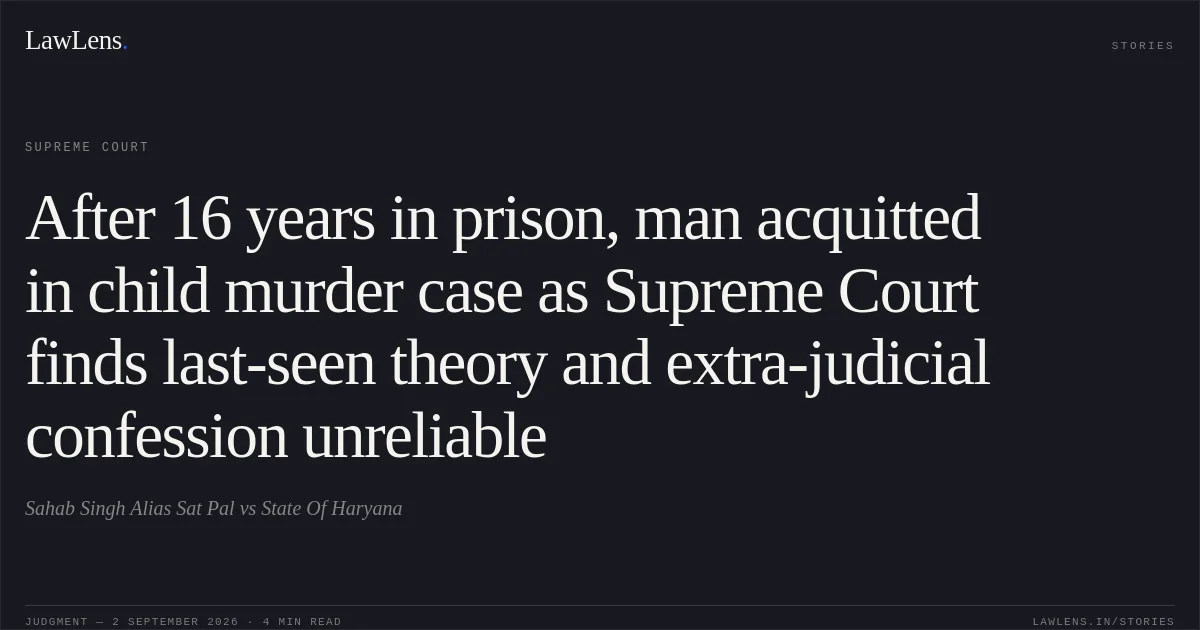
The Supreme Court answered the issues in favour of the appellant and held that the prosecution failed to prove beyond reasonable doubt that he committed the offences under Sections 302, 201 and 377 IPC. The last-seen circumstance, extra-judicial confession, disclosure statement, recoveries and forensic evidence were individually unreliable or insufficient and, cumulatively, did not complete the chain of circumstances.
The Court set aside the High Court’s judgment dated 18 October 2022 and the Sessions Court’s judgments of conviction and sentence dated 24 and 26 April 2010.
Source reference: para. 48The appeal was allowed, the appellant was extended the benefit of doubt, and his release from prison was directed forthwith unless his continued detention was required in connection with another case.
Source reference: para. 49–50Acts & Sections Cited
4 provisions across 2 statutes referred to in this judgment. Each provision opens on LawLens.
Indian Penal Code, 18603
Bharatiya Sakshya Adhiniyam, 20231
Original Court PDF
Sahab Singh Alias Sat PalvsState Of Haryana
Click to open original judgment
Original judgment, available to read, download and summarize on LawLens.in